
JPMorgan analysis shows AI agent deployment surging while broader adoption flatlines
Agentic AI use more than doubled among large enterprises, but overall AI engagement metrics tell a less exciting story.
There’s a growing gap between the AI hype cycle and the AI reality cycle, and JPMorgan just put numbers on it.
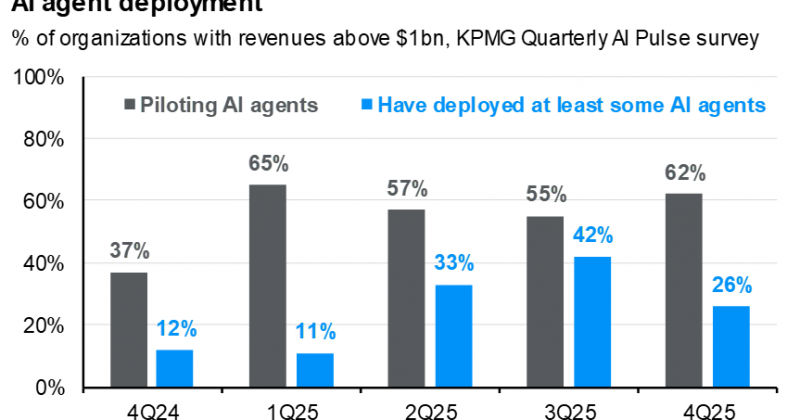
The bank’s asset management research hub published an analysis of the KPMG AI Quarterly Pulse Survey, and the headline finding is a contradiction baked into a single dataset. Agentic AI deployment among large organizations, those pulling in over $1 billion in annual revenue, jumped from 11% to 26% between 2025 and February 2026. That’s a meaningful leap. But zoom out to overall enterprise AI engagement, and the trajectory looks far less dramatic.
The agentic boom, by the numbers
JPMorgan’s framing of the data is telling. The bank calls this period “The Agentic Boom,” a phrase that captures the shift from basic chatbot interactions to autonomous, multi-step AI workflows.
The survey data, collected through February 28, 2026, backs this up in several ways. Reasoning models now account for more than 50% of all AI interactions during the period analyzed. The complexity and length of AI-generated outputs have also increased significantly, suggesting that organizations deploying these tools are pushing them harder and expecting more sophisticated results.
The same analysis highlights that broader AI adoption metrics across enterprises remain “gradual and steady.” The long tail of enterprise adoption, where most businesses actually live, isn’t keeping pace.
AI, tech, and the markets they move—in one daily briefing.
Daily. Free. Join 34,000+ readers across crypto, finance, and policy.
Why the gap matters for markets
JPMorgan’s analysis, published in May 2026 following the February survey findings, emphasizes a transition from pilot phases into active deployment among leading adopters.
Agentic AI systems are resource-hungry by nature. Unlike a chatbot that processes a single query and returns a response, these systems execute multi-step workflows that demand sustained computational power. The infrastructure requirements are categorically different.
What this means for investors
The KPMG survey captures a snapshot of organizations with over $1 billion in revenue. These are companies with the budgets to experiment, fail, and try again. For mid-market and smaller enterprises, the computational demands of autonomous AI workflows represent a meaningful cost barrier, not just in dollars but in talent and organizational readiness.
The absence of any crypto or blockchain angle in JPMorgan’s analysis is notable in itself. Despite growing interest in the intersection of AI and decentralized technologies, the bank’s research stays firmly in the traditional infrastructure lane.
The data tells a story of depth over breadth. AI is getting dramatically more capable inside the organizations that are already committed, while broader enterprise adoption remains gradual and steady.