
JPMorgan addresses Broadcom TPU v9 program schedule amid delay fears

JPMorgan addresses Broadcom TPU v9 program schedule amid delay fears

Analyst Harlan Sur reaffirms Broadcom's next-gen Google chip is on track for 2028 production, raising the stock's price target to $580

Broadcom’s custom silicon partnership with Google just got a vote of confidence from Wall Street. JPMorgan analyst Harlan Sur pushed back on recent speculation that the TPU v9, Google’s next-generation AI training chip built by Broadcom, had fallen behind schedule.

Sur’s June 17 note confirmed the 2nm ASIC program remains firmly on track for volume production ramping in 2028. He raised his price target on Broadcom to $580 and reiterated an Overweight rating, a signal that the delay fears circulating in recent days were, in his view, unfounded.

What the TPU v9 actually is, and why it matters

The chip packs four compute dies, 16 HBM (high-bandwidth memory) stacks, and 400Gbps SERDES interconnects.

Advertisement

Broadcom kicked off the intellectual property design phase for TPU v9 in the first half of 2025, then moved into full system-on-chip design in the second half of that year. That timeline, according to Sur’s supply-chain checks, has not slipped.

The predecessor chip, TPU v8i, built on a 3nm process, was fully qualified by mid-2025. It’s expected to begin ramping in the quarter following Sur’s note.

The five-year deal anchoring the relationship

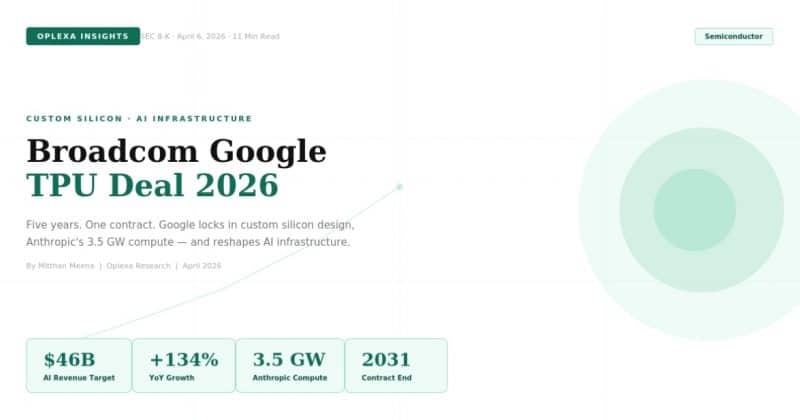
In March 2026, Google and Broadcom signed a five-year cooperation agreement covering TPU generations v8 through v11. That’s a multi-generational commitment that locks in Broadcom as Google’s primary custom silicon partner through the end of this decade.

The agreement also means Broadcom is already working on TPU v10 development alongside v9.

The rumors that prompted Sur’s note had put pressure on Broadcom’s stock in the days prior. Sur’s reaffirmation, backed by what JPMorgan described as comprehensive supply-chain evaluations, was aimed at defusing that narrative before it could take hold.

Disclosure: This article was edited by Editorial Team. For more information on how we create and review content, see our Editorial Policy.

JPMorgan addresses Broadcom TPU v9 program schedule amid delay fears

JPMorgan addresses Broadcom TPU v9 program schedule amid delay fears

Analyst Harlan Sur reaffirms Broadcom's next-gen Google chip is on track for 2028 production, raising the stock's price target to $580

Broadcom’s custom silicon partnership with Google just got a vote of confidence from Wall Street. JPMorgan analyst Harlan Sur pushed back on recent speculation that the TPU v9, Google’s next-generation AI training chip built by Broadcom, had fallen behind schedule.

Sur’s June 17 note confirmed the 2nm ASIC program remains firmly on track for volume production ramping in 2028. He raised his price target on Broadcom to $580 and reiterated an Overweight rating, a signal that the delay fears circulating in recent days were, in his view, unfounded.

What the TPU v9 actually is, and why it matters

The chip packs four compute dies, 16 HBM (high-bandwidth memory) stacks, and 400Gbps SERDES interconnects.

Advertisement

Broadcom kicked off the intellectual property design phase for TPU v9 in the first half of 2025, then moved into full system-on-chip design in the second half of that year. That timeline, according to Sur’s supply-chain checks, has not slipped.

The predecessor chip, TPU v8i, built on a 3nm process, was fully qualified by mid-2025. It’s expected to begin ramping in the quarter following Sur’s note.

The five-year deal anchoring the relationship

In March 2026, Google and Broadcom signed a five-year cooperation agreement covering TPU generations v8 through v11. That’s a multi-generational commitment that locks in Broadcom as Google’s primary custom silicon partner through the end of this decade.

The agreement also means Broadcom is already working on TPU v10 development alongside v9.

The rumors that prompted Sur’s note had put pressure on Broadcom’s stock in the days prior. Sur’s reaffirmation, backed by what JPMorgan described as comprehensive supply-chain evaluations, was aimed at defusing that narrative before it could take hold.

Disclosure: This article was edited by Editorial Team. For more information on how we create and review content, see our Editorial Policy.