
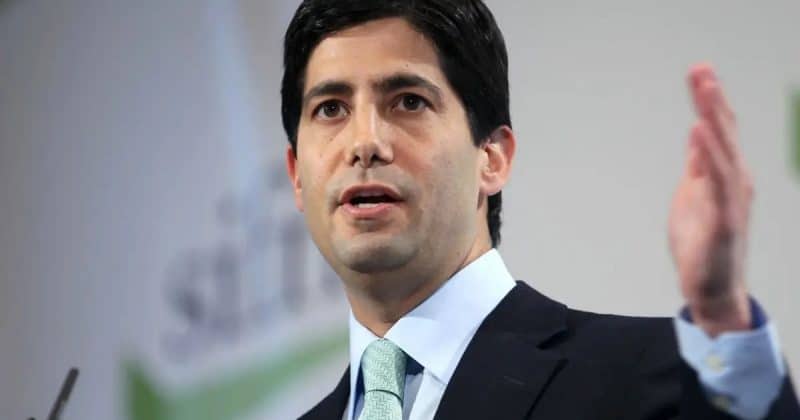
Kevin Warsh makes his global debut at ECB forum alongside world’s top central bankers

Kevin Warsh makes his global debut at ECB forum alongside world’s top central bankers

The new Fed chair joined Christine Lagarde, Andrew Bailey, and Tiff Macklem in Sintra for a panel on inflation and interest rates that markets watched with unusual intensity.

Kevin Warsh stepped onto the international stage for the first time as Federal Reserve Chair on July 1, 2026, joining a panel at the ECB Forum on Central Banking in Sintra, Portugal. The appearance came roughly six weeks after he officially took control of the world’s most powerful central bank.

Warsh sat alongside ECB President Christine Lagarde, Bank of England Governor Andrew Bailey, and Bank of Canada Governor Tiff Macklem for a moderated discussion led by CNBC’s Sara Eisen. The conversation centered on inflation, interest rates, and the operational headaches central banks are navigating in a world where price pressures refuse to behave predictably.

From appointment to Sintra in 40 days

Warsh was appointed Fed Chair on May 22, 2026, beginning a four-year term that runs through 2030. He previously served as a Governor from 2006 to 2011, a tenure that coincided with the global financial crisis and the extraordinary monetary policy responses that followed.

Advertisement

His first Federal Reserve meeting as Chair took place on June 17, 2026, where the committee held rates steady and reaffirmed a commitment to the 2% inflation target. That decision set the table for Sintra. Investors and analysts watching the ECB Forum panel, which kicked off at 9 a.m. EDT, were hunting for any signal that Warsh might be preparing to deviate from that stance.

What markets were watching for

Prediction markets lit up ahead of the panel. Traders were specifically monitoring whether Warsh would drop hints about impending rate cuts or acknowledge growing recession risks.

Warsh’s positioning alongside Lagarde, Bailey, and Macklem also provided a useful comparison point. The panel format allowed observers to gauge how aligned, or misaligned, the world’s major central banks are in their approach.

What this means for investors

The commitment to the 2% inflation target suggests that immediate rate cuts are unlikely unless economic data deteriorates significantly. Bond traders, in particular, should interpret Warsh’s early messaging as a signal that patience will define this Fed leadership, at least in its opening chapters.

The broader takeaway from the Sintra panel is that global central banks remain focused squarely on traditional monetary policy mechanics. Notably, the discussions did not touch on crypto assets, digital currencies, or blockchain-related financial infrastructure. A Fed that holds rates steady is a Fed that keeps liquidity conditions relatively tight, which historically creates headwinds for risk assets including Bitcoin and altcoins.

The prediction market activity ahead of the event suggests that positioning was already skewed toward anticipation of policy shifts.

Disclosure: This article was edited by Editorial Team. For more information on how we create and review content, see our Editorial Policy.

Kevin Warsh makes his global debut at ECB forum alongside world’s top central bankers

Kevin Warsh makes his global debut at ECB forum alongside world’s top central bankers

The new Fed chair joined Christine Lagarde, Andrew Bailey, and Tiff Macklem in Sintra for a panel on inflation and interest rates that markets watched with unusual intensity.

Kevin Warsh stepped onto the international stage for the first time as Federal Reserve Chair on July 1, 2026, joining a panel at the ECB Forum on Central Banking in Sintra, Portugal. The appearance came roughly six weeks after he officially took control of the world’s most powerful central bank.

Warsh sat alongside ECB President Christine Lagarde, Bank of England Governor Andrew Bailey, and Bank of Canada Governor Tiff Macklem for a moderated discussion led by CNBC’s Sara Eisen. The conversation centered on inflation, interest rates, and the operational headaches central banks are navigating in a world where price pressures refuse to behave predictably.

From appointment to Sintra in 40 days

Warsh was appointed Fed Chair on May 22, 2026, beginning a four-year term that runs through 2030. He previously served as a Governor from 2006 to 2011, a tenure that coincided with the global financial crisis and the extraordinary monetary policy responses that followed.

Advertisement

His first Federal Reserve meeting as Chair took place on June 17, 2026, where the committee held rates steady and reaffirmed a commitment to the 2% inflation target. That decision set the table for Sintra. Investors and analysts watching the ECB Forum panel, which kicked off at 9 a.m. EDT, were hunting for any signal that Warsh might be preparing to deviate from that stance.

What markets were watching for

Prediction markets lit up ahead of the panel. Traders were specifically monitoring whether Warsh would drop hints about impending rate cuts or acknowledge growing recession risks.

Warsh’s positioning alongside Lagarde, Bailey, and Macklem also provided a useful comparison point. The panel format allowed observers to gauge how aligned, or misaligned, the world’s major central banks are in their approach.

What this means for investors

The commitment to the 2% inflation target suggests that immediate rate cuts are unlikely unless economic data deteriorates significantly. Bond traders, in particular, should interpret Warsh’s early messaging as a signal that patience will define this Fed leadership, at least in its opening chapters.

The broader takeaway from the Sintra panel is that global central banks remain focused squarely on traditional monetary policy mechanics. Notably, the discussions did not touch on crypto assets, digital currencies, or blockchain-related financial infrastructure. A Fed that holds rates steady is a Fed that keeps liquidity conditions relatively tight, which historically creates headwinds for risk assets including Bitcoin and altcoins.

The prediction market activity ahead of the event suggests that positioning was already skewed toward anticipation of policy shifts.

Disclosure: This article was edited by Editorial Team. For more information on how we create and review content, see our Editorial Policy.