
Nexo Earn with Nexo
KOSPI rallies 8.2% as Korean retail investors buy the dip while foreigners dump $3.7 billion

KOSPI rallies 8.2% as Korean retail investors buy the dip while foreigners dump $3.7 billion

South Korea's 'ant investors' absorbed massive foreign selling to fuel a historic single-day rebound, but record margin debt levels raise questions about what happens next.

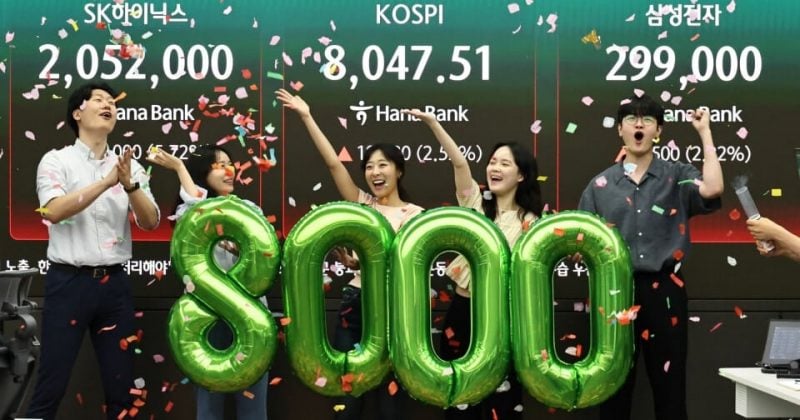
One day after circuit breakers halted trading on the Korea Exchange, the KOSPI staged a furious comeback. The index surged 8.2% on June 9, climbing to 8,096.93 after cratering 8.3% the session before. The catalyst for the rebound was familiar to anyone who has watched Korean markets over the past year: retail investors, locally known as “ants,” rushed in to buy the dip.

Foreign investors, meanwhile, were heading for the exits. They sold a net 5.56 trillion won, roughly $3.7 billion, on the rebound day alone. Institutional investors joined the selling side as well. The retail bid absorbed it all and then some, turning what could have been a two-day rout into a single-day scare followed by a snap-back rally.

What triggered the crash, and why it reversed so fast

The June 8 sell-off traced back to unexpectedly strong US jobs data, which reignited speculation that the Federal Reserve might resume rate hikes. The KOSPI fell hard enough to trigger circuit breakers, automated mechanisms that pause trading when losses exceed certain thresholds. The index closed at 7,484.41, erasing weeks of gains in a matter of hours.

Earlier in 2026, during a May session, the KOSPI experienced an 8.4% intraday swing when it briefly broke through the 8,000 level. Each time the market has dropped sharply this year, domestic retail investors have stepped in as aggressive buyers, treating corrections as discounted entry points rather than warning signals.

Advertisement

The semiconductor engine behind the KOSPI’s doubling

The KOSPI’s gains exceeded 100% year-to-date at its peaks in 2026, making it one of the best-performing major indexes on the planet this year. That performance has been overwhelmingly concentrated in semiconductor stocks, particularly Samsung Electronics and SK Hynix. Both companies have benefited enormously from the ongoing AI buildout. Global demand for high-bandwidth memory chips, where SK Hynix holds a dominant position, has pushed revenues and margins to levels that seemed implausible even two years ago.

The KOSPI hit an intraday high above 8,800 earlier this year. For context, the index was trading below 2,500 as recently as late 2022.

Record margin debt is the elephant in the room

The most concerning data point lurking beneath the rally is this: retail margin debt in Korea exceeded 60 trillion won, approximately $39 billion, by the end of May 2026. That is a record.

This dynamic has played out before in Korean markets. During the 2020 COVID crash and the 2022 Luna/Terra collapse, margin-driven retail positions were unwound rapidly, amplifying drawdowns well beyond what fundamentals alone would have dictated. The difference now is that the absolute level of margin debt is significantly higher than in either of those episodes.

The June 8-9 sequence offered a preview of what a deleveraging event could look like at these debt levels. The market fell 8.3% and then immediately bounced 8.2%, suggesting margin calls were either minimal or quickly resolved.

What this means for investors

Foreign investors have been net sellers during multiple correction episodes this year, and domestic retail has consistently been the counterparty absorbing that supply. US macroeconomic data will remain the primary external trigger for Korean market volatility, with every jobs report, inflation reading, and Fed meeting that shifts rate expectations rippling through the KOSPI within hours, particularly given the index’s heavy semiconductor weighting.

The record margin debt figure, 60 trillion won and climbing, is the variable that transforms garden-variety corrections into potential crises. Investors with exposure to Korean equities should be watching margin lending data as closely as they watch earnings reports.

Disclosure: This article was edited by Editorial Team. For more information on how we create and review content, see our Editorial Policy.

KOSPI rallies 8.2% as Korean retail investors buy the dip while foreigners dump $3.7 billion

KOSPI rallies 8.2% as Korean retail investors buy the dip while foreigners dump $3.7 billion

South Korea's 'ant investors' absorbed massive foreign selling to fuel a historic single-day rebound, but record margin debt levels raise questions about what happens next.

One day after circuit breakers halted trading on the Korea Exchange, the KOSPI staged a furious comeback. The index surged 8.2% on June 9, climbing to 8,096.93 after cratering 8.3% the session before. The catalyst for the rebound was familiar to anyone who has watched Korean markets over the past year: retail investors, locally known as “ants,” rushed in to buy the dip.

Foreign investors, meanwhile, were heading for the exits. They sold a net 5.56 trillion won, roughly $3.7 billion, on the rebound day alone. Institutional investors joined the selling side as well. The retail bid absorbed it all and then some, turning what could have been a two-day rout into a single-day scare followed by a snap-back rally.

What triggered the crash, and why it reversed so fast

The June 8 sell-off traced back to unexpectedly strong US jobs data, which reignited speculation that the Federal Reserve might resume rate hikes. The KOSPI fell hard enough to trigger circuit breakers, automated mechanisms that pause trading when losses exceed certain thresholds. The index closed at 7,484.41, erasing weeks of gains in a matter of hours.

Earlier in 2026, during a May session, the KOSPI experienced an 8.4% intraday swing when it briefly broke through the 8,000 level. Each time the market has dropped sharply this year, domestic retail investors have stepped in as aggressive buyers, treating corrections as discounted entry points rather than warning signals.

Advertisement

The semiconductor engine behind the KOSPI’s doubling

The KOSPI’s gains exceeded 100% year-to-date at its peaks in 2026, making it one of the best-performing major indexes on the planet this year. That performance has been overwhelmingly concentrated in semiconductor stocks, particularly Samsung Electronics and SK Hynix. Both companies have benefited enormously from the ongoing AI buildout. Global demand for high-bandwidth memory chips, where SK Hynix holds a dominant position, has pushed revenues and margins to levels that seemed implausible even two years ago.

The KOSPI hit an intraday high above 8,800 earlier this year. For context, the index was trading below 2,500 as recently as late 2022.

Record margin debt is the elephant in the room

The most concerning data point lurking beneath the rally is this: retail margin debt in Korea exceeded 60 trillion won, approximately $39 billion, by the end of May 2026. That is a record.

This dynamic has played out before in Korean markets. During the 2020 COVID crash and the 2022 Luna/Terra collapse, margin-driven retail positions were unwound rapidly, amplifying drawdowns well beyond what fundamentals alone would have dictated. The difference now is that the absolute level of margin debt is significantly higher than in either of those episodes.

The June 8-9 sequence offered a preview of what a deleveraging event could look like at these debt levels. The market fell 8.3% and then immediately bounced 8.2%, suggesting margin calls were either minimal or quickly resolved.

What this means for investors

Foreign investors have been net sellers during multiple correction episodes this year, and domestic retail has consistently been the counterparty absorbing that supply. US macroeconomic data will remain the primary external trigger for Korean market volatility, with every jobs report, inflation reading, and Fed meeting that shifts rate expectations rippling through the KOSPI within hours, particularly given the index’s heavy semiconductor weighting.

The record margin debt figure, 60 trillion won and climbing, is the variable that transforms garden-variety corrections into potential crises. Investors with exposure to Korean equities should be watching margin lending data as closely as they watch earnings reports.

Disclosure: This article was edited by Editorial Team. For more information on how we create and review content, see our Editorial Policy.