
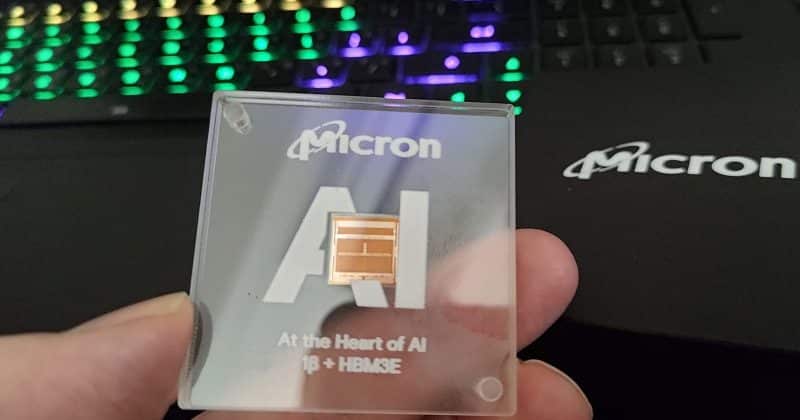
Micron secures $22B in cash deposits as AI memory chip deals reshape semiconductor economics
Sixteen long-term agreements lock in roughly $100 billion in minimum revenue, signaling a structural shift in how memory chips get sold.
Micron Technology announced 16 multi-year strategic agreements tied to AI-optimized memory chips on June 24, with customers collectively putting up approximately $22 billion in cash deposits and related commitments. Fourteen of those contracts are structured as take-or-pay deals, meaning customers are on the hook for roughly $100 billion in minimum contracted revenue whether they take delivery or not.
The numbers behind the pivot
Micron’s fiscal Q3 2026 earnings landed well above expectations. Adjusted earnings per share came in at $25.11, compared to the $21.05 analysts had penciled in. Revenue hit $41.46 billion, blowing past the $36.28 billion forecast.
Shares surged 13-17% in after-hours trading.
The company also issued Q4 revenue guidance of $49 billion to $51 billion.
Micron’s entire supply of high-bandwidth memory (HBM) for 2026 is already sold out.
Why take-or-pay changes everything
Take-or-pay contracts require customers to purchase a set volume of chips at agreed-upon prices. If they don’t take delivery, they still pay. The $22 billion in cash deposits functions as a down payment on that commitment, giving Micron capital certainty that the memory industry has rarely enjoyed.
Two days before the earnings report, Micron announced a strategic partnership with Anthropic on June 22. The collaboration focuses on memory and storage solutions designed specifically for AI infrastructure. Micron is participating in Anthropic’s Series H funding round as part of the arrangement.
What this means for crypto-adjacent investors
The HBM shortage is particularly telling. These aren’t commodity chips. They’re specialized components manufactured by only three companies globally: Micron, Samsung, and SK Hynix. When Micron says its 2026 supply is fully allocated, that’s a meaningful constraint on the total volume of AI accelerators that can be built this year.
The risk is that take-or-pay contracts protect Micron’s revenue floor, but they don’t prevent a scenario where AI spending plateaus and customers start renegotiating terms. If the AI investment thesis stumbles, those $100 billion in contractual commitments become a legal question rather than a revenue guarantee.