
Moonshot’s Kimi K3 sends AI and semiconductor stocks into a tailspin

Moonshot’s Kimi K3 sends AI and semiconductor stocks into a tailspin

China's largest open-weight AI model revives DeepSeek-era fears about the economics of US infrastructure spending

When Chinese AI startup Moonshot unveiled its Kimi K3 model on July 17, 2026, investors didn’t need a history lesson. AI and semiconductor stocks dropped sharply on the news, as traders drew immediate comparisons to the so-called DeepSeek moment of 2025, when a Chinese lab released a model that performed comparably to US rivals at a fraction of the cost.

What Kimi K3 actually is

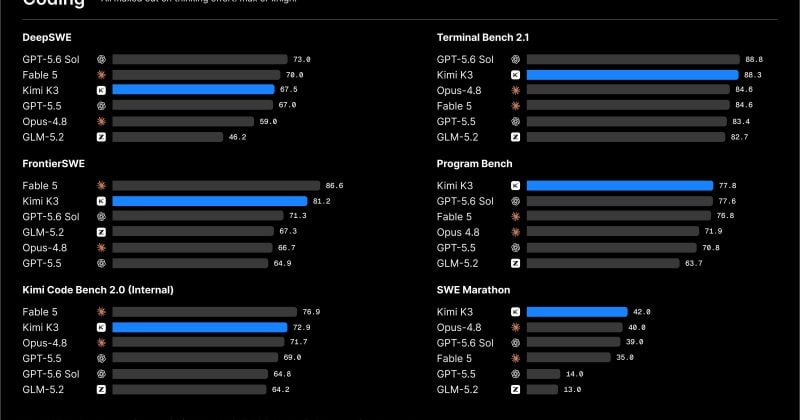
Kimi K3 carries 2.8 trillion parameters, making it the largest open-weight AI model in the world as of its launch date. On benchmark tests, the model reportedly matched or outperformed several leading US models, trailing only Anthropic’s Claude Fable 5 and OpenAI’s GPT-5.6. One area where it showed particular strength was front-end coding, a category that matters enormously to enterprise software developers.

Advertisement

The model is open-weight, meaning developers can access, study, and build on top of its architecture. Full model weights are scheduled for public release on July 27, 2026. Kimi K3 is also a significant jump from its predecessor: the previous model in the series, K2, had 1 trillion parameters.

The DeepSeek parallel that’s keeping investors up at night

DeepSeek, another Chinese AI lab, released a model in early 2025 that performed at the level of OpenAI’s best offerings but was reportedly built at a dramatically lower cost. The immediate market reaction was brutal, with Nvidia’s stock dropping sharply as the assumption that AI leadership required massive, sustained infrastructure spending cracked.

Analysts watching the sector have largely characterized Kimi K3’s release not as a shock but as an expected continuation of a trend. Moonshot is backed by Alibaba, which injected $1B into Moonshot in 2024 when the startup was valued at $2.5B. Today, amid an ongoing funding round, that valuation has climbed to approximately $31.5B. Moonshot is considered one of China’s so-called AI Tigers, a group of well-capitalized domestic labs that have emerged as genuine competitors to US incumbents.

What this means for investors watching AI and semiconductor stocks

The full weights release on July 27 will be a meaningful data point. Once developers can run and test Kimi K3 themselves, the benchmark claims will either hold up or they won’t. If they hold up, the pressure on US AI companies to justify their cost structures intensifies. If the model underperforms its billing, the market selloff may prove to be an overreaction.

Disclosure: This article was edited by Editorial Team. For more information on how we create and review content, see our Editorial Policy.

Moonshot’s Kimi K3 sends AI and semiconductor stocks into a tailspin

Moonshot’s Kimi K3 sends AI and semiconductor stocks into a tailspin

China's largest open-weight AI model revives DeepSeek-era fears about the economics of US infrastructure spending

When Chinese AI startup Moonshot unveiled its Kimi K3 model on July 17, 2026, investors didn’t need a history lesson. AI and semiconductor stocks dropped sharply on the news, as traders drew immediate comparisons to the so-called DeepSeek moment of 2025, when a Chinese lab released a model that performed comparably to US rivals at a fraction of the cost.

What Kimi K3 actually is

Kimi K3 carries 2.8 trillion parameters, making it the largest open-weight AI model in the world as of its launch date. On benchmark tests, the model reportedly matched or outperformed several leading US models, trailing only Anthropic’s Claude Fable 5 and OpenAI’s GPT-5.6. One area where it showed particular strength was front-end coding, a category that matters enormously to enterprise software developers.

Advertisement

The model is open-weight, meaning developers can access, study, and build on top of its architecture. Full model weights are scheduled for public release on July 27, 2026. Kimi K3 is also a significant jump from its predecessor: the previous model in the series, K2, had 1 trillion parameters.

The DeepSeek parallel that’s keeping investors up at night

DeepSeek, another Chinese AI lab, released a model in early 2025 that performed at the level of OpenAI’s best offerings but was reportedly built at a dramatically lower cost. The immediate market reaction was brutal, with Nvidia’s stock dropping sharply as the assumption that AI leadership required massive, sustained infrastructure spending cracked.

Analysts watching the sector have largely characterized Kimi K3’s release not as a shock but as an expected continuation of a trend. Moonshot is backed by Alibaba, which injected $1B into Moonshot in 2024 when the startup was valued at $2.5B. Today, amid an ongoing funding round, that valuation has climbed to approximately $31.5B. Moonshot is considered one of China’s so-called AI Tigers, a group of well-capitalized domestic labs that have emerged as genuine competitors to US incumbents.

What this means for investors watching AI and semiconductor stocks

The full weights release on July 27 will be a meaningful data point. Once developers can run and test Kimi K3 themselves, the benchmark claims will either hold up or they won’t. If they hold up, the pressure on US AI companies to justify their cost structures intensifies. If the model underperforms its billing, the market selloff may prove to be an overreaction.

Disclosure: This article was edited by Editorial Team. For more information on how we create and review content, see our Editorial Policy.