
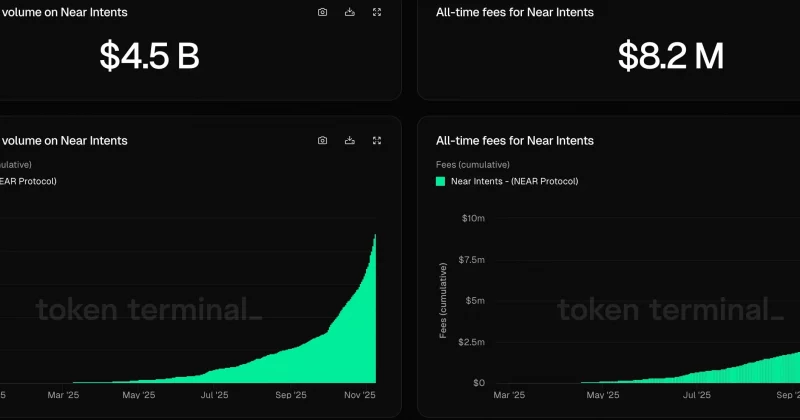
NEAR Intents surpasses $20B in all-time transaction volume
The cross-chain execution layer quadrupled its volume in just seven months, processing over 25 million swaps along the way.
NEAR Intents, the intent-based cross-chain execution layer built on NEAR Protocol, has crossed $20 billion in cumulative transaction volume. That number was sitting at $19 billion as recently as May 25, 2026, meaning the platform added another billion dollars in volume in roughly a week.
To put the growth trajectory in perspective: NEAR Intents hit $5 billion in transaction volume in November 2025. By January 2026, it had doubled to $10 billion. Now, barely five months later, it has doubled again.
What NEAR Intents actually does
NEAR Intents uses an intent-driven architecture where competing solvers bid to fulfill user requests. These solvers handle the actual cross-chain execution, finding the most efficient path for atomic swaps, payments, and bridging actions. The user doesn’t need to care about which chain is doing what under the hood.
The platform currently integrates with somewhere between 25 and over 70 chains and assets, depending on how you count indirect connections. Wallet support extends to options like Zashi, the Zcash wallet, and Ledger hardware wallets.
Over its lifetime, NEAR Intents has processed more than 25 million swaps.
The news moving money, markets, and the world—before your day starts.
Daily. Free. Join 34,000+ readers across crypto, finance, and policy.
The fee revenue picture
NEAR Intents has generated approximately $32 million in cumulative fees. Recent weekly fee generation, when annualized, comes in at around $36 million. The annualized fee revenue has been estimated in a range between $32 million and $58 million, depending on which time window you’re measuring.
The last 30 days have also seen the introduction of confidential payments, a feature that adds privacy capabilities to the cross-chain execution layer.
What this means for investors
Recent market activity has shown NEAR price surges ranging from 15% to 90% that appear linked to periods of increasing cross-chain transaction volume.
There’s also a forward-looking angle involving AI agents. Intent-based architectures are naturally suited for AI-driven interactions because agents can express desired outcomes without needing to understand the mechanical steps of cross-chain execution.
The risk to watch is concentration. If a significant portion of that $20 billion comes from a small number of large traders or a handful of chain pairs, the growth story is more fragile than the headline number suggests. Similarly, cross-chain infrastructure carries inherent smart contract risk, and exploits in this category have historically been among the most expensive in crypto.