
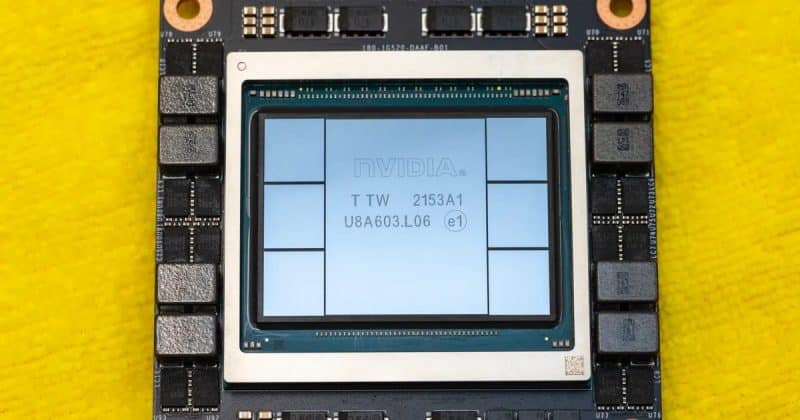
Nvidia’s banned AI chips double in price on China’s black market
Tightened US export controls have created a thriving underground market where Nvidia B300 servers sell for roughly 7 million yuan, about twice their American list price
The fastest-growing market for Nvidia’s most advanced AI chips isn’t a hyperscaler data center in Virginia or a startup hub in San Francisco. It’s China’s black market, where banned processors are now fetching roughly double their official US price.
According to a Financial Times report published June 23, Nvidia B300 servers are changing hands at approximately 7 million yuan, or about $1 million, on underground channels inside China. That’s around twice what they’d cost through legitimate channels in the US.
The supply squeeze gets tighter
The price surge traces directly to a decision by the US Department of Commerce on May 31. New guidance effectively closed loopholes that had allowed high-end Nvidia chips, including the Blackwell and Rubin models, to reach Chinese companies through foreign subsidiaries.
Before these latest restrictions, the smuggling pipeline was already substantial. At least $1 billion worth of Nvidia AI chips were illicitly funneled into China during 2025 alone.
The tightened controls were designed to cut off exactly this kind of leakage. But so far, the primary effect hasn’t been to stop the flow entirely. It’s been to make the remaining flow significantly more expensive.
AI, tech, and the markets they move—in one daily briefing.
Daily. Free. Join 34,000+ readers across crypto, finance, and policy.
Why Chinese firms keep paying
Chinese AI companies are locked in an intense competition, both with each other and with their American counterparts, to build larger and more capable models. Advanced Nvidia GPUs remain the gold standard for training these systems.
Meanwhile, China isn’t just relying on smuggled chips. The country has been accelerating domestic semiconductor production to reduce its dependence on American technology.
What this means for investors
On one hand, the black market premium validates Nvidia’s dominant market position. When people are willing to pay double through illegal channels just to get your product, that’s a powerful signal about the value of what you’re selling.
On the other hand, this is revenue that Nvidia will never see. Every chip sold on China’s black market is a chip that was either diverted from a legitimate sale or smuggled through intermediaries.
The $1 billion in chips that reached China illegally in 2025 also raises questions about which intermediary companies and which countries served as transit points. Any crackdown on those networks could create ripple effects across global tech supply chains, potentially disrupting legitimate trade flows alongside illicit ones.