
Nexo Earn with Nexo
Nvidia CEO Jensen Huang says AI-generated commits on GitHub tripled to 1.4B in 2026

Nvidia CEO Jensen Huang says AI-generated commits on GitHub tripled to 1.4B in 2026

The explosion in code commits, from 300 million in 2023 to nearly 1.4 billion in early 2026, signals what Huang calls proof that 'useful AI has arrived.'

In 2023, GitHub saw roughly 300 million code commits. By early 2026, that number had ballooned to nearly 1.4 billion. That’s not a typo, and it’s not a gradual climb. It’s a near-fivefold increase in three years, driven almost entirely by AI coding assistants that went from novelty to necessity faster than most people updated their LinkedIn bios.

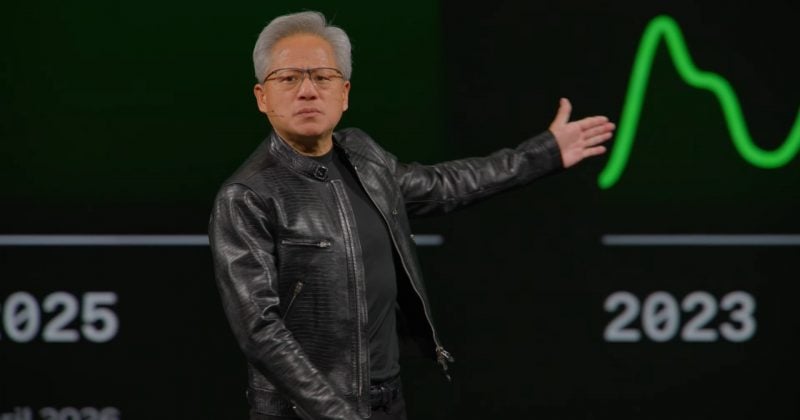
Nvidia CEO Jensen Huang dropped that stat during his keynote at GTC Taipei on June 1, 2026, framing the surge as definitive evidence of a new era in software development. The trajectory tells a clear story: 300 million commits in 2023, 400 million in 2024, 500 million in 2025, then an abrupt leap to 1.4 billion in just the first few months of this year.

The numbers behind the code explosion

The commit count is the headline figure, but it’s not the only metric that jumped. Huang cited 90 million pull requests merged and 20 million new repositories created monthly on GitHub, all happening under what he described as “record acceleration.”

The year-over-year trajectory is worth pausing on. From 2023 to 2025, commits grew by roughly 100 million per year, a steady but unremarkable incline. Then 2026 hit and the curve went vertical. The January-to-April window alone nearly tripled the full-year totals from prior years.

“Useful AI has arrived.”

Advertisement

That was Huang’s characterization of the data, delivered with the kind of understated confidence that comes from running a company whose chips power most of the AI tools responsible for those commits.

From autocomplete to autonomous agents

The early wave of AI coding tools, think GitHub Copilot circa 2022, worked like glorified autocomplete. They could suggest the next few lines of code based on context, saving developers time on boilerplate tasks.

What Huang described at GTC Taipei is a different animal entirely. AI coding assistants have evolved into agentic systems capable of substantial workflow automation. These aren’t tools that wait for a developer to type a prompt. They can plan tasks, execute multi-step workflows, write tests, debug code, and submit pull requests with minimal human oversight.

For context, GitHub had about 100 million developers on its platform as of recent counts. Nearly 1.4 billion commits in a few months means each developer is, on average, associated with far more output than any human could produce alone.

More AI, more jobs: Huang’s counterintuitive pitch

Huang’s argument: the productivity gains from AI coding tools don’t shrink engineering teams. They expand them. When each developer can accomplish more, organizations don’t fire half the team. They realize they can now tackle projects that were previously too expensive or complex, and they hire more engineers to capture that newly accessible value.

Huang’s keynote also served as a product launch event. Nvidia unveiled the Vera Rubin multi-rack system, purpose-built for agentic AI workloads. The timing was deliberate. By showing the GitHub data first, Huang established the demand curve. Then he presented the hardware designed to serve it.

This represents a strategic evolution for Nvidia. The company built its AI dominance selling GPUs. The Vera Rubin system signals a move toward selling complete AI infrastructure: integrated, multi-rack deployments optimized for the kind of autonomous agent workflows that are generating all those commits.

What this means for investors

The GitHub data validates a thesis that many in the market have been betting on but couldn’t quite prove: AI tools have crossed from experimental to production-grade at scale. Nearly 1.4 billion commits in a few months isn’t a pilot program. It’s an industry-wide shift in how software gets built.

The risk, naturally, is that the commit count becomes a vanity metric. More commits don’t necessarily mean better software. If AI agents are generating vast amounts of mediocre or redundant code, the raw numbers could mask quality problems that surface later as technical debt.

Disclosure: This article was edited by Editorial Team. For more information on how we create and review content, see our Editorial Policy.

Nvidia CEO Jensen Huang says AI-generated commits on GitHub tripled to 1.4B in 2026

Nvidia CEO Jensen Huang says AI-generated commits on GitHub tripled to 1.4B in 2026

The explosion in code commits, from 300 million in 2023 to nearly 1.4 billion in early 2026, signals what Huang calls proof that 'useful AI has arrived.'

In 2023, GitHub saw roughly 300 million code commits. By early 2026, that number had ballooned to nearly 1.4 billion. That’s not a typo, and it’s not a gradual climb. It’s a near-fivefold increase in three years, driven almost entirely by AI coding assistants that went from novelty to necessity faster than most people updated their LinkedIn bios.

Nvidia CEO Jensen Huang dropped that stat during his keynote at GTC Taipei on June 1, 2026, framing the surge as definitive evidence of a new era in software development. The trajectory tells a clear story: 300 million commits in 2023, 400 million in 2024, 500 million in 2025, then an abrupt leap to 1.4 billion in just the first few months of this year.

The numbers behind the code explosion

The commit count is the headline figure, but it’s not the only metric that jumped. Huang cited 90 million pull requests merged and 20 million new repositories created monthly on GitHub, all happening under what he described as “record acceleration.”

The year-over-year trajectory is worth pausing on. From 2023 to 2025, commits grew by roughly 100 million per year, a steady but unremarkable incline. Then 2026 hit and the curve went vertical. The January-to-April window alone nearly tripled the full-year totals from prior years.

“Useful AI has arrived.”

Advertisement

That was Huang’s characterization of the data, delivered with the kind of understated confidence that comes from running a company whose chips power most of the AI tools responsible for those commits.

From autocomplete to autonomous agents

The early wave of AI coding tools, think GitHub Copilot circa 2022, worked like glorified autocomplete. They could suggest the next few lines of code based on context, saving developers time on boilerplate tasks.

What Huang described at GTC Taipei is a different animal entirely. AI coding assistants have evolved into agentic systems capable of substantial workflow automation. These aren’t tools that wait for a developer to type a prompt. They can plan tasks, execute multi-step workflows, write tests, debug code, and submit pull requests with minimal human oversight.

For context, GitHub had about 100 million developers on its platform as of recent counts. Nearly 1.4 billion commits in a few months means each developer is, on average, associated with far more output than any human could produce alone.

More AI, more jobs: Huang’s counterintuitive pitch

Huang’s argument: the productivity gains from AI coding tools don’t shrink engineering teams. They expand them. When each developer can accomplish more, organizations don’t fire half the team. They realize they can now tackle projects that were previously too expensive or complex, and they hire more engineers to capture that newly accessible value.

Huang’s keynote also served as a product launch event. Nvidia unveiled the Vera Rubin multi-rack system, purpose-built for agentic AI workloads. The timing was deliberate. By showing the GitHub data first, Huang established the demand curve. Then he presented the hardware designed to serve it.

This represents a strategic evolution for Nvidia. The company built its AI dominance selling GPUs. The Vera Rubin system signals a move toward selling complete AI infrastructure: integrated, multi-rack deployments optimized for the kind of autonomous agent workflows that are generating all those commits.

What this means for investors

The GitHub data validates a thesis that many in the market have been betting on but couldn’t quite prove: AI tools have crossed from experimental to production-grade at scale. Nearly 1.4 billion commits in a few months isn’t a pilot program. It’s an industry-wide shift in how software gets built.

The risk, naturally, is that the commit count becomes a vanity metric. More commits don’t necessarily mean better software. If AI agents are generating vast amounts of mediocre or redundant code, the raw numbers could mask quality problems that surface later as technical debt.

Disclosure: This article was edited by Editorial Team. For more information on how we create and review content, see our Editorial Policy.