
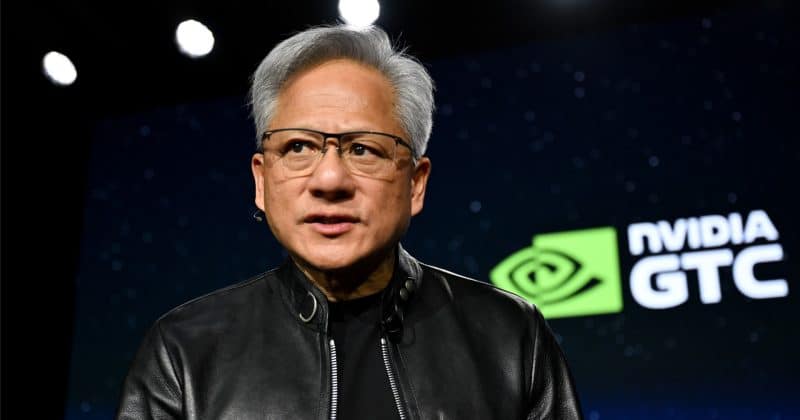
Nvidia CEO Jensen Huang outlines AI’s shift from retrieval to generation
Huang frames the move from fetching pre-stored data to real-time content creation as the biggest computing paradigm shift in six decades
Jensen Huang wants you to know that era is over. The Nvidia CEO has been laying out a vision where computing stops retrieving and starts generating, producing custom outputs in real time based on what users actually need rather than pointing them toward something that already exists.
From lookup tables to AI factories
Huang has framed this as perhaps the most significant shift in computing paradigms since the industry’s inception. In a March interview with Lex Fridman and at Nvidia’s GTC conference, he detailed how this transition demands entirely new categories of hardware. GPUs remain central, but the ecosystem now requires purpose-built CPUs designed specifically for AI workloads.
Enter the Nvidia Vera CPU, engineered for what the company calls “agentic AI,” systems that don’t just respond to prompts but reason, plan, and act with increasing autonomy. Early sales of the Vera CPU have reportedly hit $20 billion in 2026, a number that suggests enterprise appetite for this kind of silicon is anything but theoretical.
Huang sees a total addressable market of $200 billion for specialized AI-agent CPUs alone. That’s not the whole AI infrastructure pie. That’s just the CPU slice of it.
The infrastructure behind the paradigm
This is where Huang’s concept of “AI factories” comes in. These aren’t factories in the smokestacks-and-conveyor-belts sense. They’re massive data center deployments purpose-built to manufacture digital content at scale. Instead of producing physical goods, they produce intelligence, churning out generated text, synthetic images, video, and increasingly complex reasoning chains around the clock.
AI, tech, and the markets they move—in one daily briefing.
Daily. Free. Join 34,000+ readers across crypto, finance, and policy.
The technology builds on earlier techniques like retrieval-augmented generation, or RAG. In English: RAG systems combine the old retrieval approach with generative models, letting an AI pull relevant data from a knowledge base and then synthesize a fresh answer from it. But the trajectory Huang describes goes further, toward systems that can reason and learn in real time without needing to lean on pre-stored documents at all.
What this means for investors and the broader market
A $20 billion early sales figure for a single CPU product line is remarkable by any standard, and a $200 billion estimated market opportunity for AI-agent CPUs suggests we’re still in early innings.
For investors watching Nvidia specifically, the retrieval-to-generation thesis provides a framework for understanding why GPU and specialized CPU demand might sustain growth even as initial AI training cycles mature. Training a model is a one-time event. Generating outputs from that model happens continuously, forever. The inference workload, in other words, is structurally larger than the training workload over time.
While AMD, Intel, and a growing roster of custom silicon startups are chasing the AI accelerator market, Nvidia’s ecosystem advantage, CUDA, its software stack, its developer community, creates meaningful switching costs. Geopolitical constraints on chip exports, particularly to China, add another layer of uncertainty that investors can’t ignore.