
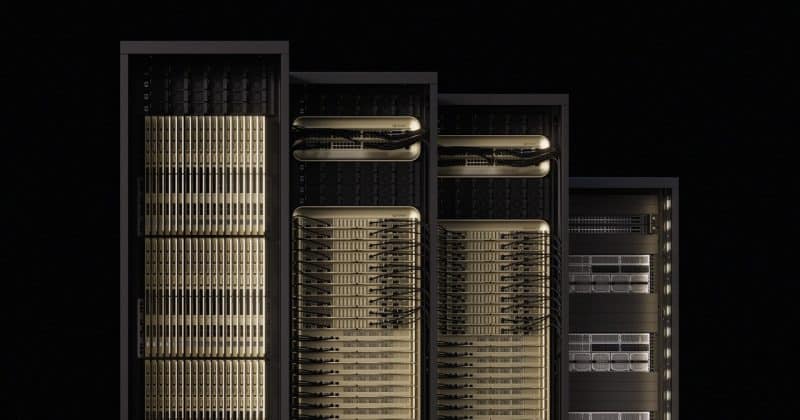
Nvidia’s next-gen AI rack system delayed to 2028 due to manufacturing issues
The Kyber NVL144 delay and cancellation of related designs raise questions about the pace of AI infrastructure buildout, with ripple effects across tech and crypto mining sectors.
Nvidia’s most ambitious AI rack system just hit a wall. The Kyber NVL144, a next-generation rack-scale architecture that CEO Jensen Huang personally showcased at GTC just three months ago, has been pushed back by over 12 months to 2028 due to manufacturing problems with a critical circuit board component.
What went wrong
The culprit, according to semiconductor analyst firm SemiAnalysis, is the midplane printed circuit board. That’s the piece of hardware responsible for enabling the dense all-copper NVLink interconnect that makes the Kyber NVL144 tick.
Huang stood on stage at GTC and presented this architecture to the world roughly three months before the delay was announced on July 5, 2026. That timeline suggests Nvidia either didn’t know about the severity of the issue or believed it could be resolved quickly.
Making matters worse, the associated NVL72x2 back-to-back rack design has been outright canceled. That configuration was meant to serve as a bridge, offering expanded scalability by linking two NVL72 racks together. Its cancellation effectively caps the scaling potential of Nvidia’s current-generation systems until the company can deliver the Kyber architecture or find an alternative path forward.
The bigger picture for AI hardware
Nvidia continues shipping its existing Oberon and Rubin rack systems, meeting demand from hyperscalers and enterprise customers. The Rubin Ultra architecture is now on hold, with its progress dependent on the maturation of co-packaged optics, a technology that integrates optical components directly into chip packages. Reports indicate that Rubin Ultra has been scaled back from quad-chip to dual-chip variants, further constraining what the next generation can deliver even when it does arrive.
AI, tech, and the markets they move—in one daily briefing.
Daily. Free. Join 34,000+ readers across crypto, finance, and policy.
Earlier product generations dealt with overheating problems and power delivery redesigns, creating supply chain headaches that rippled through the high-density AI market.
What this means for crypto and broader markets
Nvidia GPUs remain deeply embedded in crypto mining operations, particularly for proof-of-work chains and increasingly for AI-adjacent blockchain applications. Any disruption to Nvidia’s product roadmap affects the broader GPU supply chain, which in turn influences pricing and availability for miners.
The broader question is whether this delay represents a temporary engineering hiccup or something more structural. If co-packaged optics technology, which underpins both the Kyber and Rubin Ultra timelines, takes longer than expected to mature, the entire industry’s scaling roadmap gets rewritten.