
Nexo Earn with Nexo
Nvidia unveils photonics co-packaged optics switch with Lambda to enhance AI workloads

Nvidia unveils photonics co-packaged optics switch with Lambda to enhance AI workloads

The new Quantum-X CPO switch promises 3.5x power efficiency gains and 10x network resiliency, with Lambda among the first to deploy it in production GPU clusters.

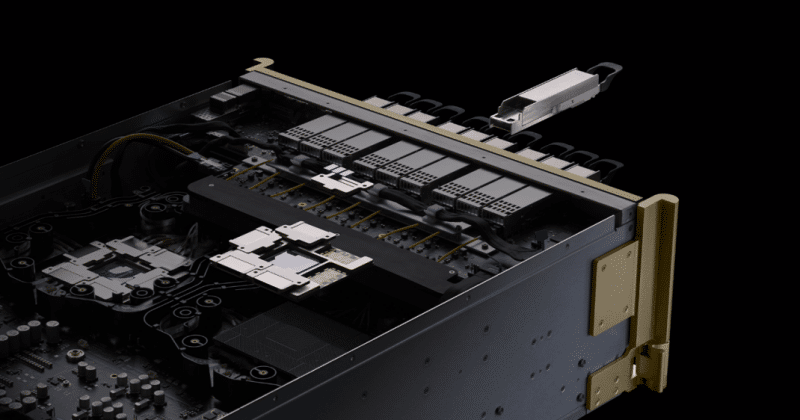
Nvidia just made the internet cables inside AI data centers a lot more interesting. The company’s new co-packaged optics switch, built on silicon photonics, replaces the traditional pluggable transceivers that connect GPU racks with optical components baked directly into the switch package itself.

Lambda, one of the first AI infrastructure providers to adopt the technology, showed off the Quantum-X InfiniBand Photonics Q3450-LD switch on June 1, 2026, calling it a meaningful leap for GPU throughput.

What the numbers actually say

The Quantum-X CPO switches deliver 3.5 times greater power efficiency compared to conventional designs. Network resiliency improves by a factor of 10. That second number matters enormously for large-scale AI training runs, where a single network hiccup can force expensive restarts of jobs running across thousands of GPUs.

On the power front, a standard switch consumes roughly 7 kW. The CPO version draws approximately 3.95 kW, a saving of 3.05 kW per unit.

Advertisement

The Q3450-LD switch supports up to 115.2 Tbps of full-duplex bandwidth, enabling high-speed connections across numerous chips and ports within a cluster.

Lambda’s messaging around the technology centered on a phrase that neatly captures the value proposition: “more tokens per watt.”

Who else is buying in

Lambda isn’t alone in this bet. CoreWeave, Meta, Microsoft, and Oracle Cloud Infrastructure are also among the first wave of adopters deploying Nvidia’s CPO switches.

Lambda first announced its integration with Nvidia’s silicon photonics-based networking on November 20, 2025. The June 2026 unboxing of the Q3450-LD switch was the public-facing payoff of that early commitment.

Nvidia has framed CPO switches as essential infrastructure for what it calls “agentic AI workloads” running inside “AI factories,” its term for the massive GPU clusters being built to train and deploy next-generation models.

What this means for investors

For Nvidia, this deepens the moat. The company already dominates AI compute with its GPUs. By owning the networking layer too, including the optical interconnects, Nvidia makes it harder for customers to mix and match components from competing vendors.

A saving of 3.05 kW per switch, multiplied across an entire facility, translates directly into lower operating costs and reduced cooling requirements.

The risk to watch is execution. Co-packaged optics is a relatively nascent technology in production environments. Integrating optical components directly onto the switch package introduces manufacturing complexity that pluggable transceivers avoid. The fact that five major companies are deploying simultaneously does provide a broader testing base, but it also means any systemic issue would ripple across the industry rather than being contained to a single operator.

Disclosure: This article was edited by Editorial Team. For more information on how we create and review content, see our Editorial Policy.

Nvidia unveils photonics co-packaged optics switch with Lambda to enhance AI workloads

Nvidia unveils photonics co-packaged optics switch with Lambda to enhance AI workloads

The new Quantum-X CPO switch promises 3.5x power efficiency gains and 10x network resiliency, with Lambda among the first to deploy it in production GPU clusters.

Nvidia just made the internet cables inside AI data centers a lot more interesting. The company’s new co-packaged optics switch, built on silicon photonics, replaces the traditional pluggable transceivers that connect GPU racks with optical components baked directly into the switch package itself.

Lambda, one of the first AI infrastructure providers to adopt the technology, showed off the Quantum-X InfiniBand Photonics Q3450-LD switch on June 1, 2026, calling it a meaningful leap for GPU throughput.

What the numbers actually say

The Quantum-X CPO switches deliver 3.5 times greater power efficiency compared to conventional designs. Network resiliency improves by a factor of 10. That second number matters enormously for large-scale AI training runs, where a single network hiccup can force expensive restarts of jobs running across thousands of GPUs.

On the power front, a standard switch consumes roughly 7 kW. The CPO version draws approximately 3.95 kW, a saving of 3.05 kW per unit.

Advertisement

The Q3450-LD switch supports up to 115.2 Tbps of full-duplex bandwidth, enabling high-speed connections across numerous chips and ports within a cluster.

Lambda’s messaging around the technology centered on a phrase that neatly captures the value proposition: “more tokens per watt.”

Who else is buying in

Lambda isn’t alone in this bet. CoreWeave, Meta, Microsoft, and Oracle Cloud Infrastructure are also among the first wave of adopters deploying Nvidia’s CPO switches.

Lambda first announced its integration with Nvidia’s silicon photonics-based networking on November 20, 2025. The June 2026 unboxing of the Q3450-LD switch was the public-facing payoff of that early commitment.

Nvidia has framed CPO switches as essential infrastructure for what it calls “agentic AI workloads” running inside “AI factories,” its term for the massive GPU clusters being built to train and deploy next-generation models.

What this means for investors

For Nvidia, this deepens the moat. The company already dominates AI compute with its GPUs. By owning the networking layer too, including the optical interconnects, Nvidia makes it harder for customers to mix and match components from competing vendors.

A saving of 3.05 kW per switch, multiplied across an entire facility, translates directly into lower operating costs and reduced cooling requirements.

The risk to watch is execution. Co-packaged optics is a relatively nascent technology in production environments. Integrating optical components directly onto the switch package introduces manufacturing complexity that pluggable transceivers avoid. The fact that five major companies are deploying simultaneously does provide a broader testing base, but it also means any systemic issue would ripple across the industry rather than being contained to a single operator.

Disclosure: This article was edited by Editorial Team. For more information on how we create and review content, see our Editorial Policy.