
Nexo Earn with Nexo
Nvidia CEO Jensen Huang unveils Vera Rubin production timeline at GTC Taipei 2026

Nvidia CEO Jensen Huang unveils Vera Rubin production timeline at GTC Taipei 2026

The next-generation AI platform promises 10x cheaper inference than Blackwell, with full production starting this fall.

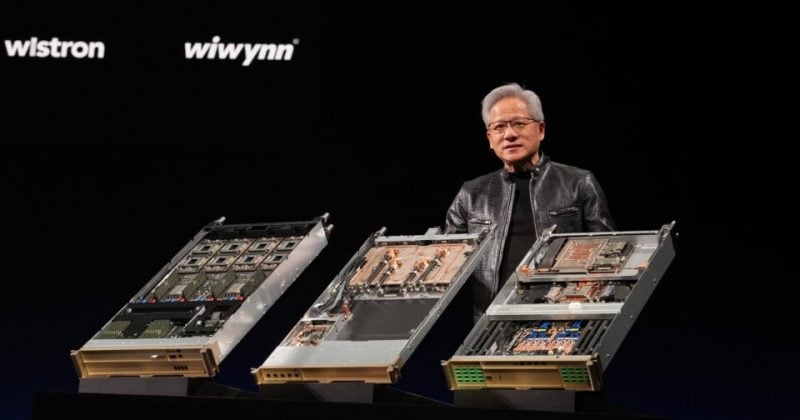
Jensen Huang took the stage at the Taipei Music Center on June 1 and did what he does best: made a room full of engineers feel like they were witnessing the future. The Nvidia CEO used his GTC Taipei 2026 keynote to announce that the Vera Rubin platform, the company’s next-generation AI infrastructure system, is ramping into full production by fall 2026.

The headline number: Nvidia expects to accumulate $1 trillion in cumulative orders for its Blackwell and Rubin systems by 2027.

What Vera Rubin actually is

The NVL72 systems bundle together Rubin GPUs, Vera CPUs, Groq 3 LPX inference trays, Spectrum-6 networking, and BlueField-4 storage into one cohesive stack. Instead of cobbling together components from different vendors, Nvidia designed every layer of the system to work together from the ground up.

Advertisement

The approach is what Nvidia calls “extreme co-design,” optimizing every component to talk to its neighbors with minimal friction for high-throughput inference workloads that power agentic AI systems.

Nvidia says Vera Rubin delivers up to 10 times lower cost per token compared to the Blackwell architecture, along with significantly greater throughput per megawatt when paired with Groq components. Production shipments are scheduled for autumn 2026.

Taiwan at the center of the AI supply chain

Huang emphasized Taiwan’s critical role in Nvidia’s manufacturing ecosystem, noting that the company collaborates with over 350 factories across 30 countries. Of those, 150 are located in Taiwan.

The supply chain for Vera Rubin is twice the size of what Blackwell required, according to Huang.

Why agentic AI is the target

The Vera Rubin platform is explicitly designed for agentic AI workloads, meaning AI systems that don’t just respond to prompts but take autonomous actions, chain together multi-step reasoning, and operate continuously. The unified AI factory design prioritizes high-efficiency inference, which positions Nvidia to capture demand as enterprises move from experimental to operational AI deployments.

What this means for investors

The $1 trillion cumulative order projection through 2027 encompasses both Blackwell and Rubin systems, reflecting the full arc of Nvidia’s current and next-gen product lines.

With 150 of Nvidia’s partner factories concentrated in Taiwan, any disruption to Taiwan’s manufacturing capacity would ripple through the entire Vera Rubin production timeline. The supply chain expansion to twice the size of Blackwell’s introduces execution risk that investors pricing in the $1 trillion order forecast should also weigh against the concentration risk that makes it possible.

Disclosure: This article was edited by Editorial Team. For more information on how we create and review content, see our Editorial Policy.

Nvidia CEO Jensen Huang unveils Vera Rubin production timeline at GTC Taipei 2026

Nvidia CEO Jensen Huang unveils Vera Rubin production timeline at GTC Taipei 2026

The next-generation AI platform promises 10x cheaper inference than Blackwell, with full production starting this fall.

Jensen Huang took the stage at the Taipei Music Center on June 1 and did what he does best: made a room full of engineers feel like they were witnessing the future. The Nvidia CEO used his GTC Taipei 2026 keynote to announce that the Vera Rubin platform, the company’s next-generation AI infrastructure system, is ramping into full production by fall 2026.

The headline number: Nvidia expects to accumulate $1 trillion in cumulative orders for its Blackwell and Rubin systems by 2027.

What Vera Rubin actually is

The NVL72 systems bundle together Rubin GPUs, Vera CPUs, Groq 3 LPX inference trays, Spectrum-6 networking, and BlueField-4 storage into one cohesive stack. Instead of cobbling together components from different vendors, Nvidia designed every layer of the system to work together from the ground up.

Advertisement

The approach is what Nvidia calls “extreme co-design,” optimizing every component to talk to its neighbors with minimal friction for high-throughput inference workloads that power agentic AI systems.

Nvidia says Vera Rubin delivers up to 10 times lower cost per token compared to the Blackwell architecture, along with significantly greater throughput per megawatt when paired with Groq components. Production shipments are scheduled for autumn 2026.

Taiwan at the center of the AI supply chain

Huang emphasized Taiwan’s critical role in Nvidia’s manufacturing ecosystem, noting that the company collaborates with over 350 factories across 30 countries. Of those, 150 are located in Taiwan.

The supply chain for Vera Rubin is twice the size of what Blackwell required, according to Huang.

Why agentic AI is the target

The Vera Rubin platform is explicitly designed for agentic AI workloads, meaning AI systems that don’t just respond to prompts but take autonomous actions, chain together multi-step reasoning, and operate continuously. The unified AI factory design prioritizes high-efficiency inference, which positions Nvidia to capture demand as enterprises move from experimental to operational AI deployments.

What this means for investors

The $1 trillion cumulative order projection through 2027 encompasses both Blackwell and Rubin systems, reflecting the full arc of Nvidia’s current and next-gen product lines.

With 150 of Nvidia’s partner factories concentrated in Taiwan, any disruption to Taiwan’s manufacturing capacity would ripple through the entire Vera Rubin production timeline. The supply chain expansion to twice the size of Blackwell’s introduces execution risk that investors pricing in the $1 trillion order forecast should also weigh against the concentration risk that makes it possible.

Disclosure: This article was edited by Editorial Team. For more information on how we create and review content, see our Editorial Policy.