
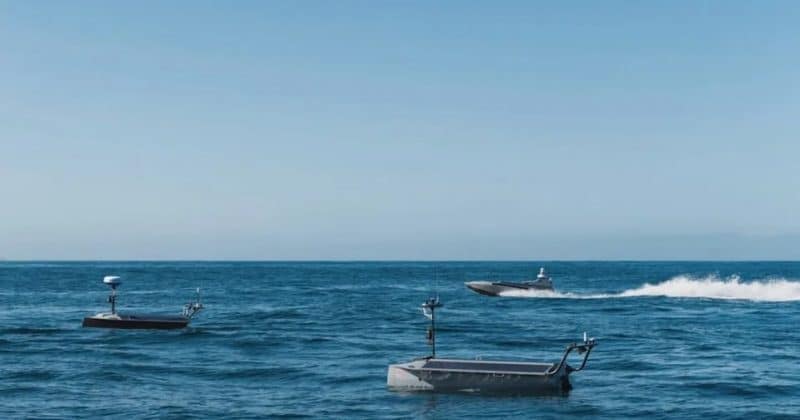
Seasats launches autonomous hunter ships to track Chinese ghost fleets
The San Diego startup's 12-foot Lightfish vessels are quietly reshaping maritime surveillance, backed by $40M in funding and a Pentagon contract.
A fleet of tiny, unmanned boats is now doing work that used to require billion-dollar warships. Seasats, a San Diego-based defense startup, has officially deployed its autonomous Lightfish vessels to track Chinese “ghost fleets,” the distant-water fishing armadas that vanish from radar by switching off their transponders while illegally harvesting the ocean.
The company has raised over $40 million in total funding to make this happen. And in May 2026, one of its vessels pulled off the first known autonomous transit of the Taiwan Strait, quietly recording interactions with Chinese naval ships along the way.
Small boats, big mandate
Chinese distant-water fishing vessels routinely disable their Automatic Identification System transponders, the maritime equivalent of turning off your phone’s location services, to fish illegally in restricted waters without anyone noticing.
Seasats’ answer is the Lightfish, a small uncrewed surface vessel, or sUSV, that measures roughly 12 feet long and weighs between 305 and 350 pounds. It can stay at sea for up to six months at a stretch.
The vessels operate with real-time satellite communication and onboard AI processing, allowing them to identify, track, and report on vessels that have gone dark. They can function in GPS-denied environments, which matters enormously in contested waters where electronic warfare is a real consideration.
The news moving money, markets, and the world—before your day starts.
Daily. Free. Join 34,000+ readers across crypto, finance, and policy.
Backing this effort is the US Navy’s Task Force 59, the experimental unit dedicated to integrating unmanned systems into fleet operations.
Follow the money
Seasats closed a $20 million Series A funding round in February 2026, led by Konvoy Ventures. That round pushed total funding past the $40 million mark.
A month earlier, in January 2026, the company received a $24 million APFIT award from the Department of Defense. That acronym stands for Accelerate the Procurement and Fielding of Innovative Technologies.
The Taiwan Strait transit
The May 2026 autonomous transit of the Taiwan Strait was more than a technical milestone. The Taiwan Strait is one of the most sensitive waterways on Earth. China considers it sovereign territory. The US regularly sends warships through it under the banner of freedom of navigation.
The Lightfish documented real-time interactions with Chinese naval vessels, providing data on movement patterns, response times, and behavior in the strait. It also demonstrated that small autonomous vessels can operate in one of the world’s busiest and most contested shipping lanes without getting sunk, captured, or confused by heavy maritime traffic.