
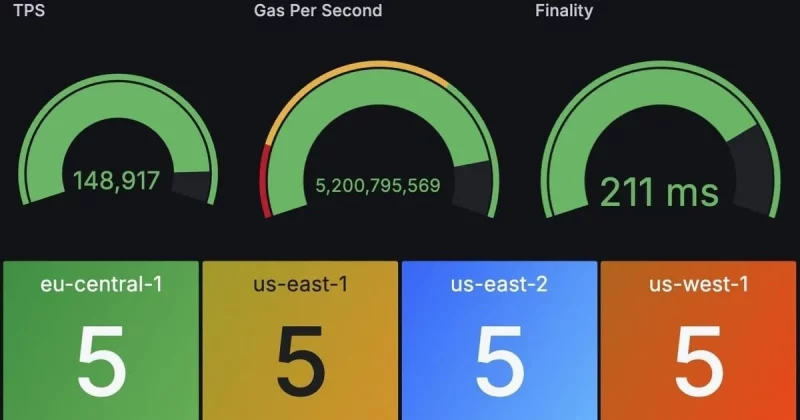
SEI unveils Giga upgrade roadmap, targets 200,000 TPS and 400ms finality
Sei Labs lays out a phased plan to boost throughput roughly 50-fold, introducing a multi-proposer consensus protocol and asynchronous execution across its EVM-compatible chain.
Sei Network just drew a line in the sand. The layer-1 blockchain published its first public Giga upgrade roadmap on May 28, targeting over 200,000 transactions per second and sub-400 millisecond finality, numbers that would make it one of the fastest EVM-compatible chains in existence.
For context, Sei’s prior throughput benchmarks sat somewhere in the range of 5,000 to 12,500 TPS. The Giga upgrade represents roughly a 40 to 50-fold increase in raw capacity.
What Giga actually changes under the hood
The upgrade isn’t a single switch-flip. Sei Labs is rolling out Giga progressively throughout 2026, with no single definitive launch date. Instead, the team has set up a public milestone tracker at giga.seilabs.io for anyone who wants to follow along.
At the core of the performance leap is something called Autobahn, a multi-proposer consensus protocol. Traditional blockchains rely on a single block proposer at a time, creating a bottleneck. Autobahn lets multiple validators propose blocks simultaneously, which is how you get from thousands of TPS to hundreds of thousands.
Beyond consensus, the upgrade introduces asynchronous execution. Rather than processing transactions sequentially within each block, the network can execute them in parallel, decoupling execution from the consensus layer itself. The result is 5 gigagas of throughput, a metric that measures how much computational work the chain can handle per second.
Sei Labs is also shipping a revamped EVM client, meaning the network retains full compatibility with Ethereum’s tooling ecosystem while dramatically outperforming Ethereum’s own execution layer. The current Sei mainnet already achieves sub-400ms block times in its optimized configuration, roughly 30 times faster than Ethereum’s finality. Giga aims to lock that speed in as a permanent floor, not a best-case scenario.
The upgrade also bundles in protections against Miner Extractable Value, the practice where validators reorder transactions to extract profit at users’ expense.
The crypto and markets news you actually need—every morning.
Daily. Free. Join 34,000+ readers across crypto, finance, and policy.
Giga also includes support for AI tooling, signaling that Sei Labs sees on-chain AI agents and automated strategies as a core use case for high-throughput infrastructure.
The road to Giga: what came before
Sei Labs published the Giga whitepaper on May 19, 2025, branding the project as the first multi-proposer EVM layer-1 blockchain. That paper laid out the theoretical framework. What’s new is the concrete delivery timeline and public tracking mechanism.
Earlier in 2026, the network shipped versions 6.3 and 6.4, which focused on EVM improvements and block time enhancements. Those updates served as stepping stones, proving out individual components that Giga combines into a unified architecture overhaul.
The phased approach is deliberate. Sei is transitioning to an EVM-only model alongside the Giga rollout, which means shedding its previous CosmWasm execution environment entirely.
What this means for investors and traders
The sub-400ms finality isn’t theoretical. It’s already live on mainnet. The Giga upgrade is extending proven capabilities rather than building from scratch, which changes the risk profile compared to a chain making promises with nothing shipped.
Institutional interest in high-speed blockchain infrastructure has been intensifying, particularly around tokenized assets and automated trading strategies. If Giga delivers on its benchmarks, Sei would occupy a relatively uncrowded niche: full EVM compatibility at speeds that rival purpose-built, non-EVM chains. Developers wouldn’t need to learn a new programming language or abandon Ethereum’s tooling ecosystem to access dramatically better performance.
Progressive rollouts mean investors will get real-time data on whether each milestone lands on schedule. The public tracker at giga.seilabs.io serves as a direct accountability mechanism, and the SEI token’s trajectory through the rest of 2026 will likely correlate directly with whether those milestones turn green on time.