
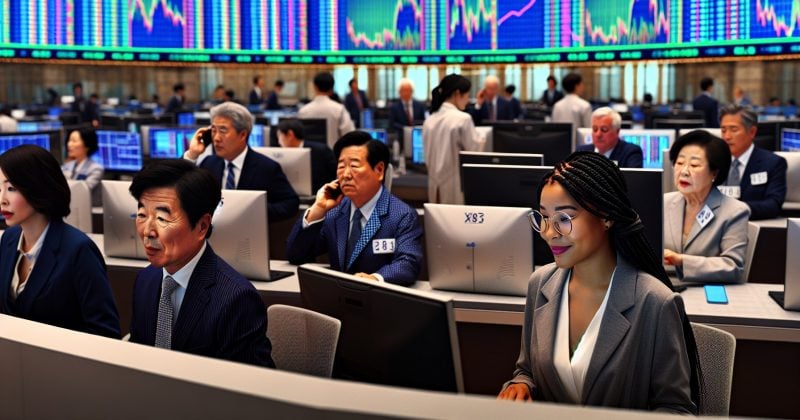
South Korea’s stock market drops 35% in July as semiconductor rout triggers circuit breakers

Via quantifiedstrategies.com

South Korea’s stock market drops 35% in July as semiconductor rout triggers circuit breakers

The KOSPI's worst month in recent memory is dragging Korean crypto exchange volumes down with it, raising questions about capital flows across risk assets.

South Korea’s benchmark KOSPI index has lost roughly 35% of its value this month, a collapse so severe that circuit breakers have been triggered multiple times as the market scrambles to contain the damage. The culprit? A semiconductor sector meltdown driven by fears that Chinese chipmakers are closing the gap on Korean giants.

On July 28, the KOSPI plunged 10.84% to close at 6,023.66, marking its largest single-day decline since March. Samsung Electronics dropped 14.4% and SK Hynix fell 14.7% in the same session.

A market built on chips has cracked

The KOSPI peaked at approximately 9,114 in June. It’s now sitting around 6,000, a decline of roughly 34% from that high. For context, the index is still up about 43% year-to-date, which means July has effectively incinerated months of gains in less than four weeks.

The core issue is structural concentration. South Korea’s stock market is disproportionately weighted toward semiconductor companies, and when the narrative around those companies shifts, the entire index moves with it. That narrative shift arrived in the form of growing anxiety about Chinese memory chip manufacturers eating into territory long dominated by Samsung and SK Hynix.

Advertisement

Multiple circuit breakers have been activated throughout July. Retail traders, who have been increasingly active participants in Korean equity markets, appear to be contributing to the volatility.

Crypto volumes are collapsing alongside equities

Korean crypto exchange trading volumes have cratered during the stock market selloff, falling to as low as 1.6% of KOSPI turnover on at least one occasion.

Instead of rotating out of equities into crypto, Korean investors appear to be pulling back from risk assets across the board. The “kimchi premium,” Korea’s historically elevated crypto prices relative to global exchanges, only exists when there’s excess capital chasing digital assets. Right now, that capital is either locked in underwater equity positions or sitting on the sidelines.

What’s driving the fear

Chinese manufacturers have been investing heavily in memory chip production capacity, and recent indications suggest they’re making meaningful progress on yield rates and technology that were previously considered years away.

This dynamic is amplified by broader weakness in the global technology sector. Korean semiconductor stocks aren’t falling in isolation. They’re falling faster than their global peers because of the concentration risk baked into the KOSPI’s structure.

What this means for investors

The correlation between Korean equity weakness and crypto volume contraction suggests that Bitcoin and other digital assets may not function as the safe haven some investors assume, at least not when the selling originates from a major crypto-active market like South Korea.

The 43% year-to-date gain that the KOSPI still holds creates an interesting tension. Investors who bought earlier in the year are still technically in profit, which means forced liquidations may not be as severe as the headline decline suggests. But if the index continues to fall and those year-to-date gains erode, unrealized gains turning into realized losses tends to trigger a second wave of selling.

The circuit breaker activations prevent flash crashes from spiraling, but they also trap liquidity. Investors who can’t sell during a halt face the choice of panic-selling when trading resumes or holding through further potential declines.

Disclosure: This article was edited by Editorial Team. For more information on how we create and review content, see our Editorial Policy.

South Korea’s stock market drops 35% in July as semiconductor rout triggers circuit breakers

South Korea’s stock market drops 35% in July as semiconductor rout triggers circuit breakers

The KOSPI's worst month in recent memory is dragging Korean crypto exchange volumes down with it, raising questions about capital flows across risk assets.

Via quantifiedstrategies.com

South Korea’s benchmark KOSPI index has lost roughly 35% of its value this month, a collapse so severe that circuit breakers have been triggered multiple times as the market scrambles to contain the damage. The culprit? A semiconductor sector meltdown driven by fears that Chinese chipmakers are closing the gap on Korean giants.

On July 28, the KOSPI plunged 10.84% to close at 6,023.66, marking its largest single-day decline since March. Samsung Electronics dropped 14.4% and SK Hynix fell 14.7% in the same session.

A market built on chips has cracked

The KOSPI peaked at approximately 9,114 in June. It’s now sitting around 6,000, a decline of roughly 34% from that high. For context, the index is still up about 43% year-to-date, which means July has effectively incinerated months of gains in less than four weeks.

The core issue is structural concentration. South Korea’s stock market is disproportionately weighted toward semiconductor companies, and when the narrative around those companies shifts, the entire index moves with it. That narrative shift arrived in the form of growing anxiety about Chinese memory chip manufacturers eating into territory long dominated by Samsung and SK Hynix.

Advertisement

Multiple circuit breakers have been activated throughout July. Retail traders, who have been increasingly active participants in Korean equity markets, appear to be contributing to the volatility.

Crypto volumes are collapsing alongside equities

Korean crypto exchange trading volumes have cratered during the stock market selloff, falling to as low as 1.6% of KOSPI turnover on at least one occasion.

Instead of rotating out of equities into crypto, Korean investors appear to be pulling back from risk assets across the board. The “kimchi premium,” Korea’s historically elevated crypto prices relative to global exchanges, only exists when there’s excess capital chasing digital assets. Right now, that capital is either locked in underwater equity positions or sitting on the sidelines.

What’s driving the fear

Chinese manufacturers have been investing heavily in memory chip production capacity, and recent indications suggest they’re making meaningful progress on yield rates and technology that were previously considered years away.

This dynamic is amplified by broader weakness in the global technology sector. Korean semiconductor stocks aren’t falling in isolation. They’re falling faster than their global peers because of the concentration risk baked into the KOSPI’s structure.

What this means for investors

The correlation between Korean equity weakness and crypto volume contraction suggests that Bitcoin and other digital assets may not function as the safe haven some investors assume, at least not when the selling originates from a major crypto-active market like South Korea.

The 43% year-to-date gain that the KOSPI still holds creates an interesting tension. Investors who bought earlier in the year are still technically in profit, which means forced liquidations may not be as severe as the headline decline suggests. But if the index continues to fall and those year-to-date gains erode, unrealized gains turning into realized losses tends to trigger a second wave of selling.

The circuit breaker activations prevent flash crashes from spiraling, but they also trap liquidity. Investors who can’t sell during a halt face the choice of panic-selling when trading resumes or holding through further potential declines.

Disclosure: This article was edited by Editorial Team. For more information on how we create and review content, see our Editorial Policy.