
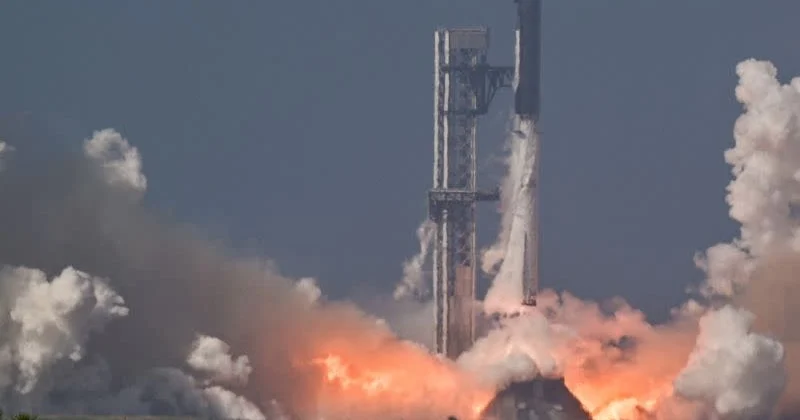
SpaceX’s Starship test strengthens IPO case ahead of June roadshow
Flight 12 showed real progress but fell short of full reusability, giving investors both a growth story and a reality check before the company's potential $1.75 trillion debut.
SpaceX just flew its biggest rocket for the twelfth time, deployed mock satellites from the new V3 design, and brought everything back in one piece. The Raptor engines still couldn’t reliably relight on both the booster and the spacecraft, meaning full reusability, the entire economic thesis behind Starship, remains unproven. For a company about to hit the road pitching a valuation of up to $1.75 trillion, that’s a detail worth lingering on.
The flight and what it proved
Starship’s Flight 12 launched on May 23, marking the first test of SpaceX’s V3 design iteration. The mission successfully deployed mock satellites, a critical demonstration for Starlink’s next-generation deployment plans. Both the booster and spacecraft returned safely.
Reusability isn’t a nice-to-have for SpaceX. It’s the core promise. The ability to fly, land, refuel, and fly again is what separates Starship’s economics from every other launch vehicle in history.
SpaceX has invested more than $15 billion into Starship development. Every Starlink expansion plan, every lunar mission contract, every Mars ambition runs through Starship eventually.
The IPO math
SpaceX filed its confidential IPO paperwork on April 1, with a public prospectus expected by late May. The investor roadshow is scheduled for early June, with pricing anticipated around June 11-12. The company is targeting a Nasdaq listing under the ticker SPCX.
SpaceX is aiming to raise between $75 billion and $80 billion at a valuation of up to $1.75 trillion. SpaceX generated $18.7 billion in revenue during the 2025 fiscal year, but reported losses estimated between $4.3 billion and $5 billion for the same period.
The news moving money, markets, and the world—before your day starts.
Daily. Free. Join 34,000+ readers across crypto, finance, and policy.
The June 11 pricing event is notably structured with a focus on retail investors, an unusual move for an IPO of this size.
Through super-voting shares, Musk controls approximately 85.7% of the company’s voting power.
What this means for investors
The reusability gap is the single biggest risk factor in SpaceX’s IPO story. Every financial projection about reduced launch costs, about Starlink scaling profitably, about competing for deep-space contracts, assumes that SpaceX solves the engine relight problem and achieves rapid turnaround flights.
The $4.3 billion to $5 billion in losses against $18.7 billion in revenue shows a company still burning through cash at an extraordinary rate. The more than $15 billion already sunk into Starship development represents a bet that the physics and engineering will eventually cooperate.
Space and satellite stocks saw notable spikes following the Flight 12 success. There are no crypto components tied to the SpaceX IPO or the Starship program. This is a traditional equity play on a Nasdaq listing.
The key dates to watch are the early June roadshow and the June 11-12 pricing window.