
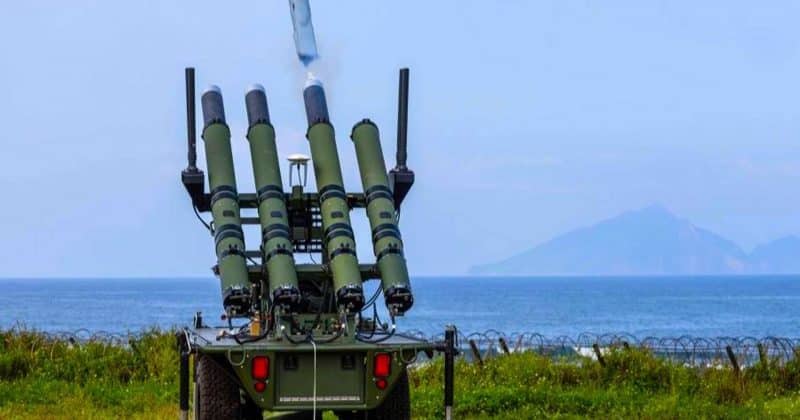
Taiwan deploys American-made Altius-600 drones against maritime targets during drills
The island's first live-fire test of US-supplied loitering munitions achieved a 100% strike rate, marking a new phase in cross-strait deterrence with implications for defense-adjacent markets
Taiwan fired American-made attack drones at maritime targets for the first time last week, achieving a perfect strike rate during live-fire exercises off the island’s west coast. The June 3 drills validated a weapons system that would serve as a cornerstone of Taiwan’s defense strategy if China ever attempts to cross the Taiwan Strait.
The Altius-600M loitering munitions, built by Anduril Industries, hit every offshore target during the Tianma Exercise. Taiwan’s 21st Artillery Command UAV Battalion reported 100% success across target acquisition, identification, tracking, and engagement. At least three towed flatbed launchers, each loaded with four Altius drones, were deployed for the exercise.
What Taiwan just tested, and why it matters
Think of a loitering munition as a cross between a drone and a cruise missile. It launches, flies to a designated area, circles while searching for targets, then dives into whatever it finds. The Altius-600M carries a 9-pound warhead and has an operational range of roughly 160 km, enough to threaten naval vessels well offshore.
The system is tube-launched from mobile flatbed trailers, which makes it exceptionally hard to locate and destroy before use.
Taiwan received its first batch of Altius-600M units in August 2025. Full delivery of all 291 units was completed by March 2026. The US State Department had previously approved the sale as part of a broader package valued at approximately NT$34 billion, or roughly $1.1 billion. That package also includes 685 Switchblade 300 loitering munitions, a smaller system designed for different tactical scenarios.
Macro, rates, and crypto—what moved markets and what matters next.
Daily. Free. Join 34,000+ readers across crypto, finance, and policy.
Anduril Industries, the defense contractor founded by Palmer Luckey, acquired the original Altius developer Area-I and has since scaled production.
The geopolitical backdrop
Taiwan’s strategy has shifted toward acquiring large numbers of small, mobile, and expendable weapons systems rather than relying solely on expensive legacy platforms like fighter jets and warships.
Taiwan is also investing heavily in domestic drone production. The island’s defense ministry has been building out indigenous manufacturing capacity, aiming to reduce dependence on foreign suppliers for future conflicts.
What this means for investors
Any serious escalation between China and Taiwan would send shockwaves through semiconductor supply chains, given that Taiwan Semiconductor Manufacturing Company produces the vast majority of the world’s advanced chips. Those chips power everything from AI data centers to the hardware running blockchain validators.
Defense spending at this scale, $1.1 billion for one weapons package alone, also reflects broader fiscal dynamics. Governments worldwide are increasing military budgets, which means more borrowing, more spending, and potentially more inflationary pressure down the road.