
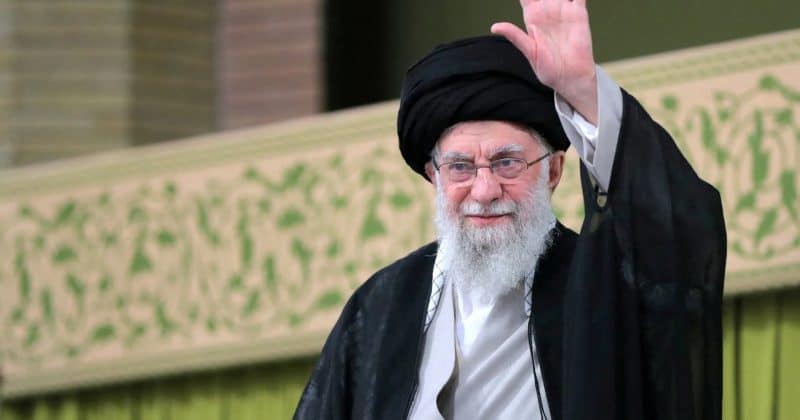
Tehran airspace closes Monday for Khamenei’s funeral as crypto markets brace for volatility

Tehran airspace closes Monday for Khamenei’s funeral as crypto markets brace for volatility

Iran's supreme leader's state funeral triggers airspace shutdowns, while Bitcoin and prediction markets reflect the geopolitical tremors rippling through digital assets.

Tehran will shut down its entire airspace on Monday to accommodate funeral ceremonies for Ali Khamenei, Iran’s Supreme Leader who was killed on February 28 during a coordinated US-Israeli military strike. Airspace restrictions will then shift to Mashhad on July 9, when Khamenei is expected to be buried at the Imam Reza shrine.

The multi-day state funeral, stretching from July 4 to July 9, has drawn millions of mourners across cities in Iran and Iraq. For crypto markets, the event represents the latest chapter in a geopolitical saga that has already sent Bitcoin on a wild ride and turned prediction platforms into de facto intelligence markets.

A funeral with global market consequences

Khamenei was 86 years old when he was killed in the strike that also took the lives of family members, including his daughter and grandchild. The attack effectively launched what has been called the 2026 Iran war, reshaping the geopolitical landscape of the Middle East in ways that financial markets are still pricing in months later.

Advertisement

The funeral procession has wound through Tehran, Qom, and Mashhad, with additional ceremonies at sacred sites in Najaf and Karbala, Iraq. Security protocols have been extraordinary, with the airspace closures representing the most visible disruption to civilian infrastructure.

Public gatherings throughout the funeral have featured heavy displays of grief alongside explicit calls for retaliation against the United States and Israel.

Bitcoin’s geopolitical hedge narrative gets another test

When Khamenei’s death was confirmed in late February, Bitcoin’s price action told a fascinating story. The asset briefly climbed to approximately $68,000 in early March, recovering some of the losses it had accumulated during the initial wave of geopolitical tension in the region.

Prediction markets emerge as geopolitical barometers

Perhaps the most striking market development surrounding Khamenei’s death has been the explosion of activity on prediction platforms. Polymarket and Kalshi both saw tens to hundreds of millions in trading volumes on contracts related to the assassination and its aftermath.

What investors should watch next

Bitcoin’s recovery to $68,000 in March, while notable, still left the asset below levels seen before the broader conflict began heating up. That gap represents unresolved uncertainty, and the funeral’s conclusion could either narrow it or widen it depending on the geopolitical trajectory.

Disclosure: This article was edited by Editorial Team. For more information on how we create and review content, see our Editorial Policy.

Tehran airspace closes Monday for Khamenei’s funeral as crypto markets brace for volatility

Tehran airspace closes Monday for Khamenei’s funeral as crypto markets brace for volatility

Iran's supreme leader's state funeral triggers airspace shutdowns, while Bitcoin and prediction markets reflect the geopolitical tremors rippling through digital assets.

Tehran will shut down its entire airspace on Monday to accommodate funeral ceremonies for Ali Khamenei, Iran’s Supreme Leader who was killed on February 28 during a coordinated US-Israeli military strike. Airspace restrictions will then shift to Mashhad on July 9, when Khamenei is expected to be buried at the Imam Reza shrine.

The multi-day state funeral, stretching from July 4 to July 9, has drawn millions of mourners across cities in Iran and Iraq. For crypto markets, the event represents the latest chapter in a geopolitical saga that has already sent Bitcoin on a wild ride and turned prediction platforms into de facto intelligence markets.

A funeral with global market consequences

Khamenei was 86 years old when he was killed in the strike that also took the lives of family members, including his daughter and grandchild. The attack effectively launched what has been called the 2026 Iran war, reshaping the geopolitical landscape of the Middle East in ways that financial markets are still pricing in months later.

Advertisement

The funeral procession has wound through Tehran, Qom, and Mashhad, with additional ceremonies at sacred sites in Najaf and Karbala, Iraq. Security protocols have been extraordinary, with the airspace closures representing the most visible disruption to civilian infrastructure.

Public gatherings throughout the funeral have featured heavy displays of grief alongside explicit calls for retaliation against the United States and Israel.

Bitcoin’s geopolitical hedge narrative gets another test

When Khamenei’s death was confirmed in late February, Bitcoin’s price action told a fascinating story. The asset briefly climbed to approximately $68,000 in early March, recovering some of the losses it had accumulated during the initial wave of geopolitical tension in the region.

Prediction markets emerge as geopolitical barometers

Perhaps the most striking market development surrounding Khamenei’s death has been the explosion of activity on prediction platforms. Polymarket and Kalshi both saw tens to hundreds of millions in trading volumes on contracts related to the assassination and its aftermath.

What investors should watch next

Bitcoin’s recovery to $68,000 in March, while notable, still left the asset below levels seen before the broader conflict began heating up. That gap represents unresolved uncertainty, and the funeral’s conclusion could either narrow it or widen it depending on the geopolitical trajectory.

Disclosure: This article was edited by Editorial Team. For more information on how we create and review content, see our Editorial Policy.