
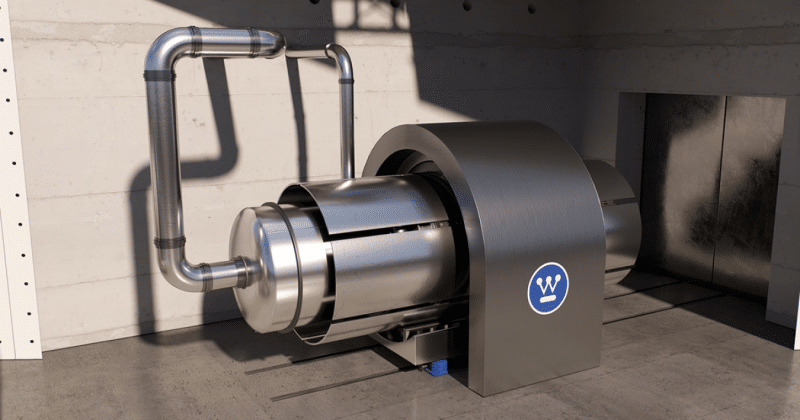
Trump administration backs $80B nuclear deal with $17.5B in government-backed financing for Westinghouse reactors
The partnership with Westinghouse, Cameco, and Brookfield aims to build roughly ten new reactors starting in 2026, with the government taking a cut of profits above a set threshold.
The Trump administration just made its biggest bet on nuclear energy. An $80 billion partnership with Westinghouse Electric Company, Cameco Corporation, and Brookfield Asset Management will fund the construction of approximately ten new nuclear reactors across the US, with government-backed financing playing a central role in getting shovels in the ground.
The deal, announced October 27-28, includes $17.5 billion in low-cost government-backed loans coordinated through the US Department of Energy. In exchange for subsidizing the financing, the federal government will claim 20% of cash distributions or profits that exceed a $17.5B threshold once certain profitability conditions are met.
What’s actually getting built
The reactors in question are Westinghouse’s AP1000 pressurized water reactors and AP300 small modular reactors. The AP1000 is a proven design, already operational at the Vogtle plant in Georgia, which became the first new US nuclear units in decades when its third and fourth reactors came online in 2023 and 2024. The AP300 is a smaller, modular variant designed for faster deployment and lower upfront capital requirements.
Construction is projected to begin in 2026. The partnership structure pairs Westinghouse’s reactor technology with Cameco’s uranium supply capabilities and Brookfield’s deep pockets in infrastructure finance. Cameco is one of the world’s largest uranium producers, headquartered in Saskatchewan. Brookfield manages hundreds of billions in assets globally, with significant exposure to energy infrastructure.
The explicit goal, per the administration, is a “nuclear renaissance” driven by surging electricity demand from data centers and artificial intelligence workloads.
The news moving money, markets, and the world—before your day starts.
Daily. Free. Join 34,000+ readers across crypto, finance, and policy.
Why this matters beyond energy policy
The deal traces back to executive orders President Trump issued in May 2025, directing federal agencies to accelerate nuclear permitting and deployment.
The US currently operates 93 commercial nuclear reactors, generating roughly 20% of the nation’s electricity. China has more than 20 reactors currently under construction, while Russia’s Rosatom has exported reactor technology across Asia, Africa, and the Middle East. By backing Westinghouse at this scale, the administration is positioning US nuclear technology as a credible competitor in both domestic and export markets.
The $80 billion total investment dwarfs previous US nuclear commitments. For comparison, the Vogtle expansion in Georgia cost approximately $35 billion for two units. The Vogtle project’s original price tag was roughly $14 billion and ended up costing more than double that.
What this means for crypto and energy-intensive industries
Bitcoin mining operations consume enormous amounts of electricity, and their profitability is heavily influenced by energy costs. Unlike solar and wind, nuclear plants generate electricity around the clock regardless of weather conditions and produce near-zero carbon emissions during operation.
For crypto investors specifically, even with an optimistic 2026 construction start, meaningful power generation from these plants is likely years away. The government is putting up $17.5B in financing while claiming 20% of profits above that threshold — a public-private risk-sharing arrangement where if the reactors don’t clear the threshold, the government eats the financing costs.