
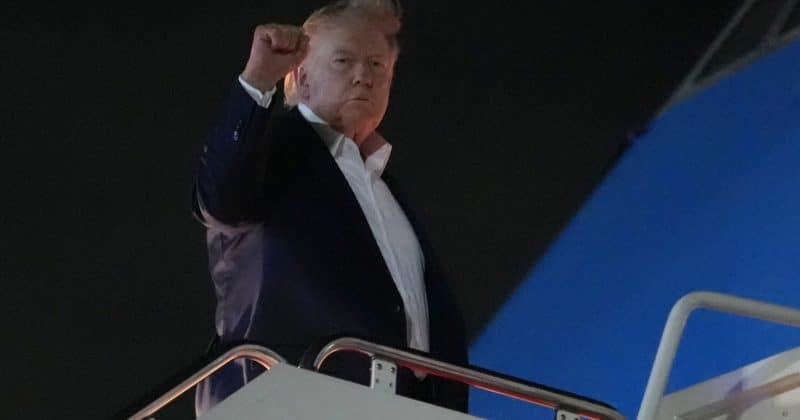
Donald Trump seeks momentum at G7 summit after Iran deal announcement
Bitcoin surged past $65K as markets cheered a preliminary US-Iran agreement, but the hard part is just getting started
President Donald Trump touched down at the G7 summit in Évian-les-Bains, France, on June 15 with something most world leaders rarely bring to these gatherings: genuine leverage. Hours earlier, he announced a preliminary agreement with Iran aimed at ending a 15-week military conflict that had rattled energy markets, disrupted global shipping, and sent risk assets into a tailspin.
The crypto market’s reaction was immediate. Bitcoin blew past $65,000 and touched nearly $66,000 in intraday trading, as traders interpreted the deal as a meaningful de-escalation of one of the most destabilizing geopolitical events of 2026.
What’s actually in the deal
The agreement, described as a memorandum of understanding rather than a formal treaty, centers on the US blockade of the Strait of Hormuz. That narrow waterway carries roughly 20% of the world’s crude oil supply, and Washington had choked it off during a conflict that erupted in late February 2026.
Under the preliminary terms, the Strait is now “partially opened” with toll-free passage restored. The deal also includes a 60-day ceasefire and a commitment to begin nuclear negotiations during that window.
Iranian Parliament Speaker Mohammad Bagher Ghalibaf signed on behalf of Tehran. Trump and Vice President JD Vance signed electronically for the US side. A formal signing ceremony is reportedly planned for later in the week in Switzerland, at which point the full text of the agreement would be released.
Trump, characteristically, expressed optimism about the arrangement, framing it as a pathway to what he called significant global success.
The news moving money, markets, and the world—before your day starts.
Daily. Free. Join 34,000+ readers across crypto, finance, and policy.
Why crypto moved first
Oil prices moved in the opposite direction from crypto. The reopening of the Strait, even partially, relieved pressure on crude supply that had been building for months. Cheaper energy feeds directly into lower inflation expectations, which in turn makes central banks less likely to tighten monetary policy.
Unlike traditional markets with limited trading hours, Bitcoin trades 24/7, making it one of the first instruments to reflect shifting geopolitical sentiment.
The gap between announcement and reality
The full text of the accord hasn’t been released yet. Without seeing the actual language, it’s impossible to know whether Washington and Tehran are interpreting the terms the same way.
The 60-day ceasefire creates a ticking clock. If nuclear negotiations don’t produce meaningful progress within that window, the entire framework could collapse.
The smart play right now is to watch the Swiss signing ceremony closely. If both sides show up and put pen to paper on a finalized text, that’s a meaningfully different signal than the current preliminary framework. Until then, Bitcoin’s move above $65,000 is pricing in a best-case scenario that hasn’t fully materialized yet.