
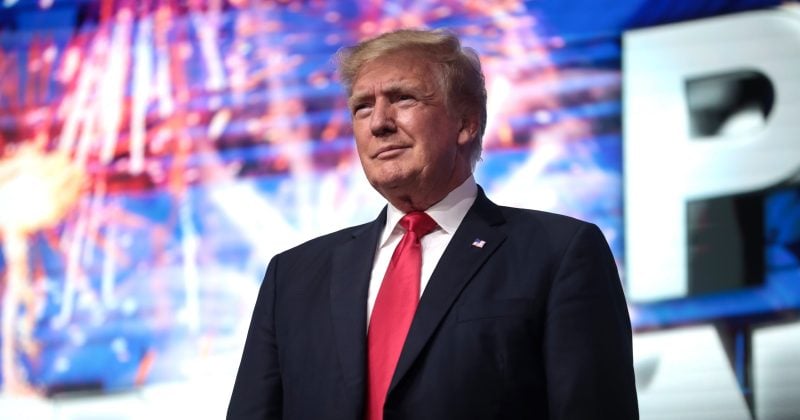
Photo: Gage Skidmore from Surprise, AZ, United States of America / Wikimedia Commons / CC BY-SA 2.0 (https://creativecommons.org/licenses/by-sa/2.0)
Trump’s Board of Peace awards first Gaza contract as stablecoin proposal draws Senate scrutiny
A Louisiana firm will build a military outpost for Moroccan troops while a parallel push for USD-backed stablecoins in Gaza reconstruction faces regulatory headwinds.
The Board of Peace, the Trump administration body tasked with overseeing Gaza’s reconstruction, has awarded its first construction contract. A Louisiana-based firm will build a rudimentary military outpost designed to house 150 Moroccan troops in the devastated territory, according to the Guardian.
On its own, a small military base contract wouldn’t normally register on crypto radar. But this one comes attached to a much larger story: a proposed USD-backed stablecoin for distributing aid and facilitating digital transactions across Gaza, a plan that has already triggered Senate investigations and could reshape how blockchain technology intersects with geopolitical reconstruction efforts.
The outpost and what comes next
Plans are reportedly in discussion for a much larger military base capable of hosting 5,000 personnel across more than 350 acres. That would represent a significant permanent international presence in Gaza, backed by a multinational coalition.
In February 2026, nine nations, including Morocco, Indonesia, Kazakhstan, Kosovo, and Albania, pledged approximately $7 billion toward Gaza reconstruction and troop deployments.
The Board of Peace itself was established in January 2026, chaired by Trump and featuring key figures like Jared Kushner. Its mandate covers both security infrastructure and economic rebuilding.
The stablecoin angle
Alongside the reconstruction, discussions have emerged about introducing a USD-backed stablecoin to handle digital transactions and aid distribution in Gaza. Gaza’s traditional banking infrastructure has been gutted by years of conflict, making conventional financial rails unreliable at best and nonexistent at worst.
No specific cryptocurrency tokens have been launched in connection with this initiative. Everything remains at the proposal stage.
US senators initiated probes in April 2026 into the Board’s stablecoin plans, raising governance questions and scrutinizing the involvement of adviser Liran Tancman. The investigations center on whether cryptocurrency tools are appropriate for humanitarian operations and whether the arrangement could effectively privatize aid logistics that traditionally fall under institutions like the United Nations.
Why this matters for crypto markets
The $7 billion in pledged reconstruction funds represents a substantial pool of capital that could flow through blockchain rails. Even if only a fraction of those funds were routed through a stablecoin mechanism, it would represent one of the largest real-world deployments of blockchain-based payments outside of conventional trading.
If investigators conclude that the stablecoin proposal is poorly governed or that it inappropriately enriches private actors, the political blowback could chill government appetite for similar projects elsewhere. The outcome of the April probes will likely set the tone for how aggressively US-linked entities pursue blockchain solutions in geopolitically sensitive contexts.
There’s also the question of which stablecoin issuer would ultimately back the project. If a major player like Tether or Circle were tapped, or if a new purpose-built stablecoin emerged, the competitive dynamics in the stablecoin space could shift. Investors should watch for any official partnerships or RFPs related to the digital payments component of Gaza reconstruction.