
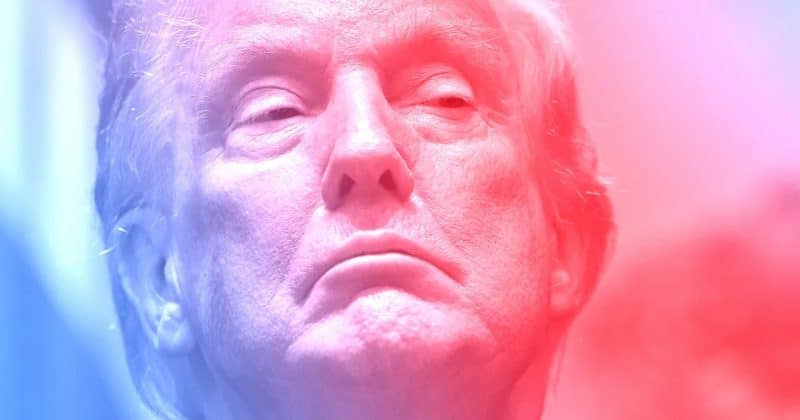
Donald Trump’s Liberation Day tariffs trigger market turmoil across stocks and crypto

Donald Trump’s Liberation Day tariffs trigger market turmoil across stocks and crypto

Bitcoin's drop below $82K during the tariff selloff shattered the digital gold narrative, at least temporarily

On April 2, 2025, President Donald Trump stepped up to a podium and declared it “Liberation Day” for American trade. A sweeping 10% baseline tariff on nearly all imports, paired with elevated reciprocal duties on dozens of countries, sent global markets into a tailspin that erased trillions in shareholder value within days.

Major stock indices plunged more than 10% in the immediate aftermath. Bitcoin, the asset that crypto evangelists have long pitched as a hedge against exactly this kind of chaos, dropped below $82,000.

The tariff shock and its fallout

The 10% universal tariff was just the baseline. China got hit hardest, with tariffs eventually ratcheted up to 125%.

Advertisement

Bitcoin’s slide below $82,000 was particularly notable. Instead of decoupling from equities, crypto assets demonstrated strong correlation with traditional risk assets. Investors fleeing uncertainty weren’t rotating into Bitcoin. They were rotating into cash, Treasuries, and anything that didn’t have the word “volatile” in its description.

The 90-day pause that launched a thousand green candles

By April 9, Trump announced a 90-day pause on the majority of the elevated tariffs. China was notably excluded from the reprieve, keeping its 125% rate intact.

The S&P 500 surged 9.52% in a single session, its largest daily gain since 2008.

Crypto markets bounced too, though Bitcoin was trading as a leveraged bet on macro sentiment. Every tariff-related headline, whether an escalation with China or a hint of negotiation, moved crypto prices.

The real economic damage

Roughly 90,000 manufacturing jobs were reportedly lost as a result of the tariff regime in the year following Liberation Day. Consumer prices trended persistently higher as the cost of imported goods filtered through supply chains.

What this means for crypto investors

The correlation between Bitcoin and equities during stress events has implications for portfolio construction. If crypto moves in the same direction as stocks during a selloff, it doesn’t provide the diversification benefit that many allocators assumed.

Subsequent adjustments to the tariff regime and related court decisions continued to inject volatility into both traditional and crypto markets for months after Liberation Day.

Disclosure: This article was edited by Editorial Team. For more information on how we create and review content, see our Editorial Policy.

Donald Trump’s Liberation Day tariffs trigger market turmoil across stocks and crypto

Donald Trump’s Liberation Day tariffs trigger market turmoil across stocks and crypto

Bitcoin's drop below $82K during the tariff selloff shattered the digital gold narrative, at least temporarily

On April 2, 2025, President Donald Trump stepped up to a podium and declared it “Liberation Day” for American trade. A sweeping 10% baseline tariff on nearly all imports, paired with elevated reciprocal duties on dozens of countries, sent global markets into a tailspin that erased trillions in shareholder value within days.

Major stock indices plunged more than 10% in the immediate aftermath. Bitcoin, the asset that crypto evangelists have long pitched as a hedge against exactly this kind of chaos, dropped below $82,000.

The tariff shock and its fallout

The 10% universal tariff was just the baseline. China got hit hardest, with tariffs eventually ratcheted up to 125%.

Advertisement

Bitcoin’s slide below $82,000 was particularly notable. Instead of decoupling from equities, crypto assets demonstrated strong correlation with traditional risk assets. Investors fleeing uncertainty weren’t rotating into Bitcoin. They were rotating into cash, Treasuries, and anything that didn’t have the word “volatile” in its description.

The 90-day pause that launched a thousand green candles

By April 9, Trump announced a 90-day pause on the majority of the elevated tariffs. China was notably excluded from the reprieve, keeping its 125% rate intact.

The S&P 500 surged 9.52% in a single session, its largest daily gain since 2008.

Crypto markets bounced too, though Bitcoin was trading as a leveraged bet on macro sentiment. Every tariff-related headline, whether an escalation with China or a hint of negotiation, moved crypto prices.

The real economic damage

Roughly 90,000 manufacturing jobs were reportedly lost as a result of the tariff regime in the year following Liberation Day. Consumer prices trended persistently higher as the cost of imported goods filtered through supply chains.

What this means for crypto investors

The correlation between Bitcoin and equities during stress events has implications for portfolio construction. If crypto moves in the same direction as stocks during a selloff, it doesn’t provide the diversification benefit that many allocators assumed.

Subsequent adjustments to the tariff regime and related court decisions continued to inject volatility into both traditional and crypto markets for months after Liberation Day.

Disclosure: This article was edited by Editorial Team. For more information on how we create and review content, see our Editorial Policy.