
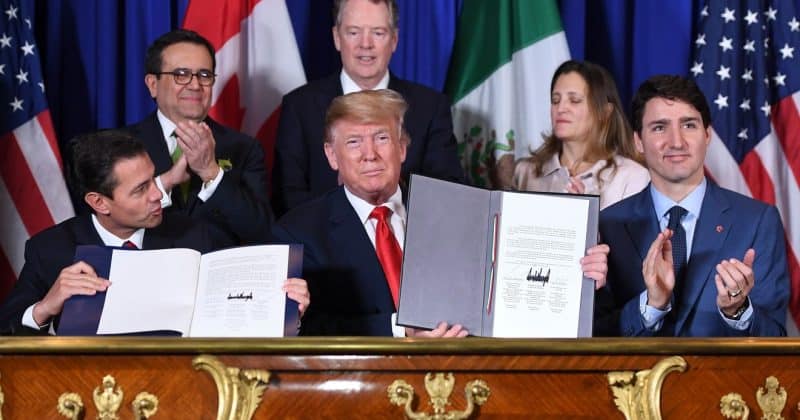
Trump rejects reauthorization of US trade deal with Canada and Mexico
The USMCA, governing roughly $1.8 trillion in annual trilateral trade, faces an uncertain future as the White House pushes for bilateral renegotiations instead of a 16-year renewal.
President Donald Trump has announced he will not reauthorize the United States-Mexico-Canada Agreement in its current form, throwing the cornerstone of North American trade into serious jeopardy just weeks before the agreement’s first mandated review.
The USMCA, which replaced NAFTA and took effect on July 1, 2020, governs approximately $1.8 trillion in annual trilateral trade between the three countries. Instead of supporting a straightforward 16-year extension, the Trump administration is pushing for separate bilateral negotiations with each partner.
What’s actually happening with the USMCA
The USMCA carries a 16-year term but includes a mandated six-year joint review, the first of which is scheduled for July 2026.
On June 1, 2026, Canada formally requested the full 16-year renewal, viewing the extension as critical protection against broader US tariffs.
US Trade Representative Jamieson Greer signaled in early June 2026 that a straightforward renewal is not on the table. The administration’s preferred approach involves breaking the trilateral framework into bilateral tracks, with annual reviews beginning in 2027. If the three parties cannot reach consensus through this process, the agreement could effectively dissolve by 2036.
This represents the inaugural use of the modernization clauses that were built into the USMCA when it was first negotiated. Those clauses were designed to address evolving issues in labor standards, automotive manufacturing, and digital trade.
The news moving money, markets, and the world—before your day starts.
Daily. Free. Join 34,000+ readers across crypto, finance, and policy.
Why the shift matters beyond trade policy
Experts from institutions like the Center for Strategic and International Studies and the Brookings Institution have warned that failure to renew the agreement as anticipated could result in welfare losses for all three countries.
The sectors most directly in the crosshairs are automotive manufacturing, agriculture, and general manufacturing. Under USMCA, vehicles must meet specific regional content requirements to qualify for tariff-free treatment. A shift to bilateral negotiations, with potentially different rules for Canadian versus Mexican content, could force automakers to restructure supply chains that took years and billions of dollars to build.
What this means for investors
There has been no mention of digital assets or blockchain technology in any of the review discussions, which have focused squarely on traditional sectors.
Investors with exposure to North American manufacturing, agriculture, or automotive stocks should be watching the July 2026 review closely. The gap between Canada’s request for a full 16-year extension and the US preference for annual bilateral reviews is wide enough to drive meaningful volatility.
The agreement’s structure gives all parties until 2036 before a full expiration under the worst-case scenario.