
Ukraine targets Russian supply lines with AI-guided drones in ‘Logistics Lockdown’ campaign
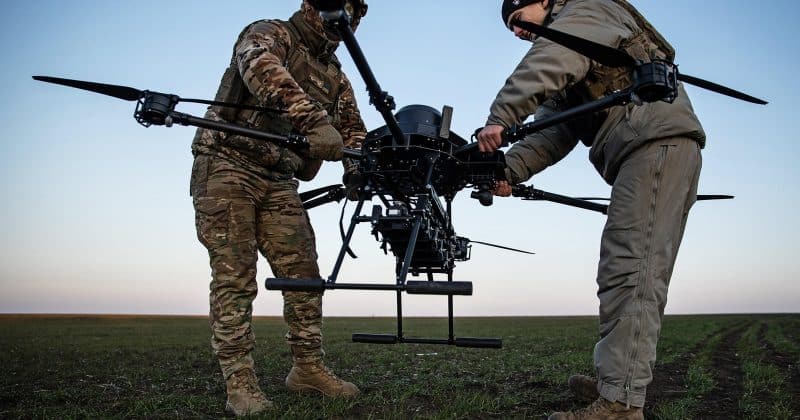
Low-cost Hornet kamikaze drones backed by former Google CEO Eric Schmidt are striking fuel tankers, convoys, and rail infrastructure up to 150 km behind enemy lines
Ukraine has shifted from simply holding territory to systematically dismantling the infrastructure that keeps Russian forces supplied. The weapon of choice: AI-guided kamikaze drones cheap enough to deploy in swarms, smart enough to find their own targets.
The campaign, dubbed “Logistics Lockdown,” represents a strategic evolution in how Ukraine is prosecuting the war. Rather than trading artillery shells at the front line, Ukraine is reaching deep into occupied territory to hit the trucks, trains, and fuel depots that keep the Russian military machine running.
The Hornet and the hive mind behind it
At the center of the campaign is the Hornet, a kamikaze drone developed by Swift Beat LLC, a US company that announced its partnership with Ukraine in July 2025. The company’s most notable backer is former Google CEO Eric Schmidt, who has increasingly positioned himself at the intersection of Silicon Valley and modern warfare.
These drones are purpose-built for autonomous strike missions, capable of hitting targets as far as 150 km behind the front lines, reaching supply hubs that commanders previously considered safely out of range of Ukraine’s cheaper weapons.
What makes the Hornet genuinely different from earlier drone generations is its AI-powered terminal guidance system. The targeting software was trained on four years’ worth of video footage depicting Russian military assets, footage accumulated across the entire duration of the conflict. That gives the drones the ability to autonomously identify and home in on specific target types like fuel tankers and truck convoys.
The cost per unit ranges from $6,000 to $12,000, depending on configuration. For context, a single Russian fuel tanker carries supplies worth orders of magnitude more than the drone destroying it.
Macro, rates, and crypto—what moved markets and what matters next.
Daily. Free. Join 34,000+ readers across crypto, finance, and policy.
Quadrupled strikes and Starlink integration
Between February and April 2026, Ukraine’s mid-range strikes reportedly quadrupled. That’s not a marginal increase. That’s a fundamental change in operational tempo.
One of the key enablers has been Starlink integration. The satellite communication system provides resilient data links that allow drone operators, or the drones themselves, to maintain connectivity even in environments saturated with Russian electronic warfare measures.
The target list reads like a logistics officer’s nightmare: fuel tankers, truck convoys, rail infrastructure, and supply depots. Each category represents a different chokepoint in Russia’s supply chain. Destroy enough fuel tankers and armored vehicles run dry. Hit rail junctions and ammunition has to travel by road, where it’s even more vulnerable. Take out depots and you eliminate the buffer stocks that allow sustained operations.
Eric Schmidt’s defense pivot and the Silicon Valley pipeline
Schmidt’s involvement in Swift Beat is part of a broader trend of tech billionaires moving into defense technology. The former Google chief has been vocal about the need for the US and its allies to maintain technological superiority, particularly in AI applications.
The Hornet program also illustrates how the defense-tech pipeline has shortened dramatically. The combination of cheaper compute, better AI models, and a massive real-world training dataset from the conflict itself has compressed development timelines in ways that traditional defense procurement simply doesn’t accommodate.
What this means for the defense landscape
The fourfold increase in strike tempo between February and April 2026 signals that production and deployment are scaling, not just proving concept. A $6,000 to $12,000 drone that can autonomously destroy a multi-million-dollar target challenges the entire cost calculus of modern warfare.