
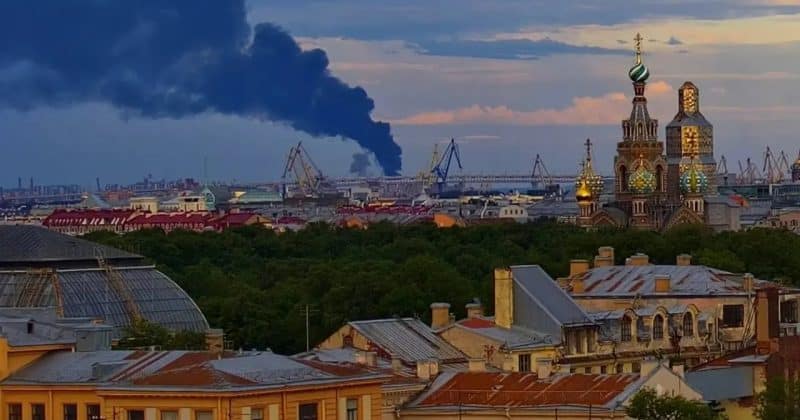
Ukrainian drones strike St. Petersburg oil terminal hours before Russia’s showcase economic forum
A long-range drone attack on one of Russia's largest oil export facilities adds a new chapter to Ukraine's campaign targeting energy infrastructure
Ukraine’s long-range drone program just reached St. Petersburg, and the timing could not have been more pointed. Overnight on June 3, 2026, Ukrainian drones struck the Petersburg Oil Terminal, one of Russia’s largest oil export hubs, setting off a fire visible across the city skyline. The attack landed just hours before the opening of the St. Petersburg International Economic Forum, the annual event where Vladimir Putin typically hosts world leaders and foreign investors to project an image of Russian economic resilience.
What happened and how far those drones flew
The drones traveled over 1,000 kilometers from Ukrainian territory to reach their target, a distance roughly equivalent to flying from London to Warsaw. Ukrainian President Volodymyr Zelenskyy confirmed the strike publicly, also noting that the Kronstadt naval base was included in the overnight operation. Russian air defenses reported intercepting 59 Ukrainian drones, though the terminal fire confirmed at least some got through. No fatalities were reported from the oil terminal fire itself.
This strike fits into a broader pattern Ukraine has pursued throughout 2026. Ukrainian forces targeted 15 Russian oil refineries earlier in the year, a systematic effort to erode the revenue streams that fund Russia’s military operations.
Why energy infrastructure is the strategic target of choice
The choice of the Petersburg Oil Terminal is particularly notable because St. Petersburg is not a front-line city. It sits in northwestern Russia, far from the conflict zone in the south and east. Reaching it required drones capable of navigating hundreds of kilometers of Russian airspace, which signals a meaningful expansion in Ukrainian operational range and capability. The fact that 59 drones were reportedly intercepted also tells you something: Russia scrambled significant air defense resources, and the terminal still burned.
The news moving money, markets, and the world—before your day starts.
Daily. Free. Join 34,000+ readers across crypto, finance, and policy.
The SPIEF timing adds a layer that is impossible to ignore. Russia uses the forum annually as a soft-power instrument, a stage for Putin to invite foreign executives and signal that the Russian economy is open, stable, and investable despite Western sanctions. Having the host city’s skyline filled with smoke from a burning oil terminal on opening day is the kind of optic that no amount of official messaging can fully offset.
What this means for energy markets and crypto-adjacent assets
For crypto markets, the connection is indirect but not trivial. Bitcoin and broader digital assets have increasingly traded with a correlation to macro risk sentiment. Energy-linked tokens and projects tied to commodity markets are more directly exposed. Any sustained rally in oil prices driven by supply-side disruption creates a specific kind of market environment: inflation-adjacent, uncertainty-heavy, and historically associated with investors rotating toward hard-asset proxies.
What traders should watch is whether this attack is a one-off headline event or represents an escalation in the frequency and geographic reach of Ukrainian strikes on Russian infrastructure. A pattern of successful long-range strikes against facilities this far inside Russian territory would represent a genuine shift in the conflict’s character, one that European energy markets, already sensitive to Russia-related supply risk, would need to reprice.