
Nexo Earn with Nexo
US goods trade deficit narrows to $82.4B in April as exports surge

US goods trade deficit narrows to $82.4B in April as exports surge

A 4% jump in exports outpaced import growth, shrinking the trade gap by nearly $3 billion from March's revised figures.

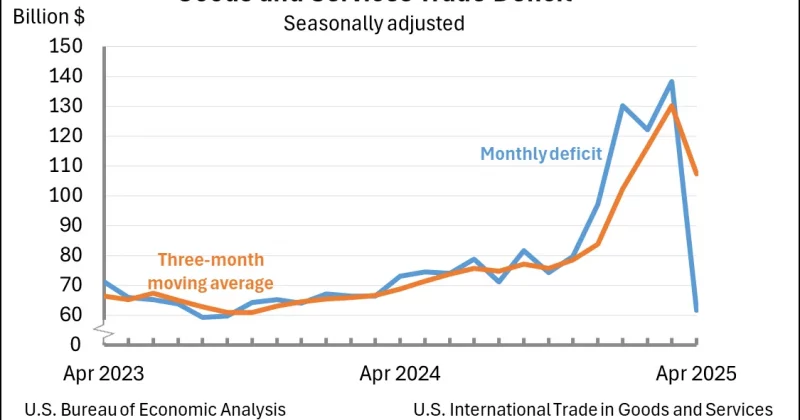
The US goods trade deficit came in at $82.4 billion in April, down from a revised $85.3 billion in March, according to Census Bureau data released on May 29. That’s a roughly $3 billion improvement in a single month, driven almost entirely by exports growing faster than imports.

Exports climbed 4% to $219.7 billion, while imports rose a more modest 1.9% to $302.1 billion.

The numbers in context

To appreciate why this matters, look at the trajectory. March’s goods deficit was originally pegged somewhere in the $87 billion to $88 billion range before being revised down to $85.3 billion. February came in at $83.5 billion.

Advertisement

Year-over-year, the reduction stands at about 24% through early 2026, a meaningful shift for an economy that has historically run massive trade gaps.

The export gains were led by capital goods, industrial supplies, and consumer goods. Retail and wholesale inventories also increased in April, which signals that businesses are stocking up rather than running lean.

The 2025 tariff regime continues to cast a long shadow over trade data. When tariffs went into effect, the initial response was a rush to front-load imports before new duties kicked in. That artificially inflated the deficit in earlier periods.

The full goods and services trade balance data is scheduled for release on June 9. That report will provide a more complete picture of America’s trade position.

What this means for investors

For traditional markets, a narrowing trade deficit tends to be dollar-positive. When America exports more relative to imports, foreign buyers need more dollars to purchase those goods, which creates upward pressure on the currency.

For crypto markets, Bitcoin and other digital assets are often framed as hedges against fiat currency weakness. If the dollar strengthens on the back of improving trade fundamentals, that hedge thesis becomes less compelling in the short term.

The June 9 release will be the next major catalyst. Traders should watch for revisions to April’s preliminary numbers as well, since March’s original estimates were revised down by roughly $2 billion to $3 billion.

Disclosure: This article was edited by Editorial Team. For more information on how we create and review content, see our Editorial Policy.

US goods trade deficit narrows to $82.4B in April as exports surge

US goods trade deficit narrows to $82.4B in April as exports surge

A 4% jump in exports outpaced import growth, shrinking the trade gap by nearly $3 billion from March's revised figures.

The US goods trade deficit came in at $82.4 billion in April, down from a revised $85.3 billion in March, according to Census Bureau data released on May 29. That’s a roughly $3 billion improvement in a single month, driven almost entirely by exports growing faster than imports.

Exports climbed 4% to $219.7 billion, while imports rose a more modest 1.9% to $302.1 billion.

The numbers in context

To appreciate why this matters, look at the trajectory. March’s goods deficit was originally pegged somewhere in the $87 billion to $88 billion range before being revised down to $85.3 billion. February came in at $83.5 billion.

Advertisement

Year-over-year, the reduction stands at about 24% through early 2026, a meaningful shift for an economy that has historically run massive trade gaps.

The export gains were led by capital goods, industrial supplies, and consumer goods. Retail and wholesale inventories also increased in April, which signals that businesses are stocking up rather than running lean.

The 2025 tariff regime continues to cast a long shadow over trade data. When tariffs went into effect, the initial response was a rush to front-load imports before new duties kicked in. That artificially inflated the deficit in earlier periods.

The full goods and services trade balance data is scheduled for release on June 9. That report will provide a more complete picture of America’s trade position.

What this means for investors

For traditional markets, a narrowing trade deficit tends to be dollar-positive. When America exports more relative to imports, foreign buyers need more dollars to purchase those goods, which creates upward pressure on the currency.

For crypto markets, Bitcoin and other digital assets are often framed as hedges against fiat currency weakness. If the dollar strengthens on the back of improving trade fundamentals, that hedge thesis becomes less compelling in the short term.

The June 9 release will be the next major catalyst. Traders should watch for revisions to April’s preliminary numbers as well, since March’s original estimates were revised down by roughly $2 billion to $3 billion.

Disclosure: This article was edited by Editorial Team. For more information on how we create and review content, see our Editorial Policy.