
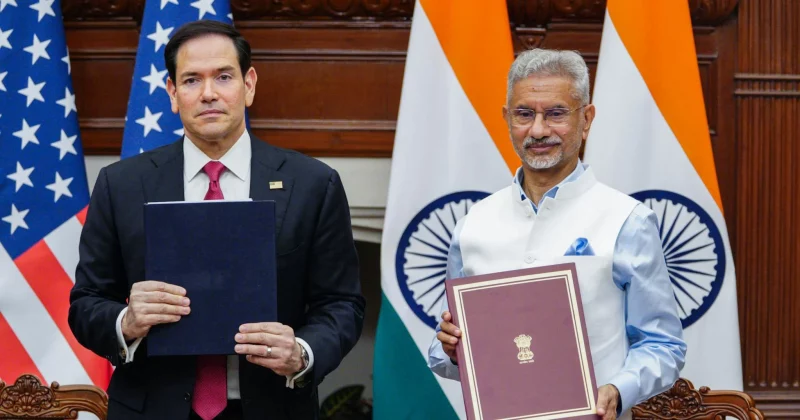
US and India sign critical minerals framework to enhance supply chains
The bilateral agreement targets diversification away from China's dominance in rare earth mining and processing.
The United States and India have formalized a bilateral Critical Minerals Framework, aimed at reducing both nations’ dependence on single-source suppliers for the rare earth elements and minerals that power everything from electric vehicle batteries to semiconductor chips.
The agreement was signed in New Delhi by US Secretary of State Marco Rubio and Indian External Affairs Minister S. Jaishankar during the Quad Foreign Ministers’ meeting. Its full title, the “Framework on Securing of Supply in the Mining and Processing of Critical Minerals and Rare Earths,” tells you pretty much everything about the strategic intent.
What the framework actually covers
The agreement promotes joint efforts across the entire critical minerals value chain: mining, processing, recycling, and investment. The goal is to build supply chains resilient enough to withstand geopolitical disruptions, which is a diplomatic way of saying “less reliant on China.”
China controls over 60% of global mining for rare earths and more than 85% of refining capacity for certain rare earth categories. The framework specifically addresses vulnerabilities tied to what officials have described as single-source monopolies and coercive market practices.
The framework builds on a memorandum of understanding that the two countries signed in October 2024 on critical mineral supply chains.
Macro, rates, and crypto—what moved markets and what matters next.
Daily. Free. Join 34,000+ readers across crypto, finance, and policy.
The Quad connection
A parallel Quad critical minerals framework was also discussed at the meeting, linking this bilateral deal to the broader Indo-Pacific strategy shared by the US, India, Japan, and Australia.
India brings significant geological potential to this partnership. The country has substantial reserves of rare earth minerals, lithium deposits identified in recent geological surveys, and a labor force capable of scaling mining and processing operations. What India has historically lacked is the investment capital and technology transfer to develop those resources at scale. This framework is designed to address exactly that gap.
What this means for investors
There’s a risk worth watching. Mining and processing infrastructure takes years to build. The framework signals intent, not immediate capacity. These projects require permitting, environmental reviews, infrastructure development, and massive capital expenditure before a single ton of refined material reaches the market.