
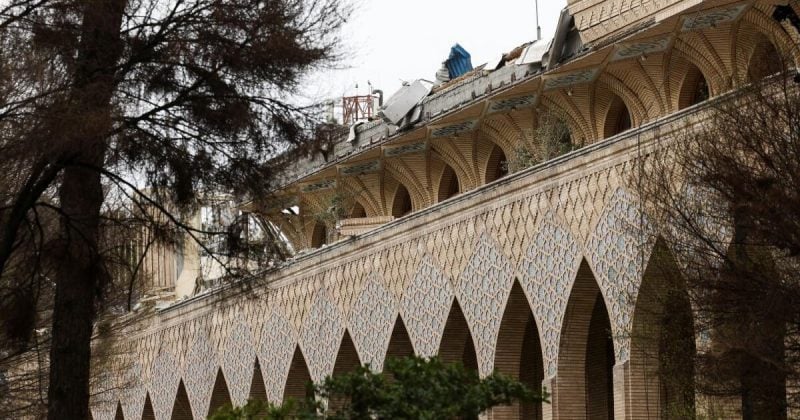
US and Israel air campaign causes damage to historic buildings in Iran

US and Israel air campaign causes damage to historic buildings in Iran

UNESCO confirms collateral damage to World Heritage sites as 'Epic Fury' strikes hit over 100 cultural locations across twelve provinces

Ancient domes cracked. Museum floors shattered. Ceilings that survived centuries of earthquakes, invasions, and revolutions buckled under the pressure waves of modern precision munitions.

The US-Israeli air campaign against Iran, which began on February 28, 2026, has inflicted significant damage on some of the country’s most treasured cultural heritage sites. The coordinated military operation, dubbed ‘Epic Fury,’ was aimed at Iranian military targets, but the collateral toll on irreplaceable historical architecture is becoming impossible to ignore.

The scope of the damage

Iranian officials report that between 108 and 120 cultural locations have been impacted across twelve provinces. That includes at least 34 museums.

Advertisement

Among the most prominent casualties is the Golestan Palace in Tehran, which sustained severe damage around March 2. The palace complex, a UNESCO World Heritage Site, dates back to the 16th century and served as the seat of the Qajar dynasty.

Isfahan was hit particularly hard. The 17th-century Chehel Sotoun Palace, famous for its slender wooden columns and elaborate frescoes depicting court scenes and battles, sustained damage. So did the ancient Masjed-e Jame mosque, a structure that represents over a thousand years of continuous Islamic architectural evolution.

UNESCO has confirmed the impacts on multiple World Heritage sites as of early March 2026 and expressed what it described as “deep concern.” The organization had previously identified and shared the coordinates of protected cultural sites with relevant parties, a standard practice intended to prevent exactly this kind of outcome.

Why cultural heritage destruction matters beyond sentiment

Cultural heritage sites are protected under international law for a reason. The 1954 Hague Convention for the Protection of Cultural Property in the Event of Armed Conflict, along with its protocols, establishes legal obligations for belligerents to avoid damage to cultural sites whenever militarily feasible.

There is also the question of reconstruction. Persian architectural techniques, particularly the intricate tile work and muqarnas vaulting found in sites like Isfahan’s historic mosques, require specialized artisanal knowledge that is increasingly rare. Some of what has been damaged may be functionally irreplaceable, even if the buildings themselves can be structurally restored.

What investors should watch

Here’s the thing: this story has no direct crypto market angle. There is no token tied to Iranian cultural preservation, no DeFi protocol exposed to Middle Eastern geopolitical risk in a measurable way, and no on-chain data suggesting traders are positioning around heritage destruction narratives.

Sanctions are the most direct transmission mechanism. Any expansion of sanctions related to the conflict could push more economic activity toward crypto rails, as has happened repeatedly in previous sanctions regimes involving Iran, Russia, and North Korea. Conversely, tighter enforcement of existing sanctions could increase regulatory scrutiny on exchanges and DeFi protocols that facilitate cross-border transfers.

Disclosure: This article was edited by Editorial Team. For more information on how we create and review content, see our Editorial Policy.

US and Israel air campaign causes damage to historic buildings in Iran

US and Israel air campaign causes damage to historic buildings in Iran

UNESCO confirms collateral damage to World Heritage sites as 'Epic Fury' strikes hit over 100 cultural locations across twelve provinces

Ancient domes cracked. Museum floors shattered. Ceilings that survived centuries of earthquakes, invasions, and revolutions buckled under the pressure waves of modern precision munitions.

The US-Israeli air campaign against Iran, which began on February 28, 2026, has inflicted significant damage on some of the country’s most treasured cultural heritage sites. The coordinated military operation, dubbed ‘Epic Fury,’ was aimed at Iranian military targets, but the collateral toll on irreplaceable historical architecture is becoming impossible to ignore.

The scope of the damage

Iranian officials report that between 108 and 120 cultural locations have been impacted across twelve provinces. That includes at least 34 museums.

Advertisement

Among the most prominent casualties is the Golestan Palace in Tehran, which sustained severe damage around March 2. The palace complex, a UNESCO World Heritage Site, dates back to the 16th century and served as the seat of the Qajar dynasty.

Isfahan was hit particularly hard. The 17th-century Chehel Sotoun Palace, famous for its slender wooden columns and elaborate frescoes depicting court scenes and battles, sustained damage. So did the ancient Masjed-e Jame mosque, a structure that represents over a thousand years of continuous Islamic architectural evolution.

UNESCO has confirmed the impacts on multiple World Heritage sites as of early March 2026 and expressed what it described as “deep concern.” The organization had previously identified and shared the coordinates of protected cultural sites with relevant parties, a standard practice intended to prevent exactly this kind of outcome.

Why cultural heritage destruction matters beyond sentiment

Cultural heritage sites are protected under international law for a reason. The 1954 Hague Convention for the Protection of Cultural Property in the Event of Armed Conflict, along with its protocols, establishes legal obligations for belligerents to avoid damage to cultural sites whenever militarily feasible.

There is also the question of reconstruction. Persian architectural techniques, particularly the intricate tile work and muqarnas vaulting found in sites like Isfahan’s historic mosques, require specialized artisanal knowledge that is increasingly rare. Some of what has been damaged may be functionally irreplaceable, even if the buildings themselves can be structurally restored.

What investors should watch

Here’s the thing: this story has no direct crypto market angle. There is no token tied to Iranian cultural preservation, no DeFi protocol exposed to Middle Eastern geopolitical risk in a measurable way, and no on-chain data suggesting traders are positioning around heritage destruction narratives.

Sanctions are the most direct transmission mechanism. Any expansion of sanctions related to the conflict could push more economic activity toward crypto rails, as has happened repeatedly in previous sanctions regimes involving Iran, Russia, and North Korea. Conversely, tighter enforcement of existing sanctions could increase regulatory scrutiny on exchanges and DeFi protocols that facilitate cross-border transfers.

Disclosure: This article was edited by Editorial Team. For more information on how we create and review content, see our Editorial Policy.