
US, Japan, and South Korea team up to export small modular reactors and reshape global energy
A trilateral memorandum signed at the NATO summit puts SMR technology at the center of Indo-Pacific energy strategy
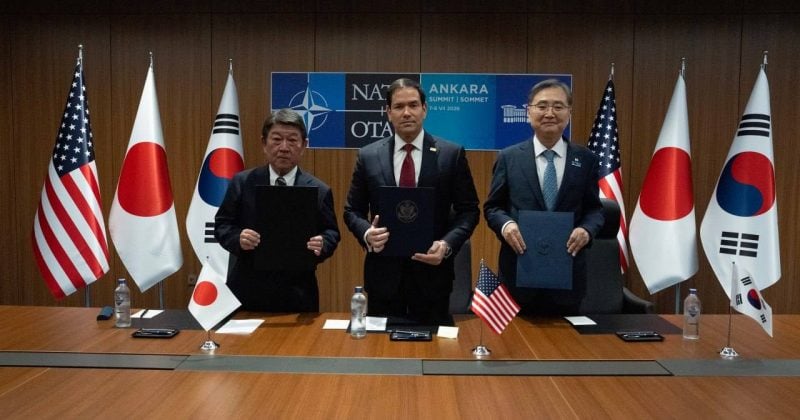
Three of the world’s most technologically advanced democracies just decided that the best way to win friends in the Indo-Pacific is to offer them a reliable power grid. During the NATO summit in Ankara on July 7-8, 2026, US Secretary of State Marco Rubio, Japan’s Foreign Minister Toshimitsu Motegi, and South Korea’s Foreign Minister Cho Hyun signed a Memorandum of Cooperation focused on deploying small modular reactors in third countries.
What the three countries actually agreed to do
The MOC is a division-of-labor arrangement that plays to each country’s existing strengths rather than duplicating effort. The US leads on reactor design. Japan brings heavy manufacturing components and advanced engineering. South Korea contributes construction speed and battle-tested supply chains, having built reactors abroad faster and cheaper than almost anyone else.
The US backed up the handshake with money. Washington committed over $10 million to the State Department’s FIRST program, which stands for Foundational Infrastructure for Responsible Use of Small Modular Reactor Technology. The program provides technical assistance and training to countries looking to stand up nuclear infrastructure for the first time.
One concrete partnership already embedded in this framework is a collaboration between Samsung C&T and GE Vernova Hitachi targeting the BWRX-300 reactor design, one of the more commercially mature SMR models currently in development.
Why SMRs, and why now
Small modular reactors are, as the name suggests, smaller than conventional nuclear plants and designed to be factory-built and shipped to site rather than constructed entirely on location. The pitch is lower upfront cost, faster deployment, and the ability to scale by adding units rather than building a massive facility all at once.
Global electricity demand is climbing fast, driven largely by the infrastructure requirements of artificial intelligence. Data centers running large language models and training compute need 24/7 baseload power, the kind that solar panels and wind turbines cannot reliably provide on their own. Industry projections cited in the agreement anticipate conditional power purchase agreements scaling from 25 gigawatts to 45 gigawatts in capacity.
The news moving money, markets, and the world—before your day starts.
Daily. Free. Join 34,000+ readers across crypto, finance, and policy.
The real competition this agreement is designed to win
Russia’s Rosatom and Chinese state-owned nuclear enterprises have spent the last decade aggressively marketing reactor technology to developing countries, often bundling financing, construction, and fuel supply into a single long-term package. The US-Japan-South Korea trilateral is explicitly designed to offer an alternative. Countries that want nuclear power without the geopolitical strings attached now have a credible option backed by three allied governments with strong nonproliferation track records.
The FIRST program funding reinforces that framing. Technical assistance and training programs build long-term relationships between recipient countries and US institutions, creating ties that outlast any single infrastructure project.
What investors and energy markets should watch
The Samsung C&T and GE Vernova Hitachi partnership on the BWRX-300 is worth following as a bellwether. If that collaboration produces a deployed reactor in a third country within a competitive timeframe and budget, it validates the entire trilateral framework and opens the door to a pipeline of follow-on projects across the region.
The gap between 25 gigawatts and 45 gigawatts in conditional power purchase agreements is a significant addressable market. SMRs are not the only technology competing to fill that gap. Natural gas, utility-scale batteries, and geothermal are all in the mix.
Both Rosatom and Chinese suppliers have shown willingness to offer financing terms and construction timelines that Western projects have historically struggled to match. The trilateral partnership’s answer to that challenge is quality, safety standards, and nonproliferation assurances.