
Valar Atomics’ Ward 250 reactor achieves criticality milestone
The venture-backed startup hit a self-sustaining nuclear chain reaction, beating its DOE target by months and signaling a new era for microreactor technology
Valar Atomics just did something no venture-backed nuclear startup has done before. Its Ward 250 microreactor reached criticality on March 31, 2026, achieving a self-sustaining nuclear chain reaction in what amounts to the first full-scale reactor to hit that benchmark under the US Department of Energy’s accelerated pilot program.
In English: the reactor can now sustain a nuclear chain reaction on its own, which is the foundational step before a reactor can actually generate power. Think of it as the nuclear equivalent of an engine turning over for the first time. Everything before this was theory and testing. Now it’s real.
From stealth to criticality in record time
The timeline here is genuinely staggering. Valar Atomics emerged from stealth in early 2025 under CEO Isaiah Taylor. The company broke ground on the Ward 250 project on September 17, 2025, after completing a non-nuclear prototype called Ward Zero in February of that year.
By November 17, 2025, Valar had validated its core physics models through a cold criticality test of a subscale NOVA Core model at Los Alamos National Laboratory. That test essentially proved the math worked. The March 31 milestone proved the hardware works too.
The DOE’s Nuclear Reactor Pilot Program had set a criticality target of July 4, 2026. Valar beat that deadline by more than three months. The company is now targeting power operations ahead of that Independence Day date, which would mean going from groundbreaking to generating electricity in under ten months.
For context, traditional nuclear projects measure timelines in decades, not months. The much-discussed Vogtle Units 3 and 4 in Georgia took roughly 14 years from initial license application to commercial operation.
Macro, rates, and crypto—what moved markets and what matters next.
Daily. Free. Join 34,000+ readers across crypto, finance, and policy.
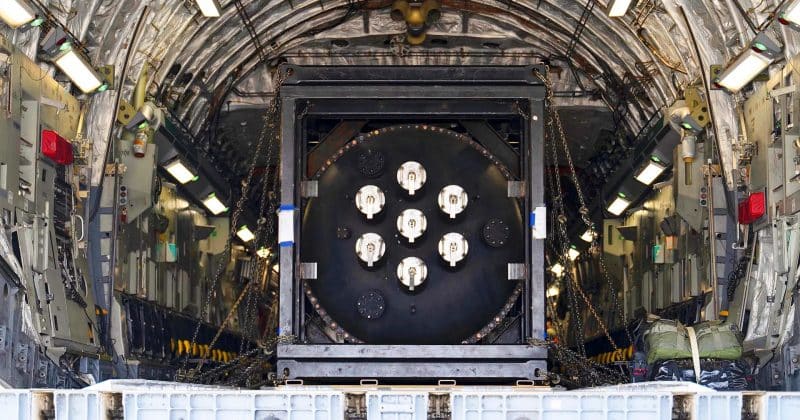
In February 2026, Valar airlifted Ward 250 reactor components to Utah using a C-17 military transport aircraft. The whole point of a microreactor is that you can move it. Traditional nuclear plants are massive, site-specific infrastructure projects. Valar is building something closer to a product than a construction project.
The money and the machine
The company raised a $19 million seed round in February 2025. By November 2025, that had grown to a $130 million round. Then in March 2026, Valar closed a massive $450 million raise at a $2 billion valuation.
The Ward 250 itself is a helium-cooled high-temperature gas reactor, or HTGR. It uses TRISO fuel, which consists of uranium particles coated in multiple layers of ceramic and carbon. The graphite-moderated design is engineered for high temperatures, making it suitable not just for electricity but also for industrial heat applications.
TRISO fuel is considered one of the most robust nuclear fuel forms ever developed. Each particle is essentially its own containment system, which is a meaningful safety feature for a reactor designed to be transported and deployed rapidly in varied locations.
Valar has partnered with Kiewit, one of the largest construction and engineering firms in North America, along with the San Rafael Energy Lab.