
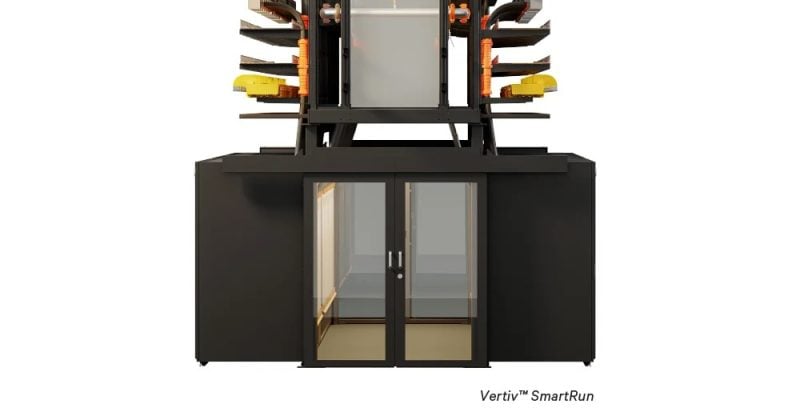
Vertiv and Nvidia advance AI factory design with SmartRun integration
Vertiv and Nvidia have teamed up to build converged physical infrastructure for the next generation of AI factories, combining Vertiv’s prefabricated power and cooling systems with Nvidia’s digital twin simulation platform. The result is a system designed to let data center operators model, test, and optimize massive AI deployments before breaking ground.
The collaboration centers on Nvidia’s Vera Rubin DSX AI factory reference design and the Nvidia Omniverse DSX Blueprint. Vertiv is contributing DSX SimReady digital models of its advanced power and cooling hardware, enabling real-time simulation of AI factory layouts inside Nvidia’s Omniverse environment.
What Vertiv is actually building
At the heart of this announcement is the Vertiv SmartRun system, a prefabricated overhead solution that bundles power distribution and liquid cooling into a single modular package. Instead of threading separate power and cooling infrastructure through a facility piece by piece, SmartRun delivers it all in one integrated unit.
The system supports high-density AI workloads of up to 600 kW per rack. For context, a typical enterprise server rack draws somewhere in the range of 10 to 20 kW. AI GPU racks are an entirely different animal, and 600 kW per rack reflects the absurd thermal and electrical appetite of next-generation AI compute clusters.
Vertiv is also introducing what it calls OneCore Rubin DSX integrated infrastructure. This is the company’s tailored infrastructure package specifically designed around Nvidia’s Vera Rubin architecture, aimed at enabling faster and lower-risk deployments at gigawatt scale.
The news moving money, markets, and the world—before your day starts.
Daily. Free. Join 34,000+ readers across crypto, finance, and policy.
The digital twin angle
By creating DSX SimReady digital models of Vertiv’s power and cooling hardware, engineers can run real-time simulations of entire AI factory layouts inside a virtual environment. They can stress-test thermal performance, identify airflow chokepoints, and model failure scenarios, all before a single physical component gets installed.
The modular nature of SmartRun also plays into this. Because the system is prefabricated and standardized, its digital model can be replicated and rearranged in simulation with high accuracy. Operators can experiment with different rack configurations, cooling topologies, and power distribution schemes without the cost of physical prototyping.
Why this matters for investors
Vertiv, which trades on the NYSE under the ticker VRT, is positioning itself as the go-to infrastructure partner for this buildout. Schneider Electric has also been collaborating with Nvidia on similar reference architectures. Vertiv’s SmartRun approach, combining power and cooling into a single prefabricated overhead solution, offers a differentiation angle centered on deployment speed.
The gigawatt-scale reference architectures that underpin this announcement were initially introduced in late 2025. This latest collaboration extends that work by adding the simulation and digital twin layer, which reduces deployment risk for operators building at scale.