
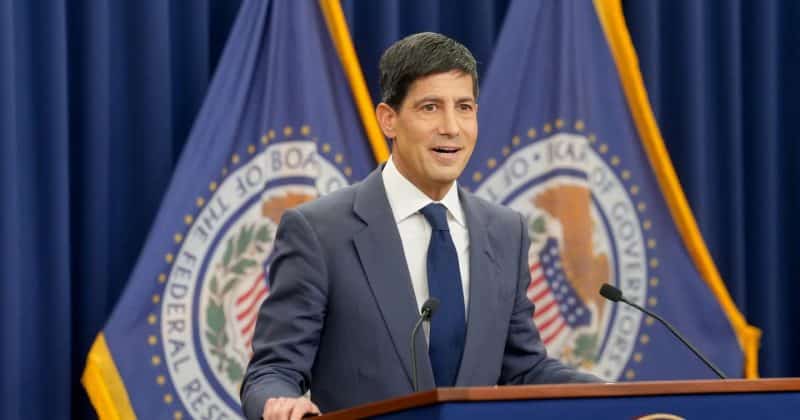
Kevin Warsh’s first Fed meeting sends gold, silver, and Bitcoin tumbling
The new Fed chair's hawkish debut lifted the dollar and dragged down every non-yielding asset in sight
Kevin Warsh’s inaugural FOMC meeting as Federal Reserve Chair did exactly what markets feared it would. Gold, silver, and Bitcoin all slid as the dollar surged on fresh expectations that interest rates could actually go up before the year is out.
The June 17 meeting kept the federal funds rate parked at 3.50% to 3.75%, which was widely expected. What wasn’t priced in was the dramatic shift in the Fed’s own projections: nine out of nineteen officials now forecast at least one rate hike by the end of 2026, pushing the median year-end rate outlook from 3.4% to 3.8%.
Bitcoin takes the hit
Bitcoin had been trading around $66K heading into the meeting. By the time Warsh’s hawkish messaging settled in, it had retreated to a range between $64,800 and $65,300. A roughly $1,200 drop doesn’t sound catastrophic on its own, but the speed and catalyst matter more than the magnitude here.
The move underscored something crypto traders already know but occasionally forget: Bitcoin remains deeply sensitive to Federal Reserve policy signals. When the dollar strengthens on expectations of tighter monetary policy, non-yielding assets like Bitcoin and gold tend to suffer. They produce no interest, no dividends, no yield. In a world where cash earns more, the opportunity cost of holding them rises.
Gold and silver followed the same script. Both precious metals dropped below key technical levels as the dollar caught a bid, reinforcing the correlation between Fed hawkishness and weakness across the entire non-yielding asset complex.
A new kind of Fed chair
Here’s the thing about Warsh. He’s not your typical central banker, at least not in the crypto context. The man owned interests in over 30 crypto assets before taking the job. He once described Bitcoin as “the newest, coolest software” with gold-like store-of-value characteristics. On paper, this should make him the most crypto-friendly Fed chair in history.
Macro, rates, and crypto—what moved markets and what matters next.
Daily. Free. Join 34,000+ readers across crypto, finance, and policy.
But personal opinions about Bitcoin don’t override institutional responsibilities. Warsh’s first meeting made clear that his priority is controlling inflation and maintaining credibility, not making crypto holders feel warm inside.
Warsh also broke with over a decade of tradition by declining to submit his own economic projections alongside the committee’s. His predecessors, including Jerome Powell and Janet Yellen, always included their individual forecasts in the dot plot. Warsh’s decision to abstain signals a preference for data-driven decisions over forward guidance, which is a subtle but important philosophical shift in how the Fed communicates.
This isn’t the first time Warsh’s name has rattled markets, either. When his nomination was announced back in January 2026, a similar wave of selling hit Bitcoin and precious metals as traders priced in the likelihood of a more hawkish Fed. That reaction turned out to be a preview of what happened after his first actual meeting in the chair.
What this means for investors
The revised rate projections are the headline number to watch. A median year-end rate outlook of 3.8%, up from 3.4%, tells you the committee is collectively leaning toward tightening.
For Bitcoin specifically, the sensitivity to rate expectations creates a tricky environment. Bitcoin’s bull case rests partly on the idea that it’s a store of value and an inflation hedge. When the Fed credibly signals it will fight inflation by raising rates, that undercuts one of Bitcoin’s core investment theses, at least in the near term. Money flows toward yield-bearing assets, and Bitcoin has to compete without offering any.