
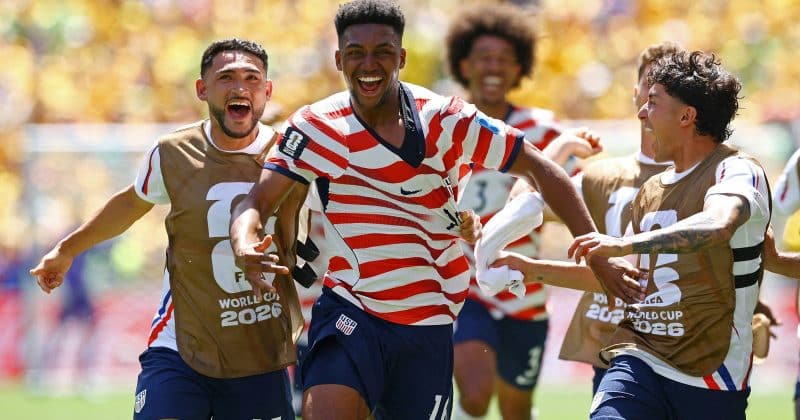
World Cup 2026 sees resurgence of traditional wing play as 29 teams score from crosses

World Cup 2026 sees resurgence of traditional wing play as 29 teams score from crosses

Despite the lowest crossing volume since 1966, teams at the expanded 48-team tournament are converting from wide areas at a historic rate

Something unusual is happening at the 2026 FIFA World Cup. Teams are crossing the ball less than at any tournament since tracking began six decades ago, yet they’re scoring from those crosses at a rate that has analysts doing double-takes at their spreadsheets.

Through the first 48 matches of the expanded 48-team format, 29 teams have scored at least one goal within five seconds of a cross into the box. That’s roughly 60% of the entire field finding the net from wide deliveries.

Less volume, more venom

The average number of crosses per game sits at 31.5, a decline of about 10% from the 2022 tournament in Qatar. That figure represents the lowest crossing rate for any World Cup since records began in 1966.

Advertisement

Yet the tournament has produced 47 goals from crosses in those first 48 matches. That works out to roughly 0.98 goals per game.

The data, compiled by Opta, points to a deliberate shift in how teams approach wide play. The improvement comes from timing and precision rather than sheer volume.

The expanded format factor

The 2026 World Cup is the first to feature 48 teams, up from 32 at every tournament since 1998. The 10% reduction in overall crossing volume reinforces that teams aren’t mindlessly going wide. They’re choosing to cross when the conditions favor it, leading to higher-quality deliveries and, consequently, more goals.

What the data really tells us

Opta’s five-second window for measuring goals from crosses captures the immediate chaos that follows a ball swinging into the box. Headers, volleys, scrambles, deflections. If a goal arrives within that window, the cross gets the credit.

At nearly one goal per game from this source alone, the 2026 tournament is establishing wing play as one of its defining tactical narratives.

Disclosure: This article was edited by Editorial Team. For more information on how we create and review content, see our Editorial Policy.

World Cup 2026 sees resurgence of traditional wing play as 29 teams score from crosses

World Cup 2026 sees resurgence of traditional wing play as 29 teams score from crosses

Despite the lowest crossing volume since 1966, teams at the expanded 48-team tournament are converting from wide areas at a historic rate

Something unusual is happening at the 2026 FIFA World Cup. Teams are crossing the ball less than at any tournament since tracking began six decades ago, yet they’re scoring from those crosses at a rate that has analysts doing double-takes at their spreadsheets.

Through the first 48 matches of the expanded 48-team format, 29 teams have scored at least one goal within five seconds of a cross into the box. That’s roughly 60% of the entire field finding the net from wide deliveries.

Less volume, more venom

The average number of crosses per game sits at 31.5, a decline of about 10% from the 2022 tournament in Qatar. That figure represents the lowest crossing rate for any World Cup since records began in 1966.

Advertisement

Yet the tournament has produced 47 goals from crosses in those first 48 matches. That works out to roughly 0.98 goals per game.

The data, compiled by Opta, points to a deliberate shift in how teams approach wide play. The improvement comes from timing and precision rather than sheer volume.

The expanded format factor

The 2026 World Cup is the first to feature 48 teams, up from 32 at every tournament since 1998. The 10% reduction in overall crossing volume reinforces that teams aren’t mindlessly going wide. They’re choosing to cross when the conditions favor it, leading to higher-quality deliveries and, consequently, more goals.

What the data really tells us

Opta’s five-second window for measuring goals from crosses captures the immediate chaos that follows a ball swinging into the box. Headers, volleys, scrambles, deflections. If a goal arrives within that window, the cross gets the credit.

At nearly one goal per game from this source alone, the 2026 tournament is establishing wing play as one of its defining tactical narratives.

Disclosure: This article was edited by Editorial Team. For more information on how we create and review content, see our Editorial Policy.