
Nexo Earn with Nexo
Xi Jinping and Kim Jong Un commit to deepening cooperation in Pyongyang summit

Xi Jinping and Kim Jong Un commit to deepening cooperation in Pyongyang summit

The first visit by a Chinese leader to North Korea in seven years signals a tightening authoritarian axis as geopolitical fault lines deepen.

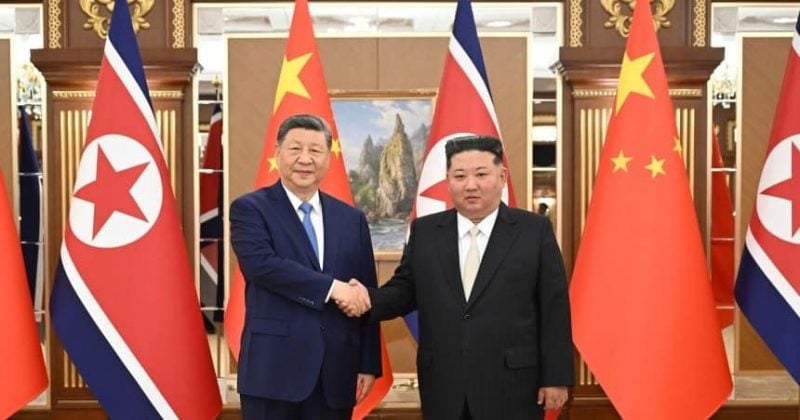
Xi Jinping touched down in Pyongyang on June 8 for a two-day summit with Kim Jong Un, the first time a Chinese leader has visited North Korea in seven years. The last time Xi made this trip was June 2019, back when the world was still pretending that diplomatic engagement might convince Pyongyang to play nice.

The two leaders described their alliance as “unbreakable.” The summit covered a wide range of cooperative commitments spanning trade, economy, diplomacy, military coordination, technology, and agriculture.

The visit comes against a backdrop of North Korea’s increasingly tight relationship with Russia, particularly after the two countries signed a mutual defense pact in 2024. The previous face-to-face meetings between Xi and Kim occurred in 2018 and 2019, a period when diplomacy with North Korea was briefly fashionable.

Advertisement

What actually happened in Pyongyang

For China, North Korea is a buffer state that prevents US-allied forces from sitting directly on China’s northeastern border. For North Korea, having both China and Russia competing for influence means more economic aid, more military cooperation, and more diplomatic cover at the United Nations Security Council.

What this means for markets and investors

The summit contained no discussions of cryptocurrency, blockchain technology, or digital assets of any kind. The focus remained squarely on traditional state-to-state cooperation: trade flows, military coordination, and agricultural support.

North Korea has been one of the most prolific state-sponsored actors in crypto theft, with groups linked to Pyongyang responsible for billions of dollars in hacks over the past several years. The fact that digital assets didn’t appear on the official agenda suggests these activities remain in the shadow economy rather than the formal diplomatic framework between the two nations.

China has historically been the primary conduit through which North Korea accesses the global financial system. Deeper cooperation between Beijing and Pyongyang could mean more sophisticated evasion of Western financial controls, including through digital channels.

Traders should watch for any subsequent policy moves from Washington in response to this summit. Previous escalations in China-North Korea relations have triggered rounds of secondary sanctions targeting Chinese entities, which can ripple through broader Asian markets and, by extension, crypto trading volumes that are heavily concentrated in the region.

Disclosure: This article was edited by Editorial Team. For more information on how we create and review content, see our Editorial Policy.

Xi Jinping and Kim Jong Un commit to deepening cooperation in Pyongyang summit

Xi Jinping and Kim Jong Un commit to deepening cooperation in Pyongyang summit

The first visit by a Chinese leader to North Korea in seven years signals a tightening authoritarian axis as geopolitical fault lines deepen.

Xi Jinping touched down in Pyongyang on June 8 for a two-day summit with Kim Jong Un, the first time a Chinese leader has visited North Korea in seven years. The last time Xi made this trip was June 2019, back when the world was still pretending that diplomatic engagement might convince Pyongyang to play nice.

The two leaders described their alliance as “unbreakable.” The summit covered a wide range of cooperative commitments spanning trade, economy, diplomacy, military coordination, technology, and agriculture.

The visit comes against a backdrop of North Korea’s increasingly tight relationship with Russia, particularly after the two countries signed a mutual defense pact in 2024. The previous face-to-face meetings between Xi and Kim occurred in 2018 and 2019, a period when diplomacy with North Korea was briefly fashionable.

Advertisement

What actually happened in Pyongyang

For China, North Korea is a buffer state that prevents US-allied forces from sitting directly on China’s northeastern border. For North Korea, having both China and Russia competing for influence means more economic aid, more military cooperation, and more diplomatic cover at the United Nations Security Council.

What this means for markets and investors

The summit contained no discussions of cryptocurrency, blockchain technology, or digital assets of any kind. The focus remained squarely on traditional state-to-state cooperation: trade flows, military coordination, and agricultural support.

North Korea has been one of the most prolific state-sponsored actors in crypto theft, with groups linked to Pyongyang responsible for billions of dollars in hacks over the past several years. The fact that digital assets didn’t appear on the official agenda suggests these activities remain in the shadow economy rather than the formal diplomatic framework between the two nations.

China has historically been the primary conduit through which North Korea accesses the global financial system. Deeper cooperation between Beijing and Pyongyang could mean more sophisticated evasion of Western financial controls, including through digital channels.

Traders should watch for any subsequent policy moves from Washington in response to this summit. Previous escalations in China-North Korea relations have triggered rounds of secondary sanctions targeting Chinese entities, which can ripple through broader Asian markets and, by extension, crypto trading volumes that are heavily concentrated in the region.

Disclosure: This article was edited by Editorial Team. For more information on how we create and review content, see our Editorial Policy.