
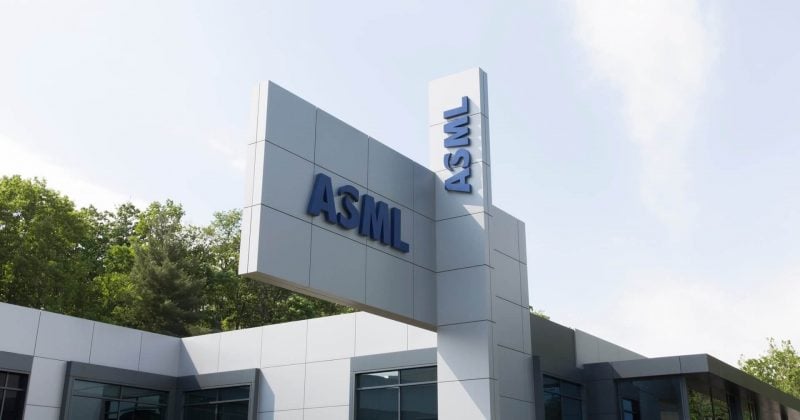
Via asml.com
Bank of America sees ASML as resilient amid China concerns
BofA maintains its buy rating on the Dutch chipmaker, calling the recent stock selloff an overreaction to fears about Chinese competition in lithography tools
ASML, the Dutch company that makes the machines that make the world’s most advanced chips, just watched its stock drop roughly 6% in a single session. The culprit: news that a Chinese firm can now mass-produce DUV lithography systems, the kind of tools ASML has long dominated. Bank of America’s response to the panic? Calm down.
BofA has reiterated its Buy rating on ASML, arguing that investors are reading too much into trade press coverage about Chinese competitors and not enough into the company’s actual business fundamentals. The stock closed around $1,655 per share on July 27, 2026, and then slid an additional 4% or so in preliminary trading the next day.
The China question, translated
China has historically accounted for approximately 33% of ASML’s revenue. But thanks to export controls that block the sale of ASML’s most advanced EUV (extreme ultraviolet) machines to Chinese buyers, that share is projected to fall to around 20% by 2026. The revenue hit from losing Chinese business is already baked into forward-looking models.
The latest scare centers on immersion DUV (deep ultraviolet) lithography, which is older and less sophisticated than EUV technology. A Chinese company reportedly demonstrated the ability to mass-produce these DUV systems, and the market interpreted this as a direct threat to ASML’s bread and butter. BofA disagrees with that interpretation.
Macro, rates, and crypto—what moved markets and what matters next.
Daily. Free. Join 34,000+ readers across crypto, finance, and policy.
Why BofA is still bullish
The overall market for wafer fabrication equipment is expected to reach at least $250 billion by 2028. BofA sees that as a potential 30% annual growth rate over two years, driven overwhelmingly by artificial intelligence investments.
BofA highlights that ASML’s pricing power and gross margins above industry norms should support strong earnings going forward. BofA’s earnings projections for ASML in 2027 and 2028 sit 6-7% above Wall Street’s consensus estimates.
What this means for investors
BofA’s note frames the current dip as a buying opportunity for anyone with conviction in the AI-driven semiconductor buildout. The 6-7% earnings upside that BofA sees relative to consensus would, if realized, make today’s stock price look cheap in hindsight.