
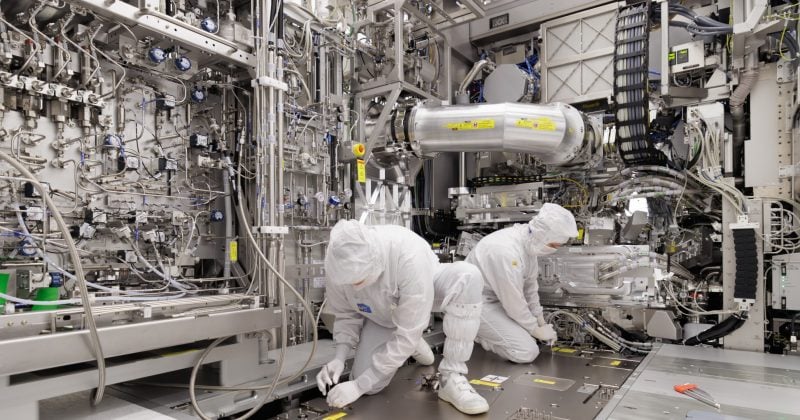
China begins limited production of homegrown immersion DUV lithography machines

Via tomshardware.com

China begins limited production of homegrown immersion DUV lithography machines

Beijing's push for semiconductor self-sufficiency just hit a major milestone, and the ripple effects could reshape chip supply chains and tech investment for years

China’s semiconductor ambitions just took a concrete step forward. The country has begun limited production of domestically developed immersion deep ultraviolet (DUV) lithography machines, the critical tools needed to print circuit patterns onto silicon wafers.

Lithography machines project light through a mask to etch tiny patterns onto chips. Until now, the advanced versions have been controlled almost entirely by Western companies, most notably ASML in the Netherlands.

What’s actually happening on the ground

Semiconductor Manufacturing International Corporation, better known as SMIC, is China’s largest chip foundry. The company started testing a domestic immersion DUV lithography tool built by Shanghai Yuliangsheng Technology back in September 2025.

Advertisement

Yuliangsheng is a startup with ties to Huawei and SiCarrier. The machine is designed to handle 28 nm-class chip processes. Through advanced multi-patterning techniques, the tool could potentially reach 7 nm or finer nodes.

The targeted date for active mass production at SMIC is as early as 2027. SMIC isn’t the only player making moves. SMEE, another domestic equipment maker, has reportedly sold around ten units of its SSA800 series, which also targets 28 nm immersion DUV lithography.

The geopolitical chess match

China’s existing inventory of imported DUV machines continues to support high-volume production, with millions of logic dies expected to be produced in 2026. In response to China’s progress, US lawmakers proposed additional restrictions specifically targeting DUV immersion tools in April 2026. Previous restrictions focused primarily on extreme ultraviolet (EUV) lithography, the more advanced technology that enables chips at 5 nm and below.

Why crypto and tech investors should pay attention

For the crypto mining sector specifically, this matters because mining hardware manufacturers have historically depended on a small number of foundries, primarily TSMC in Taiwan. A more capable SMIC could eventually offer alternative production capacity, potentially affecting pricing and availability of mining ASICs.

The 28 nm node that these domestic machines target is mature technology by global standards — Apple’s latest chips are manufactured at 3 nm. But 28 nm chips are used in automotive, industrial, IoT, and countless other applications.

Investors watching the broader tech and crypto space should track two things: whether SMIC hits its 2027 mass production target, and whether US restrictions on DUV tools actually materialize and how aggressively they’re enforced.

Disclosure: This article was edited by Editorial Team. For more information on how we create and review content, see our Editorial Policy.

China begins limited production of homegrown immersion DUV lithography machines

China begins limited production of homegrown immersion DUV lithography machines

Beijing's push for semiconductor self-sufficiency just hit a major milestone, and the ripple effects could reshape chip supply chains and tech investment for years

Via tomshardware.com

China’s semiconductor ambitions just took a concrete step forward. The country has begun limited production of domestically developed immersion deep ultraviolet (DUV) lithography machines, the critical tools needed to print circuit patterns onto silicon wafers.

Lithography machines project light through a mask to etch tiny patterns onto chips. Until now, the advanced versions have been controlled almost entirely by Western companies, most notably ASML in the Netherlands.

What’s actually happening on the ground

Semiconductor Manufacturing International Corporation, better known as SMIC, is China’s largest chip foundry. The company started testing a domestic immersion DUV lithography tool built by Shanghai Yuliangsheng Technology back in September 2025.

Advertisement

Yuliangsheng is a startup with ties to Huawei and SiCarrier. The machine is designed to handle 28 nm-class chip processes. Through advanced multi-patterning techniques, the tool could potentially reach 7 nm or finer nodes.

The targeted date for active mass production at SMIC is as early as 2027. SMIC isn’t the only player making moves. SMEE, another domestic equipment maker, has reportedly sold around ten units of its SSA800 series, which also targets 28 nm immersion DUV lithography.

The geopolitical chess match

China’s existing inventory of imported DUV machines continues to support high-volume production, with millions of logic dies expected to be produced in 2026. In response to China’s progress, US lawmakers proposed additional restrictions specifically targeting DUV immersion tools in April 2026. Previous restrictions focused primarily on extreme ultraviolet (EUV) lithography, the more advanced technology that enables chips at 5 nm and below.

Why crypto and tech investors should pay attention

For the crypto mining sector specifically, this matters because mining hardware manufacturers have historically depended on a small number of foundries, primarily TSMC in Taiwan. A more capable SMIC could eventually offer alternative production capacity, potentially affecting pricing and availability of mining ASICs.

The 28 nm node that these domestic machines target is mature technology by global standards — Apple’s latest chips are manufactured at 3 nm. But 28 nm chips are used in automotive, industrial, IoT, and countless other applications.

Investors watching the broader tech and crypto space should track two things: whether SMIC hits its 2027 mass production target, and whether US restrictions on DUV tools actually materialize and how aggressively they’re enforced.

Disclosure: This article was edited by Editorial Team. For more information on how we create and review content, see our Editorial Policy.