
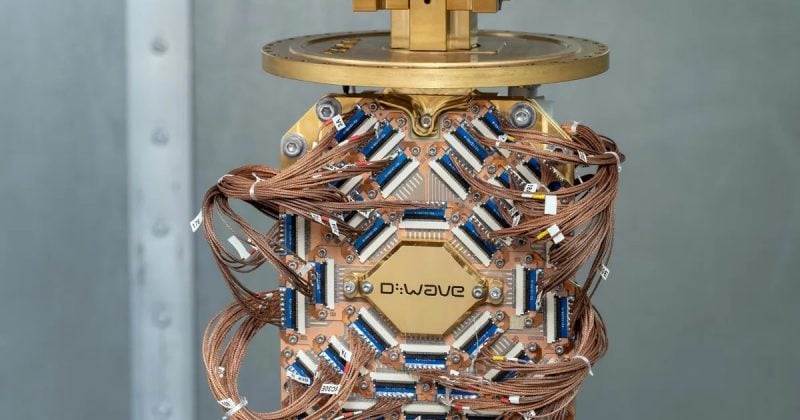
Via spectrum.ieee.org
D-Wave Quantum stock slides despite 1,120% surge in bookings
The quantum computing company's massive bookings growth couldn't distract Wall Street from a revenue miss and widening losses
D-Wave Quantum saw its stock drop between 7% and 13% after reporting second-quarter earnings on August 6, despite unveiling a first-half bookings number that would make most early-stage tech companies weep with envy. The company posted a 1,120% year-over-year increase in bookings, reaching $35.5 million. Wall Street, characteristically, focused on the parts that didn’t look as pretty.
Q2 revenue came in at $3.1 million, essentially flat compared to the prior year and well below analyst estimates of roughly $4 million. The adjusted loss landed at $0.13 per share, wider than the $0.09 consensus. In English: D-Wave is signing a lot of future deals but hasn’t figured out how to turn them into revenue fast enough for investors’ taste.
The bookings story vs. the revenue story
D-Wave’s first-half bookings surged from $2.9 million in H1 2025 to $35.5 million in H1 2026, a jaw-dropping increase driven in large part by a single $20 million system sale.
Remaining performance obligations, which represent contracted revenue that hasn’t been recognized yet, hit $40.7 million. That’s a 668% increase year-over-year.
Meanwhile, D-Wave’s customer mix is shifting in a promising direction. Forbes Global 2000 clients now account for 47.7% of Q2 revenue, up from 20.4% a year earlier.
The competitive contrast with IonQ
The timing of D-Wave’s earnings made the stock reaction even more painful. Peer company IonQ reported results on the same day and saw its shares rise.
AI, tech, and the markets they move—in one daily briefing.
Daily. Free. Join 34,000+ readers across crypto, finance, and policy.
D-Wave uses quantum annealing technology, which is particularly suited for optimization problems, as opposed to the gate-based quantum computing approach used by competitors like IonQ and IBM.
Enterprise partnerships and the crypto connection
The company expanded its agreement with AT&T for network optimization applications and announced a new collaboration with Nasdaq Verafin on August 3 focused on applying quantum technologies to financial crime detection.
D-Wave’s April 2026 partnership with Quip Network for quantum blockchain mining on an experimental testnet represents one of the first concrete attempts to apply commercial quantum computing hardware to blockchain consensus mechanisms.
D-Wave’s annealing-based approach is fundamentally different from the universal fault-tolerant quantum computers that would actually threaten Bitcoin’s cryptographic security. The machines D-Wave sells today excel at specific optimization problems, not at running Shor’s algorithm to crack elliptic curve cryptography.
What this means for investors
The $40.7 million in remaining performance obligations provides something of a floor for future revenue expectations. That backlog needs to convert to recognized revenue over coming quarters.
The concentration risk from the $20 million system sale is worth monitoring. Strip that single deal out and first-half bookings were roughly $15.5 million, still a massive increase from $2.9 million but a meaningfully different story than the headline number suggests.