
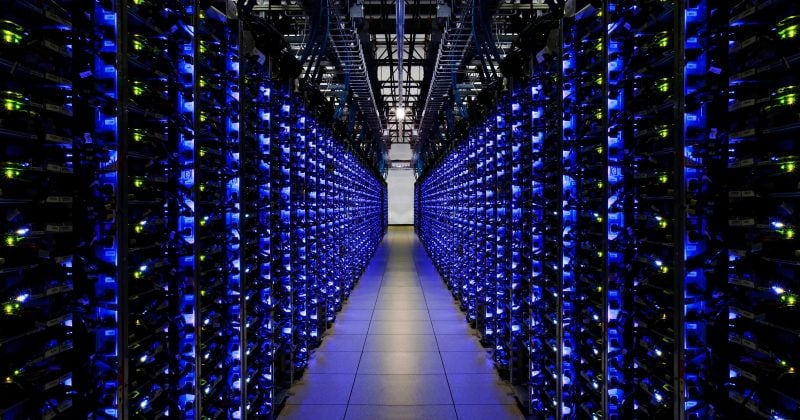
Via datacenters.google
Report warns data centres could raise US electricity bills due to gas reliance
A new analysis from the Union of Concerned Scientists finds that powering America's data center boom with natural gas could stick utility customers with nearly $1 trillion in costs by 2050.
The explosion in US data center construction has a dirty little secret, and it’s about to show up on your electricity bill. A report from the Union of Concerned Scientists titled “Data Center Power Play” finds that meeting surging data center demand primarily with new natural gas generation creates substantial financial risks for everyday utility customers, to the tune of $886 to $978 billion in cumulative wholesale electricity costs from 2026 to 2050.
The numbers behind the power grab
US data centers consumed approximately 176 TWh of electricity in 2023. That’s about 4.4% of national electricity consumption. Projections estimate data center electricity consumption will reach 325 to 580 TWh by 2028, representing 6.7% to 12% of total US electricity demand.
Natural gas currently provides more than 40% of the electricity powering US data centers, making it the single largest source. Utilities are leaning into gas-fired generation because permitting and construction timelines are shorter than for renewables.
The UCS modeling paints a concerning picture under its mid-growth scenario. As load growth accelerates faster than anticipated, driven by evolving AI workloads and cloud computing expansion, ratepayers face exposure to stranded-asset risks. That’s the scenario where utilities build expensive gas infrastructure that becomes uneconomical before it’s paid off, and customers get stuck holding the bag.
Where crypto enters the equation
MARA Holdings, one of the largest publicly traded Bitcoin miners, agreed to purchase a 505 MW natural gas plant in Ohio for $1.5 billion. That’s not a company buying electricity. That’s a company buying the power plant itself, a strategic pivot toward vertically integrated energy ownership.
Macro, rates, and crypto—what moved markets and what matters next.
Daily. Free. Join 34,000+ readers across crypto, finance, and policy.
Bitcoin miners also demonstrated their potential as grid stabilizers in 2023, curtailing approximately 888 GWh of load. That flexibility—the ability to power down mining rigs when the grid is stressed and ramp back up when supply is abundant—positions miners as potentially useful partners for grid operators. A Microsoft Azure cluster running enterprise workloads can’t just shut off during peak demand. A Bitcoin mining facility can.
What this means for crypto investors
Rising wholesale electricity prices, driven by data center demand competing for the same gas-fired generation, could squeeze miners who don’t own their power sources. The companies that have secured long-term energy contracts or, like MARA, acquired generation assets outright may develop significant competitive moats.
As the UCS report gains traction in policy discussions, state utility commissions may scrutinize cost-allocation rules more carefully. New frameworks could mandate that large power consumers, including both traditional data centers and mining operations, bear a larger share of infrastructure costs rather than socializing those expenses across all ratepayers.
For Bitcoin specifically, these energy dynamics add another layer to the post-halving economics that miners are already navigating. Block rewards have been cut, transaction fees are variable, and now the cost of the primary input—electricity—faces structural upward pressure from competing demand. The miners best positioned are those treating energy procurement as a core competency, essentially becoming energy companies that happen to mine Bitcoin rather than mining companies that happen to need energy.