
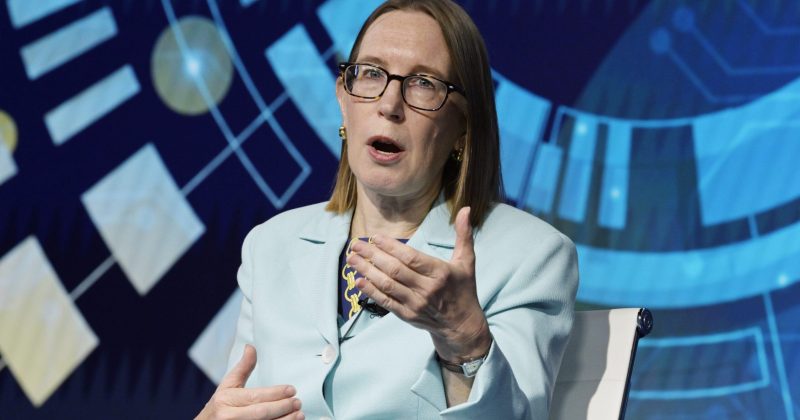
Hester Peirce departs SEC after years of advocating for digital assets

Hester Peirce departs SEC after years of advocating for digital assets

The commissioner known as 'Crypto Mom' leaves a two-member SEC as the crypto rulebook she pushed for finally takes shape

Hester Peirce, the SEC commissioner crypto fans nicknamed “Crypto Mom,” officially left the agency on October 2, 2026. Her departure ends a run that began in January 2018 and outlasted two presidential administrations.

A two-person commission

With Peirce gone, the SEC is down to two commissioners: Chairman Paul Atkins and Commissioner Mark Uyeda. Both are Republican appointees.

No successor has been named to fill her seat.

Peirce announced the move on X on September 25, 2026. Her resignation letter was dated September 21 and took effect on October 2.

Advertisement

She called her time at the agency the “honor of my professional lifetime.”

Her term technically expired in June 2025, but she stayed on in a holdover capacity for more than a year. That arrangement let her keep shaping rulemaking and votes well past her formal end date.

Her next stop is academia. Peirce is set to become an associate professor at Regent University School of Law in November 2026.

The Crypto Task Force legacy

Peirce’s biggest crypto footprint came through the SEC Crypto Task Force, which she led. The group took on token classification—how to determine which tokens count as securities and which do not—and staking guidance, addressing whether locking up tokens to secure a blockchain in exchange for rewards triggers securities law.

The SEC issued a five-year innovation exemption that allows US stocks to trade on-chain using automated market makers, the software-run trading pools that power decentralized exchanges, swapping assets by formula instead of matching buyers with sellers.

The GENIUS Act, a major piece of stablecoin legislation, was enacted in 2025 while Peirce was still at the agency.

From dissenter to insider

Peirce’s crypto reputation was built largely in dissent. She was a vocal critic of aggressive enforcement, arguing the agency should write clear rules rather than regulate through lawsuits.

She worked on the SEC staff from 2000 to 2008, long before she returned as a commissioner. She then served under both the Trump and Biden administrations, a span that covered the most hostile and the most welcoming eras for crypto at the agency.

What this means for crypto and the SEC

A two-member commission can still function, but every vote now rests on two people. With only Republican appointees remaining, no named successor has been identified to fill Peirce’s seat.

For builders, exchanges, and investors, the watch list is short. First, who gets nominated for the open seat, and how quickly. Second, whether Atkins and Uyeda keep advancing the task force’s guidance on token classification and staking. Third, how the five-year innovation exemption plays out in practice.

Disclosure: This article was edited by John Chen. For more information on how we create and review content, see our Editorial Policy.
Hester Peirce departs SEC after years of advocating for digital assets

The commissioner known as 'Crypto Mom' leaves a two-member SEC as the crypto rulebook she pushed for finally takes shape

Share

Add us on Google

Hester Peirce, the SEC commissioner crypto fans nicknamed “Crypto Mom,” officially left the agency on October 2, 2026. Her departure ends a run that began in January 2018 and outlasted two presidential administrations.

A two-person commission

With Peirce gone, the SEC is down to two commissioners: Chairman Paul Atkins and Commissioner Mark Uyeda. Both are Republican appointees.

No successor has been named to fill her seat.

Peirce announced the move on X on September 25, 2026. Her resignation letter was dated September 21 and took effect on October 2.

Advertisement

She called her time at the agency the “honor of my professional lifetime.”

Her term technically expired in June 2025, but she stayed on in a holdover capacity for more than a year. That arrangement let her keep shaping rulemaking and votes well past her formal end date.

Her next stop is academia. Peirce is set to become an associate professor at Regent University School of Law in November 2026.

The Crypto Task Force legacy

Peirce’s biggest crypto footprint came through the SEC Crypto Task Force, which she led. The group took on token classification—how to determine which tokens count as securities and which do not—and staking guidance, addressing whether locking up tokens to secure a blockchain in exchange for rewards triggers securities law.

The SEC issued a five-year innovation exemption that allows US stocks to trade on-chain using automated market makers, the software-run trading pools that power decentralized exchanges, swapping assets by formula instead of matching buyers with sellers.

The GENIUS Act, a major piece of stablecoin legislation, was enacted in 2025 while Peirce was still at the agency.

From dissenter to insider

Peirce’s crypto reputation was built largely in dissent. She was a vocal critic of aggressive enforcement, arguing the agency should write clear rules rather than regulate through lawsuits.

She worked on the SEC staff from 2000 to 2008, long before she returned as a commissioner. She then served under both the Trump and Biden administrations, a span that covered the most hostile and the most welcoming eras for crypto at the agency.

What this means for crypto and the SEC

A two-member commission can still function, but every vote now rests on two people. With only Republican appointees remaining, no named successor has been identified to fill Peirce’s seat.

For builders, exchanges, and investors, the watch list is short. First, who gets nominated for the open seat, and how quickly. Second, whether Atkins and Uyeda keep advancing the task force’s guidance on token classification and staking. Third, how the five-year innovation exemption plays out in practice.

Disclosure: This article was edited by John Chen. For more information on how we create and review content, see our Editorial Policy.