
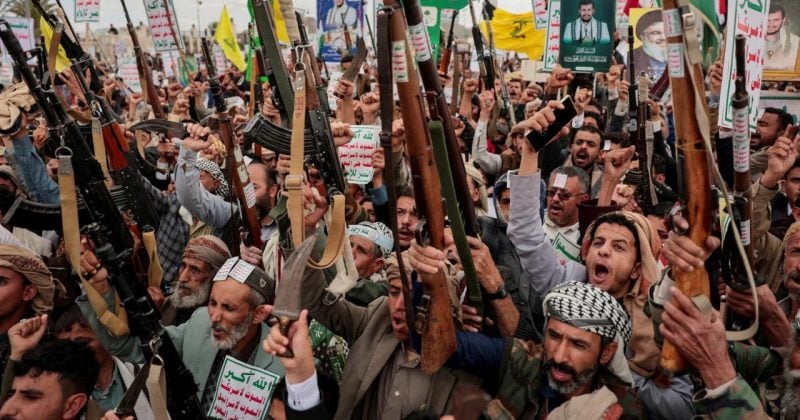
Houthi militia declares naval blockade on Saudi Arabia, raising oil supply fears and crypto safe-haven debate

Houthi militia declares naval blockade on Saudi Arabia, raising oil supply fears and crypto safe-haven debate

The maritime embargo on Saudi ports threatens 7% of global oil shipments through the Bab el-Mandeb Strait, sending ripples across energy and digital asset markets alike.

The Houthi militia declared a maritime blockade on Saudi Arabia on July 20, framing the move as retaliation for what they call a prolonged Saudi siege on Yemen. Military spokesman Brig.-Gen. Yahya Saree announced the embargo was effective immediately, describing it as “an eye for an eye.”

The target: Saudi ports and shipping lanes through the Bab el-Mandeb Strait, a narrow chokepoint at the southern tip of the Red Sea that handles roughly 7% of global oil supply.

What the blockade actually looks like

The Houthis, formally known as Ansar Allah and aligned with Iran, have already begun warning shipping companies via email not to use Saudi ports. The messaging is blunt: vessels risk attacks “in any location” within the group’s reach.

Saudi oil exports through the Red Sea port of Yanbu have reportedly averaged around 4 million barrels per day. That volume flowing through waters now declared hostile is enough to make energy traders lose sleep.

Advertisement

The Bab el-Mandeb Strait sits between Yemen on one side and Djibouti and Eritrea on the other. It’s only about 20 miles wide at its narrowest point. Every tanker heading from the Persian Gulf to Europe or the US East Coast via the Suez Canal has to pass through it.

Saudi Arabia and the broader coalition have condemned the blockade as a violation of international law.

The oil price pressure cooker

Previous Houthi attacks on Red Sea shipping in late 2023 and 2024 forced major carriers to reroute around the Cape of Good Hope, adding weeks and significant cost to voyages.

The difference this time is that the blockade explicitly targets Saudi Arabia, the world’s largest crude oil exporter. Previous campaigns focused on vessels linked to Israel or the US. Expanding the target set to Saudi-bound traffic raises the stakes considerably.

If shipping insurers start pricing in higher war-risk premiums for Red Sea transit, the cost increase flows directly into the price of every barrel that normally moves through those waters.

Why crypto markets are watching closely

Analysts have already noted Bitcoin price movements tracking alongside rising crude oil values during this latest escalation.

For crypto investors specifically, the blockade introduces a scenario where Bitcoin could benefit from a flight-to-safety narrative while simultaneously facing headwinds if a broader risk-off move hits all speculative assets.

During previous periods of elevated geopolitical risk, on-chain data showed increased stablecoin minting and movement to exchanges, suggesting investors were positioning for rapid deployment.

Disclosure: This article was edited by Editorial Team. For more information on how we create and review content, see our Editorial Policy.

Houthi militia declares naval blockade on Saudi Arabia, raising oil supply fears and crypto safe-haven debate

Houthi militia declares naval blockade on Saudi Arabia, raising oil supply fears and crypto safe-haven debate

The maritime embargo on Saudi ports threatens 7% of global oil shipments through the Bab el-Mandeb Strait, sending ripples across energy and digital asset markets alike.

The Houthi militia declared a maritime blockade on Saudi Arabia on July 20, framing the move as retaliation for what they call a prolonged Saudi siege on Yemen. Military spokesman Brig.-Gen. Yahya Saree announced the embargo was effective immediately, describing it as “an eye for an eye.”

The target: Saudi ports and shipping lanes through the Bab el-Mandeb Strait, a narrow chokepoint at the southern tip of the Red Sea that handles roughly 7% of global oil supply.

What the blockade actually looks like

The Houthis, formally known as Ansar Allah and aligned with Iran, have already begun warning shipping companies via email not to use Saudi ports. The messaging is blunt: vessels risk attacks “in any location” within the group’s reach.

Saudi oil exports through the Red Sea port of Yanbu have reportedly averaged around 4 million barrels per day. That volume flowing through waters now declared hostile is enough to make energy traders lose sleep.

Advertisement

The Bab el-Mandeb Strait sits between Yemen on one side and Djibouti and Eritrea on the other. It’s only about 20 miles wide at its narrowest point. Every tanker heading from the Persian Gulf to Europe or the US East Coast via the Suez Canal has to pass through it.

Saudi Arabia and the broader coalition have condemned the blockade as a violation of international law.

The oil price pressure cooker

Previous Houthi attacks on Red Sea shipping in late 2023 and 2024 forced major carriers to reroute around the Cape of Good Hope, adding weeks and significant cost to voyages.

The difference this time is that the blockade explicitly targets Saudi Arabia, the world’s largest crude oil exporter. Previous campaigns focused on vessels linked to Israel or the US. Expanding the target set to Saudi-bound traffic raises the stakes considerably.

If shipping insurers start pricing in higher war-risk premiums for Red Sea transit, the cost increase flows directly into the price of every barrel that normally moves through those waters.

Why crypto markets are watching closely

Analysts have already noted Bitcoin price movements tracking alongside rising crude oil values during this latest escalation.

For crypto investors specifically, the blockade introduces a scenario where Bitcoin could benefit from a flight-to-safety narrative while simultaneously facing headwinds if a broader risk-off move hits all speculative assets.

During previous periods of elevated geopolitical risk, on-chain data showed increased stablecoin minting and movement to exchanges, suggesting investors were positioning for rapid deployment.

Disclosure: This article was edited by Editorial Team. For more information on how we create and review content, see our Editorial Policy.