
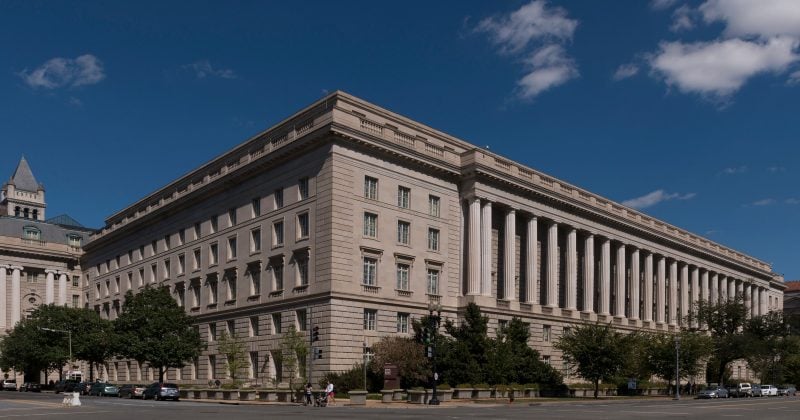
Photo: Photographer: Carol M. Highsmith / en.wikipedia.org
IRS silent on tax treatment for $25B World Cup prediction market bets
Prediction market traders are racking up billions in World Cup wagers while the IRS offers zero guidance on how those winnings should be taxed.
The 2026 FIFA World Cup has become the biggest event in prediction market history, with trading volumes potentially exceeding $25 billion across platforms like Polymarket and Kalshi. And yet the IRS, the agency that usually has an opinion on everything involving money, has said precisely nothing about how traders should report their winnings.
The numbers are staggering
Polymarket’s “World Cup Winner” market alone has surpassed $3.9 billion in trading volume as of early July 2026. Combined World Cup-related volumes from both Polymarket and Kalshi are estimated between $4.8 billion and $6.4 billion, with broader estimates that include all associated betting activity pushing the total past $25 billion.
Much of this trading is conducted using stablecoins, which adds another layer of complexity to the tax question. The CFTC, which regulates both Kalshi and Polymarket, watched volumes surge dramatically in June 2026 as World Cup excitement took hold.
The tax question nobody can answer
The IRS has not issued specific guidance on the taxation of prediction market contracts as of July 2026. That leaves traders guessing between two very different tax treatments, each with materially different consequences for their bottom line.
The first possibility: prediction market winnings get treated as gambling income. Under this framework, winnings are taxed as ordinary income at the trader’s marginal rate, which can reach 37% for high earners. Losses can offset winnings, but there’s a catch. Starting in 2026, the One Big Beautiful Bill Act limits gambling loss deductions to 90% of winnings for US taxpayers. In English: if you win $100,000 and lose $100,000, you can only deduct $90,000 of those losses. You’d owe taxes on $10,000 you never actually pocketed.
The news moving money, markets, and the world—before your day starts.
Daily. Free. Join 34,000+ readers across crypto, finance, and policy.
The second possibility: these contracts could qualify as regulated futures contracts under IRC Section 1256, which would allow for a blended 60/40 tax rate, with 60% of gains taxed at the long-term capital gains rate and 40% at the short-term rate. This treatment would also allow traders to net losses against gains more efficiently.
The IRS recently issued memos addressing how athletes competing in the World Cup should handle their tax obligations, but the agency has not addressed the taxation of prediction market contracts.
Why the CFTC angle matters
Both Kalshi and Polymarket operate under CFTC oversight, which is part of what makes the Section 1256 argument plausible. Contracts traded on CFTC-regulated exchanges have historically received 1256 treatment, which was designed for futures and options markets. Kalshi won a landmark court battle to list election contracts in 2024, and the regulatory landscape has continued to evolve. But CFTC classification and IRS tax treatment are two different conversations happening in two different agencies.
What prediction market traders should watch
For traders currently holding positions, the practical advice from most tax attorneys is to document everything meticulously: entry prices, exit prices, dates, and the specific contracts traded.
Conservative traders may want to assume the less favorable gambling treatment and plan accordingly, setting aside a larger share of winnings for potential tax obligations. Those willing to take a more aggressive position on 1256 treatment should understand they’re making a bet on top of their bets, one that could result in penalties and interest if the IRS disagrees.