
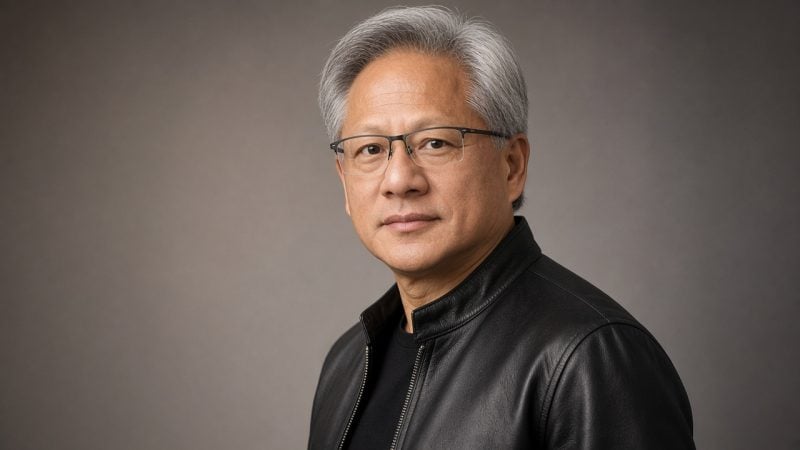
Jensen Huang says AI is a trillion-dollar opportunity because the machines never sleep
The NVIDIA CEO laid out a vision for $3T to $4T in annual AI infrastructure spending by 2030 during a fireside chat at Citadel Securities' Future of Global Markets event.
Jensen Huang has a simple thesis for why AI will be the largest technology market in history: the machines have to run all the time. Unlike a factory that shuts down at night or a trading floor that closes for weekends, AI systems operate around the clock, consuming compute power every second of every day. That perpetual demand, Huang argues, creates a spending cycle unlike anything the tech industry has ever produced.
The NVIDIA co-founder and CEO made the case during a fireside chat at Citadel Securities’ “Future of Global Markets 2025” event, held at Casa Cipriani in New York City on October 6, 2025. Speaking to an audience of institutional investors and market-makers, Huang projected that annual AI infrastructure spending could reach $3 trillion to $4 trillion by 2030.
Agentic AI and the next wave of compute demand
Huang spent a significant portion of his remarks on what he calls “agentic AI,” a category of autonomous systems capable of performing complex, multi-step tasks without constant human supervision. Think AI that doesn’t just answer your question but actually does the job: writing code, triaging patients, drafting legal briefs.
He described this segment as a “couple trillion-dollar market opportunity, probably.” The distinction between agentic AI and the chatbots most consumers interact with today is meaningful. Current AI tools are largely reactive. You ask a question, you get an answer. Agentic systems, by contrast, would operate autonomously across workflows, making decisions, executing tasks, and iterating on their own output.
AI, tech, and the markets they move—in one daily briefing.
Daily. Free. Join 34,000+ readers across crypto, finance, and policy.
The $3T to $4T infrastructure thesis
His argument rests on the idea that AI compute isn’t a one-time purchase. Traditional software runs on servers that need periodic upgrades. AI models, however, require continuous training, fine-tuning, and inference processing. The inference side, where trained models actually generate outputs, is particularly compute-intensive at scale. Every query to an AI system, every autonomous task an AI agent performs, burns through processing power.
Huang also pointed to what he described as “trillions of market cap already realized” by companies investing heavily in AI infrastructure. NVIDIA itself has been the most obvious beneficiary, with its revenue figures reflecting the massive buildout of AI capacity across the tech sector.