
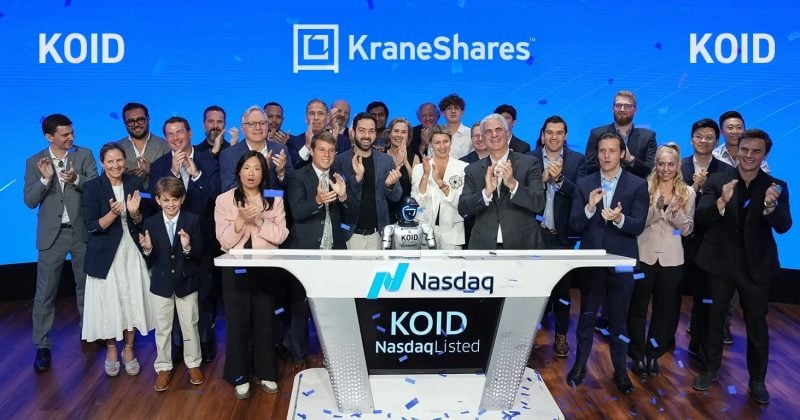
Via kraneshares.com
KraneShares’ KSTR becomes the only US-listed ETF with direct CXMT ownership
The ETF's QFII quota gives American investors a rare direct line into China's hottest semiconductor IPO, bypassing the usual workarounds.
If you wanted exposure to China’s most hyped semiconductor company from a US brokerage account, your options were, until now, basically nonexistent. KraneShares’ KSTR ETF just changed that by securing direct ownership of ChangXin Memory Technologies shares through its Qualified Foreign Institutional Investor quota, making it the sole US-listed fund holding CXMT outright.
That matters because CXMT isn’t some obscure chipmaker. The DRAM specialist IPO’d on the STAR Market in late July 2026 and promptly saw its stock surge nearly 500% on its debut. It became mainland China’s largest listed company by market capitalization, valued in the hundreds of billions of dollars. And the only way a US investor can hold those shares through an exchange-traded fund is KSTR.
What QFII access actually means
Most American investors interact with Chinese companies through American Depositary Receipts or through funds that use swap agreements and other synthetic instruments. These are essentially IOUs, not actual ownership.
QFII is a license granted by Chinese regulators that allows foreign institutions to buy and hold shares directly on mainland Chinese exchanges. KraneShares obtained this access for KSTR, which launched on January 26, 2021, and is designed to track the SSE STAR Market 50 Index. The STAR Market is China’s answer to Nasdaq, a board specifically built for technology and innovation companies. By holding CXMT shares directly rather than through derivatives or depositary receipts, KSTR gives its investors cleaner, more transparent exposure to the underlying asset.
Why CXMT is the company everyone’s watching
ChangXin Memory Technologies was founded in 2016 with a mission to build China’s domestic DRAM manufacturing capability so the country stops depending on Samsung, SK Hynix, and Micron for its memory chips. The company’s Q1 2026 revenue reportedly jumped over 700% year-over-year, driven by AI-related demand for memory chips.
The news moving money, markets, and the world—before your day starts.
Daily. Free. Join 34,000+ readers across crypto, finance, and policy.
The IPO itself was a spectacle. CXMT listed under ticker 688825 on the STAR Market, and its debut trading saw the stock rocket between 466% and 500%. The company’s valuation catapulted it past every other mainland-listed firm by market cap.
What this means for US investors
KSTR’s direct CXMT ownership represents a structural shift in how American capital can access Chinese technology companies at a time when geopolitical tensions have made such access increasingly difficult. Export controls, entity lists, and investment restrictions have created a maze of compliance requirements. Institutional channels like QFII offer a regulated pathway through that maze, and KSTR is currently the only US-listed ETF using it to hold CXMT.
The risks are substantial. Geopolitical risk is the obvious one: any escalation in US-China semiconductor tensions could affect QFII access, trading permissions, or even the legality of holding certain Chinese tech stocks. Regulatory risk runs in both directions, as Beijing could tighten foreign ownership rules, and Washington could expand investment restrictions.
A stock that jumps 500% on its first day of trading carries a certain amount of exuberance baked into its price. CXMT’s revenue growth is extraordinary, but a 700% year-over-year jump in Q1 2026 also means the company was working from a relatively small base. There’s also concentration risk to consider: while KSTR tracks a 50-stock index, CXMT’s massive market cap likely gives it an outsized weighting in the portfolio.