
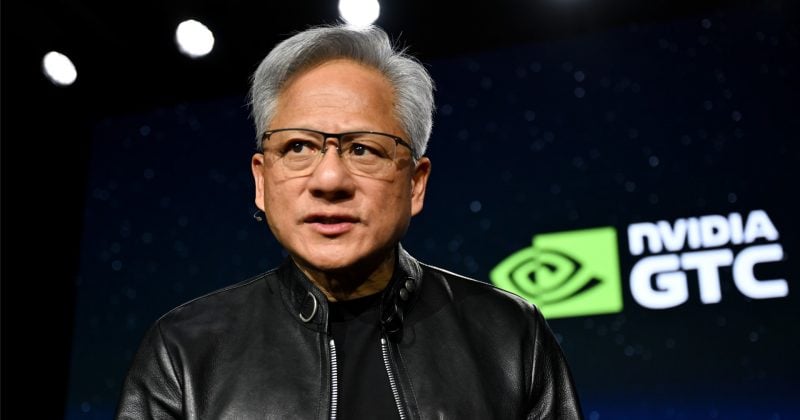
Nvidia’s market cap could reach $20T, says Jensen Huang

Nvidia’s market cap could reach $20T, says Jensen Huang

Analyst projections tie Nvidia's AI infrastructure dominance to a potential $20 trillion valuation by 2030, with ripple effects already visible in crypto markets

Analyst Beth Kindig from the I/O Fund has laid out a case for Nvidia reaching a $20 trillion market cap by 2030, built on expectations of $930 billion in annual data center revenue and a sustained price-to-sales multiple of roughly 22x. For context, no publicly traded company has ever come close to that valuation. Apple and Microsoft have traded places near the $3-4 trillion mark.

The trillion-dollar demand thesis

The foundation for these projections traces back to Huang’s keynote at GTC 2026 in March, where he declared that Nvidia anticipates over $1 trillion in cumulative demand from its upcoming AI systems, Blackwell and Vera Rubin, through 2027. That figure represented a doubling of earlier projections, which had pegged demand at around $500 billion.

Nvidia’s fiscal 2026 revenue already hit $215.9 billion, representing a 65% increase year-over-year. The vast majority of that growth came from data center and AI chip sales.

Advertisement

Huang has also been playing kingmaker. In June 2026, he singled out Marvell Technology as a potential “next trillion-dollar company,” which promptly sent Marvell’s stock surging 32%.

Why crypto cares about a chip company

AI-linked crypto tokens saw an immediate rally following the March 2026 GTC keynote. The total market cap for AI-focused digital assets pushed past $16.5 billion around that period, with tokens tied to decentralized AI infrastructure, machine learning protocols, and agentic AI frameworks all catching bids.

Huang’s particular emphasis on “agentic AI,” systems that can autonomously plan, reason, and execute tasks, has been a catalyst for the AI crypto sector. Projects building autonomous agent frameworks on blockchain rails have attracted significant capital inflows whenever Nvidia validates the broader agentic AI thesis.

What this means for investors

The $20 trillion projection deserves some healthy skepticism, even if the underlying growth story is real. Sustaining a 22x price-to-sales multiple at $930 billion in revenue assumes the market will continue to price Nvidia as a hyper-growth company even after it becomes one of the largest revenue generators on the planet.

The risk profile is asymmetric in a specific way. AI tokens get the downside of Nvidia corrections plus their own crypto-native volatility, but they don’t necessarily capture all the upside because institutional capital still flows primarily into Nvidia equity rather than token proxies.

Marvell Technology’s 32% surge on a single Huang comment illustrates how the AI supply chain is becoming its own investable thesis. In crypto, the equivalent would be infrastructure tokens for decentralized compute, data availability, and GPU marketplaces, projects that benefit from the same demand tailwinds without needing to compete directly with Nvidia’s hardware moat.

Disclosure: This article was edited by Editorial Team. For more information on how we create and review content, see our Editorial Policy.

Nvidia’s market cap could reach $20T, says Jensen Huang

Nvidia’s market cap could reach $20T, says Jensen Huang

Analyst projections tie Nvidia's AI infrastructure dominance to a potential $20 trillion valuation by 2030, with ripple effects already visible in crypto markets

Analyst Beth Kindig from the I/O Fund has laid out a case for Nvidia reaching a $20 trillion market cap by 2030, built on expectations of $930 billion in annual data center revenue and a sustained price-to-sales multiple of roughly 22x. For context, no publicly traded company has ever come close to that valuation. Apple and Microsoft have traded places near the $3-4 trillion mark.

The trillion-dollar demand thesis

The foundation for these projections traces back to Huang’s keynote at GTC 2026 in March, where he declared that Nvidia anticipates over $1 trillion in cumulative demand from its upcoming AI systems, Blackwell and Vera Rubin, through 2027. That figure represented a doubling of earlier projections, which had pegged demand at around $500 billion.

Nvidia’s fiscal 2026 revenue already hit $215.9 billion, representing a 65% increase year-over-year. The vast majority of that growth came from data center and AI chip sales.

Advertisement

Huang has also been playing kingmaker. In June 2026, he singled out Marvell Technology as a potential “next trillion-dollar company,” which promptly sent Marvell’s stock surging 32%.

Why crypto cares about a chip company

AI-linked crypto tokens saw an immediate rally following the March 2026 GTC keynote. The total market cap for AI-focused digital assets pushed past $16.5 billion around that period, with tokens tied to decentralized AI infrastructure, machine learning protocols, and agentic AI frameworks all catching bids.

Huang’s particular emphasis on “agentic AI,” systems that can autonomously plan, reason, and execute tasks, has been a catalyst for the AI crypto sector. Projects building autonomous agent frameworks on blockchain rails have attracted significant capital inflows whenever Nvidia validates the broader agentic AI thesis.

What this means for investors

The $20 trillion projection deserves some healthy skepticism, even if the underlying growth story is real. Sustaining a 22x price-to-sales multiple at $930 billion in revenue assumes the market will continue to price Nvidia as a hyper-growth company even after it becomes one of the largest revenue generators on the planet.

The risk profile is asymmetric in a specific way. AI tokens get the downside of Nvidia corrections plus their own crypto-native volatility, but they don’t necessarily capture all the upside because institutional capital still flows primarily into Nvidia equity rather than token proxies.

Marvell Technology’s 32% surge on a single Huang comment illustrates how the AI supply chain is becoming its own investable thesis. In crypto, the equivalent would be infrastructure tokens for decentralized compute, data availability, and GPU marketplaces, projects that benefit from the same demand tailwinds without needing to compete directly with Nvidia’s hardware moat.

Disclosure: This article was edited by Editorial Team. For more information on how we create and review content, see our Editorial Policy.