
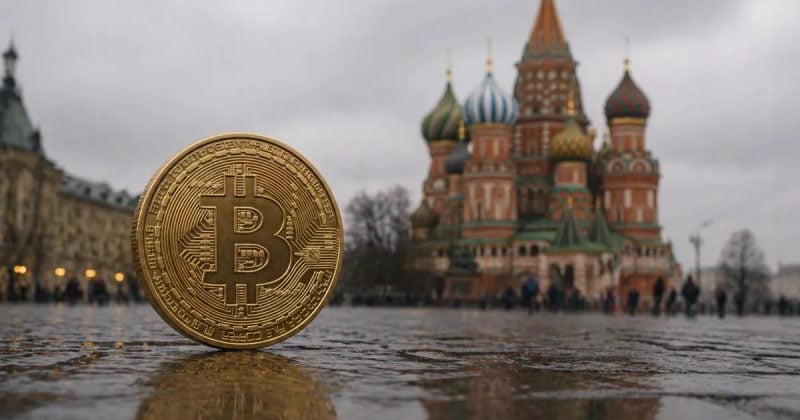
OSW Centre for Eastern Studies warns Russia’s crypto regulation may fail

Via u.today

OSW Centre for Eastern Studies warns Russia’s crypto regulation may fail

Polish think tank argues decentralized platforms and foreign exchanges will undermine Moscow's draft digital currency law

The OSW Centre for Eastern Studies, a prominent Polish think tank focused on post-Soviet geopolitics, published an analysis on July 14 arguing that Russia’s forthcoming crypto regulation will likely fail at its core objective. The reason is almost comically straightforward: the entities Moscow wants to regulate have no intention of staying inside the regulatory perimeter.

A $200 billion problem hiding in plain sight

According to official Russian figures from February 2026, daily crypto turnover in the country sits at approximately 50 billion roubles, or roughly $650 million. That implies an annualized volume north of $200 billion, with the overwhelming majority flowing through foreign platforms.

Russia ranked 10th in the Chainalysis 2025 Global Crypto Adoption Index. On-chain transaction volumes hit $376 billion between July 2024 and June 2025, a 50% jump year-over-year. DeFi usage surged eightfold during the same period.

The analysis, authored by Iwona Wiśniewska, zeroes in on this exact tension. The draft law, titled “On Digital Currency and Digital Rights,” proposes licensing trading platforms and custodians while banning domestic crypto payments. It passed its first reading in the State Duma in April 2026 and is expected to be enacted by autumn 2026.

Advertisement

Non-custodial wallets are a particular headache. If a user holds their own keys on a decentralized protocol, no licensed intermediary sits in between to enforce compliance. And with DeFi usage growing eightfold, the share of activity that falls neatly under a licensing regime is shrinking, not expanding.

The stablecoin wildcard and Bitcoin dominance

Bitcoin remains the dominant asset in both holdings and mining, with Russia ranking second globally in Bitcoin mining as of 2025. Tether’s USDT is widely used as a trading and settlement vehicle.

Then there’s A7A5, the first rouble-pegged stablecoin, which saw trading volumes exceed $120 billion by early 2026. A rouble-denominated stablecoin essentially creates a parallel financial rail: one that can facilitate domestic-value transactions while sidestepping the traditional banking system entirely.

Russia’s regulatory attempts aren’t new. A 2020 framework law established initial definitions and restrictions. Rules introduced in 2024 covered mining operations and created experimental regulatory regimes. The current draft law is the most ambitious attempt yet, but it follows the same pattern: legislation chasing a market that moves faster than lawmakers can type.

What this means for investors

For Bitcoin and USDT holders, Russian regulatory developments are worth monitoring closely. A daily turnover of $650 million means any sudden policy shift, whether a crackdown or a liberalization, could inject meaningful volatility into global markets.

The growth of A7A5 is particularly interesting for stablecoin watchers. A rouble-pegged token with $120 billion in trading volume represents a real-world test case for national-currency stablecoins operating at scale outside Western regulatory frameworks.

The competitive dynamics between centralized exchanges seeking Russian licenses and decentralized protocols ignoring them entirely will be worth tracking through the autumn implementation timeline. Russia’s eightfold DeFi growth already tells that story.

Disclosure: This article was edited by Editorial Team. For more information on how we create and review content, see our Editorial Policy.
OSW Centre for Eastern Studies warns Russia’s crypto regulation may fail

Polish think tank argues decentralized platforms and foreign exchanges will undermine Moscow's draft digital currency law

Via u.today

The OSW Centre for Eastern Studies, a prominent Polish think tank focused on post-Soviet geopolitics, published an analysis on July 14 arguing that Russia’s forthcoming crypto regulation will likely fail at its core objective. The reason is almost comically straightforward: the entities Moscow wants to regulate have no intention of staying inside the regulatory perimeter.

A $200 billion problem hiding in plain sight

According to official Russian figures from February 2026, daily crypto turnover in the country sits at approximately 50 billion roubles, or roughly $650 million. That implies an annualized volume north of $200 billion, with the overwhelming majority flowing through foreign platforms.

Russia ranked 10th in the Chainalysis 2025 Global Crypto Adoption Index. On-chain transaction volumes hit $376 billion between July 2024 and June 2025, a 50% jump year-over-year. DeFi usage surged eightfold during the same period.

The analysis, authored by Iwona Wiśniewska, zeroes in on this exact tension. The draft law, titled “On Digital Currency and Digital Rights,” proposes licensing trading platforms and custodians while banning domestic crypto payments. It passed its first reading in the State Duma in April 2026 and is expected to be enacted by autumn 2026.

Advertisement

Non-custodial wallets are a particular headache. If a user holds their own keys on a decentralized protocol, no licensed intermediary sits in between to enforce compliance. And with DeFi usage growing eightfold, the share of activity that falls neatly under a licensing regime is shrinking, not expanding.

The stablecoin wildcard and Bitcoin dominance

Bitcoin remains the dominant asset in both holdings and mining, with Russia ranking second globally in Bitcoin mining as of 2025. Tether’s USDT is widely used as a trading and settlement vehicle.

Then there’s A7A5, the first rouble-pegged stablecoin, which saw trading volumes exceed $120 billion by early 2026. A rouble-denominated stablecoin essentially creates a parallel financial rail: one that can facilitate domestic-value transactions while sidestepping the traditional banking system entirely.

Russia’s regulatory attempts aren’t new. A 2020 framework law established initial definitions and restrictions. Rules introduced in 2024 covered mining operations and created experimental regulatory regimes. The current draft law is the most ambitious attempt yet, but it follows the same pattern: legislation chasing a market that moves faster than lawmakers can type.

What this means for investors

For Bitcoin and USDT holders, Russian regulatory developments are worth monitoring closely. A daily turnover of $650 million means any sudden policy shift, whether a crackdown or a liberalization, could inject meaningful volatility into global markets.

The growth of A7A5 is particularly interesting for stablecoin watchers. A rouble-pegged token with $120 billion in trading volume represents a real-world test case for national-currency stablecoins operating at scale outside Western regulatory frameworks.

The competitive dynamics between centralized exchanges seeking Russian licenses and decentralized protocols ignoring them entirely will be worth tracking through the autumn implementation timeline. Russia’s eightfold DeFi growth already tells that story.

Disclosure: This article was edited by Editorial Team. For more information on how we create and review content, see our Editorial Policy.