
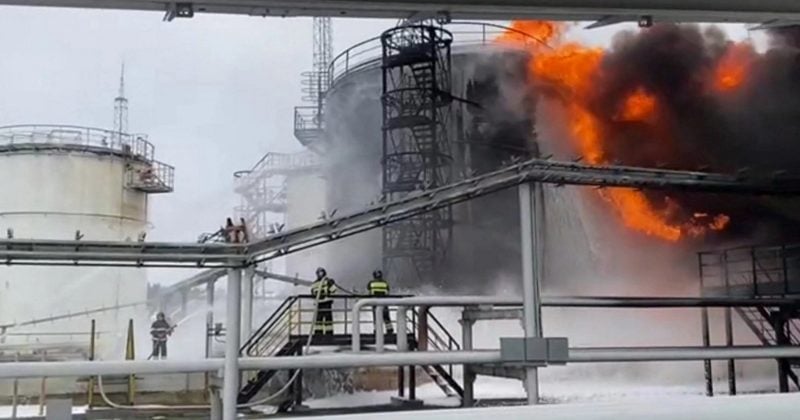
Via kyivpost.com
Russia’s largest Black Sea oil port resumes crude loadings after drone disruption, and crypto markets should care
The Sheskharis terminal handles roughly 650,000 barrels per day, and its latest shutdown is a reminder that geopolitical supply shocks still drive the macro backdrop for risk assets.
Russia’s biggest crude oil export terminal on the Black Sea is back online after Ukrainian drone activity forced a suspension of tanker loadings. The Sheskharis facility in Novorossiysk, capable of pushing roughly 650,000 barrels per day through the Transneft pipeline network, had gone quiet in late July 2026 amid escalating security threats.
What happened at Novorossiysk
The Sheskharis terminal sits at the heart of Russia’s Black Sea export infrastructure. Its throughput capacity reaches up to 75 million tons of oil per year, making it one of the most consequential chokepoints in global energy logistics.
Ukrainian drone strikes targeting the Novorossiysk area have escalated throughout 2026, with notable incidents in April, May, and July. The latest round of attacks prompted operators to suspend tanker loadings entirely, while nighttime shipping restrictions were imposed as a precautionary measure.
The terminal has now resumed operations, though the elevated threat level in the region continues to affect activity.
The news moving money, markets, and the world—before your day starts.
Daily. Free. Join 34,000+ readers across crypto, finance, and policy.
Why this disruption is different from earlier ones
Novorossiysk has been targeted before. The difference in 2026 is the cadence. Strikes in April, May, and now July suggest a strategic campaign rather than opportunistic one-offs. Ukraine appears to be systematically targeting Russia’s energy export infrastructure, with strikes extending beyond Novorossiysk to other critical facilities along the Black Sea and Baltic regions, including Primorsk and Ust-Luga.
Nighttime shipping restrictions at the port tell their own story. When vessel movements are limited to daylight hours because of drone threats, operational capacity is effectively cut even when the terminal itself is technically functional. A facility rated at 650,000 barrels per day doesn’t hit that number if ships can only safely load during a 12-hour window.
Every barrel that doesn’t leave Novorossiysk on schedule is a barrel that buyers elsewhere in the world have to source from alternative suppliers. That puts upward pressure on Brent crude and cascades through the energy complex. A sustained disruption in exports from Novorossiysk could lead to tighter global supply and potential increases in crude oil prices, further influencing energy market dynamics.