
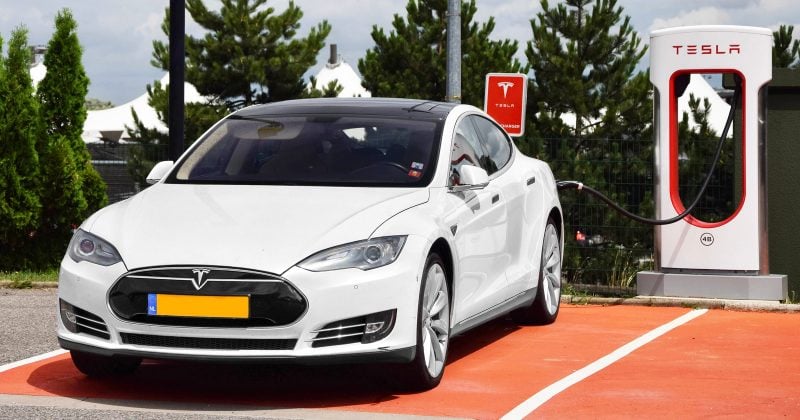
Photo: Alexandre Prévot / Wikimedia Commons / CC BY-SA 2.0 (https://creativecommons.org/licenses/by-sa/2.0)
Elon Musk’s Tesla earnings calls are now AI and robotics presentations with a side of cars
Tesla's $25 billion capex pivot toward Optimus robots and xAI investment tells you everything about where Musk thinks the money is heading
Seven years of Tesla earnings calls tell a story that has very little to do with selling cars. An analysis of Musk’s commentary across quarterly reports reveals a CEO increasingly disinterested in the core automotive business, instead treating each call as a showcase for AI ambitions and humanoid robots.
The Q2 2026 earnings call on July 22 made this pivot about as subtle as a sledgehammer. Musk declared the Optimus humanoid robot could be “the biggest product ever” for Tesla, a company that, last anyone checked, was still primarily known for electric vehicles.
From Frunks to Frankenbots
Tesla’s strategic reallocation isn’t just talk. The company discontinued production of Model S and Model X at its Fremont factory back in January 2026. The reason wasn’t declining demand or a factory upgrade for newer EVs. It was to repurpose the facility for manufacturing the Optimus V3 humanoid robot, expected to begin production this summer.
The Optimus V3 stands 5’8″ and weighs 125 lbs, powered by Tesla’s AI5 chip and xAI’s Grok model.
Tesla plans to spend an estimated $25 billion in capital expenditures on AI and robotics in 2026.
AI, tech, and the markets they move—in one daily briefing.
Daily. Free. Join 34,000+ readers across crypto, finance, and policy.
The xAI connection and what it means for markets
Tesla has invested $2 billion in xAI, Musk’s AI startup, deepening the operational ties between his companies. Musk acknowledged these connections during the earnings call.
On the robotaxi front, Musk struck a notably cautious tone. He stressed that careful deployment is necessary to prevent regulatory complications. No new specific targets for robotaxi fleet expansion were disclosed during the call.
The absence of concrete robotaxi timelines is worth noting because it contrasts sharply with the aggressive Optimus production schedule. Musk appears to be picking his battles: full speed ahead on robots, measured patience on autonomous taxis.
Why crypto and tech investors should pay attention
There’s a risk dimension here too. Tesla redirecting factory capacity away from proven revenue generators like Model S and X toward unproven robotics products is a high-variance bet. If Optimus manufacturing hits the scaling challenges Musk himself acknowledged, with entirely new components and supply chains needed, the capital burn rate could pressure Tesla’s balance sheet.
The competitive landscape is also shifting. Tesla positioning itself as a robotics-first company puts it in direct competition with Boston Dynamics, Figure AI, and a growing list of startups chasing the humanoid robot market.