
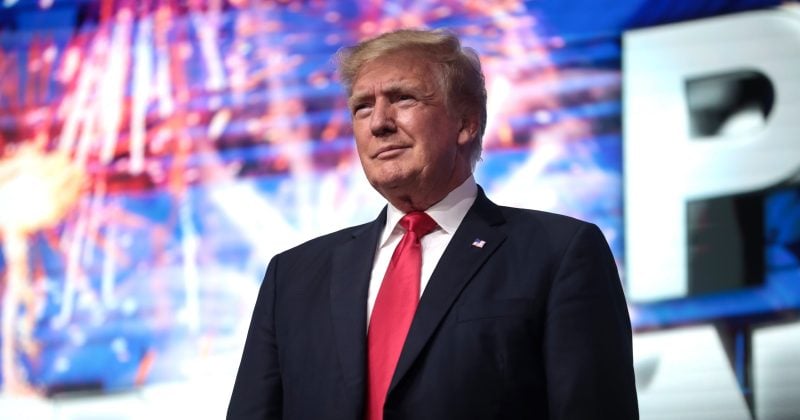
Photo: Gage Skidmore from Surprise, AZ, United States of America / Wikimedia Commons / CC BY-SA 2.0 (https://creativecommons.org/licenses/by-sa/2.0)
Trump administration pushes for fast exit from Iran conflict as crypto markets ride the volatility wave
With over $37.5 billion spent and Bitcoin swinging between $62K and $64K, the 'Third Gulf War' is reshaping both geopolitics and digital asset markets in real time.
The Trump administration wants out of the Iran conflict, and it wants out fast. After months of escalating military exchanges, collapsed ceasefires, and a price tag north of $37.5 billion, Washington is signaling that a negotiated resolution is the priority, not prolonged engagement in what some are already calling the Third Gulf War.
For crypto markets, the implications are impossible to ignore. Bitcoin has become a real-time barometer for how investors feel about the world potentially catching fire, and Iran’s decision to accept Bitcoin for Strait of Hormuz transit fees has blurred the line between battlefield strategy and blockchain adoption in ways nobody had on their 2026 bingo card.
A ceasefire that wasn’t
A June 2026 agreement between the US and Iran fell apart after Iranian provocations, including attacks on commercial vessels transiting the Strait of Hormuz. On July 7, 2026, President Trump declared the interim ceasefire “over” following those attacks, triggering a fresh round of US military strikes. The conflict had originally escalated from earlier coordinated US and Israeli operations known as Operation Epic Fury and Operation Rising Lion in early 2026.
By late July, the US paused military strikes amid what officials described as progress in renewed discussions. Trump has repeatedly emphasized limited US involvement, framing the goal as minimizing costs and reducing destabilization in the region.
Bitcoin as a geopolitical instrument
On June 8, 2026, Iran began accepting Bitcoin as payment for Strait of Hormuz transit fees. This is a sovereign government using Bitcoin to circumvent the very financial infrastructure designed to isolate it.
In April 2026, US authorities froze $344 million in cryptocurrency assets linked to Iran, with Tether cooperating in enforcing sanctions against Iranian-connected wallets. Tether’s willingness to freeze Iran-linked assets positions it as a de facto partner in US foreign policy.
Macro, rates, and crypto—what moved markets and what matters next.
Daily. Free. Join 34,000+ readers across crypto, finance, and policy.
What Bitcoin’s price action is telling us
Bitcoin traded in a range between $62,000 and $64,000 through mid-July 2026, with price movements closely tracking developments in the US-Iran situation. Every escalation pushed prices lower as risk appetite evaporated. Every hint of diplomatic progress pulled them back up.
Iran’s adoption of Bitcoin for transit fees creates a feedback loop. Escalation increases demand for sanctions-resistant payment rails, which increases Bitcoin’s utility for sanctioned states, which increases regulatory scrutiny, which creates more uncertainty for traders.
The $37.5 billion the US has spent on the conflict so far also carries fiscal implications that ripple into crypto. Government spending at that scale puts pressure on bond markets, influences Federal Reserve calculations, and shapes the broader macroeconomic backdrop against which all risk assets, including Bitcoin, are priced.
What this means for investors
The $344 million freeze in April demonstrates that holding crypto doesn’t make you invisible to sanctions enforcement. Tether’s cooperation with US authorities means that even assets designed to operate outside traditional finance can be frozen, seized, or flagged when national security interests are at stake.
Trump’s push for a quick resolution suggests the administration believes a deal is achievable, but the June ceasefire collapse is a reminder that diplomatic progress in this region can evaporate overnight. Bitcoin’s tight trading range reflects that uncertainty: investors are waiting, not committing.