
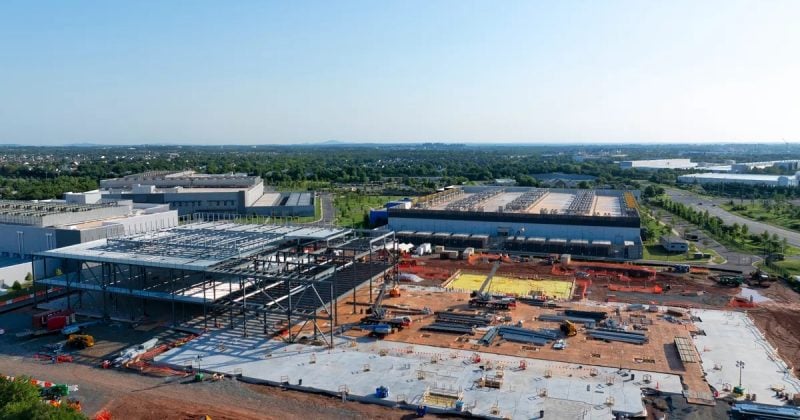
US data center construction spending surges 46% year-over-year to $68B as AI and crypto miners reshape infrastructure

Photo: Gerville / constructiondive.com

US data center construction spending surges 46% year-over-year to $68B as AI and crypto miners reshape infrastructure

Bitcoin miners are ditching hashrates for hyperscalers, and the construction boom tells the whole story

Data center construction spending has hit an annualized rate exceeding $68 billion, a 46% jump from the prior year, according to US Census Bureau figures. The catalyst is exactly what you’d expect: an insatiable appetite for AI compute that has turned empty plots of land into the most valuable real estate in tech.

The growth trajectory has been sustained since early 2024, accelerating through 2025 with annual spending rates reaching $45 billion to $50 billion or more in various months this year.

The great pivot: from Bitcoin blocks to AI racks

Companies like IREN, Cipher Mining, CleanSpark, Hut 8, and Core Scientific are executing one of the most dramatic strategic pivots in recent memory. These firms, which built their businesses around securing cheap power and running ASICs around the clock, have realized they’re sitting on something far more valuable than mining capacity: power infrastructure that AI companies desperately need.

The result has been a wave of multi-billion-dollar lease agreements as these miners repurpose their facilities for high-performance computing and AI workloads. They’re essentially converting mining sites into AI data centers, swapping SHA-256 hashes for transformer model training runs.

Advertisement

Hyperscalers are driving the bus

Microsoft and Meta have significantly increased their data center lease commitments to support AI expansion. Their core competency, securing large-scale power agreements in favorable jurisdictions, turns out to be the exact bottleneck that hyperscalers face when trying to deploy AI infrastructure quickly.

The broader nonresidential construction landscape has been mixed, which makes the data center segment’s performance even more striking.

What this means for crypto investors

No specific crypto tokens are directly tied to the $68 billion spending figure. But the implications for crypto-adjacent companies are substantial.

First, the publicly traded Bitcoin miners that have secured AI and HPC leases are effectively diversifying their revenue streams in a way that reduces their dependence on Bitcoin’s price. A company like Core Scientific, which emerged from bankruptcy to become a major AI infrastructure player, trades on a fundamentally different thesis than a pure-play miner.

Second, if miners find it more profitable to lease their facilities for AI workloads than to mine Bitcoin, hashrate could migrate away from the network.

Third, as facilities transition to AI use cases, the mining hardware gets displaced, potentially flooding the secondary market and pushing down costs for remaining miners.

The 46% year-over-year growth rate is not a one-quarter anomaly. The sustained acceleration since January 2024 suggests this is a multi-year buildout cycle.

Disclosure: This article was edited by Editorial Team. For more information on how we create and review content, see our Editorial Policy.

US data center construction spending surges 46% year-over-year to $68B as AI and crypto miners reshape infrastructure

US data center construction spending surges 46% year-over-year to $68B as AI and crypto miners reshape infrastructure

Bitcoin miners are ditching hashrates for hyperscalers, and the construction boom tells the whole story

Photo: Gerville / constructiondive.com

Data center construction spending has hit an annualized rate exceeding $68 billion, a 46% jump from the prior year, according to US Census Bureau figures. The catalyst is exactly what you’d expect: an insatiable appetite for AI compute that has turned empty plots of land into the most valuable real estate in tech.

The growth trajectory has been sustained since early 2024, accelerating through 2025 with annual spending rates reaching $45 billion to $50 billion or more in various months this year.

The great pivot: from Bitcoin blocks to AI racks

Companies like IREN, Cipher Mining, CleanSpark, Hut 8, and Core Scientific are executing one of the most dramatic strategic pivots in recent memory. These firms, which built their businesses around securing cheap power and running ASICs around the clock, have realized they’re sitting on something far more valuable than mining capacity: power infrastructure that AI companies desperately need.

The result has been a wave of multi-billion-dollar lease agreements as these miners repurpose their facilities for high-performance computing and AI workloads. They’re essentially converting mining sites into AI data centers, swapping SHA-256 hashes for transformer model training runs.

Advertisement

Hyperscalers are driving the bus

Microsoft and Meta have significantly increased their data center lease commitments to support AI expansion. Their core competency, securing large-scale power agreements in favorable jurisdictions, turns out to be the exact bottleneck that hyperscalers face when trying to deploy AI infrastructure quickly.

The broader nonresidential construction landscape has been mixed, which makes the data center segment’s performance even more striking.

What this means for crypto investors

No specific crypto tokens are directly tied to the $68 billion spending figure. But the implications for crypto-adjacent companies are substantial.

First, the publicly traded Bitcoin miners that have secured AI and HPC leases are effectively diversifying their revenue streams in a way that reduces their dependence on Bitcoin’s price. A company like Core Scientific, which emerged from bankruptcy to become a major AI infrastructure player, trades on a fundamentally different thesis than a pure-play miner.

Second, if miners find it more profitable to lease their facilities for AI workloads than to mine Bitcoin, hashrate could migrate away from the network.

Third, as facilities transition to AI use cases, the mining hardware gets displaced, potentially flooding the secondary market and pushing down costs for remaining miners.

The 46% year-over-year growth rate is not a one-quarter anomaly. The sustained acceleration since January 2024 suggests this is a multi-year buildout cycle.

Disclosure: This article was edited by Editorial Team. For more information on how we create and review content, see our Editorial Policy.